
BYD orders 10 giant car carriers and prepares for its next export leap
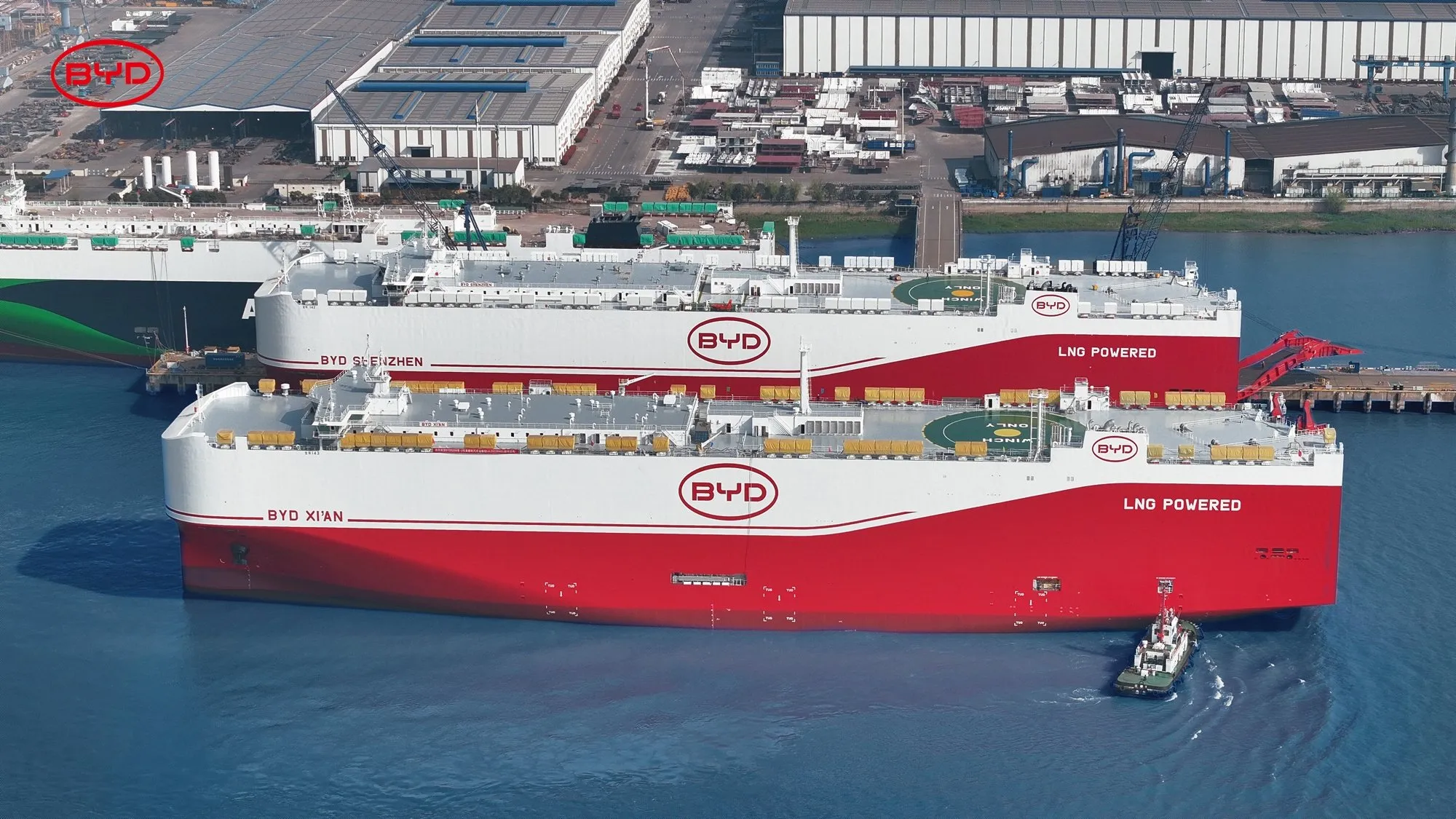
BYD is preparing to more than double its car-carrier fleet. According to fresh reports, the Chinese automaker has ordered 10 new PCTC vehicle carriers, each capable of carrying 9,200 car equivalent units. If the order is completed in full, BYD’s fleet will grow from eight to 18 vessels.
The new vessels will be built by China Merchants Industry at its Jinling and Haimen facilities and are expected to be completed between 2027 and 2029. The value of the contract has not been disclosed, and neither BYD nor the shipbuilder has officially confirmed the order.
More than 130,000 cars at a time
The 10 new vessels will add 92,000 CEU to BYD’s sea-transport capacity. CEU means car equivalent unit, so 9,200 CEU does not necessarily mean exactly 9,200 actual vehicles, as the real capacity depends on the dimensions of the vehicles being carried.
Once the new vessels are added, the total one-way capacity of the 18-strong fleet would exceed 130,000 CEU. The eight car carriers currently operated by BYD have capacities of either 7,200 or 9,000 CEU, depending on the vessel.
BYD only began building its own fleet in 2024. Its first vessel, Explorer No.1, was delivered in January that year, while the original network of eight ships was completed in September 2025. The pace is remarkable even by Chinese automotive industry standards.
BYD Shenzhen has already shown the scale of the operation
The size of the new vessels is not unfamiliar territory for BYD. The BYD Shenzhen, commissioned in 2025, also has a capacity of 9,200 CEU. The ship is 219.9 metres long and 37.7 metres wide, has 16 decks and a cruising speed of up to 19 knots, or approximately 35 km/h.
BYD Shenzhen uses an LNG dual-fuel powertrain and can use shore power in port. The same 9,200 CEU basic design is also used by BYD Xi'an.
Building such a vessel may seem like an unusual sideline for an automaker, but the logic is simple in BYD’s case. When export volumes rise into the hundreds of thousands of cars per month, controlling sea transport becomes a competitive advantage.
Exports are growing faster than the fleet
In August 2026, BYD exported around 184,000 passenger cars from China, 131 per cent more than a year earlier. Over the first eight months, exports reached 1.127 million vehicles, up 88 per cent year on year.
This explains the order for 10 additional vessels better than any press release. BYD is no longer building logistics for a few hundred thousand export cars; it is preparing for annual overseas sales running into the millions.
The current eight ships are estimated to have potential annual transport capacity of around one million vehicles. With 18 ships, this could theoretically rise to approximately 2.5 million a year, although the actual result will depend on routes, port operating speed and vessel utilisation.
For Europe, this matters far more than another new BYD model
Its own fleet reduces BYD’s dependence on external carriers and fluctuating freight rates. More importantly, it gives the company the ability to manage its supply chain in line with its own production and sales plans.
In the European market, this gives BYD an increasingly strong position. The problem for Volkswagen, Stellantis and Renault is no longer just that their Chinese rival can build electric and plug-in hybrid cars cheaply. BYD is simultaneously establishing factories, a sales network and its own international logistics system.
The vessels also serve BYD’s overseas factories. In 2025, for example, BYD Zhengzhou transported right-hand-drive cars produced in Thailand to the United Kingdom. This shows that the fleet is not merely a conveyor belt for cars exported from China, but part of a global production network.
BYD’s order for 10 new vessels is therefore bigger news than it first appears. An automaker able to control battery production, vehicle manufacturing and, ultimately, transport to the other side of the world is steadily reducing the number of areas in which it must share its margin with someone else.
For European automakers, the most uncomfortable part is not that BYD will soon have 18 car carriers. It is the reason why it needs all 18.


