
Iveda’s petrol-powered drone flies for more than 150 minutes and carries up to 8.6 kg
 1/29
1/29 
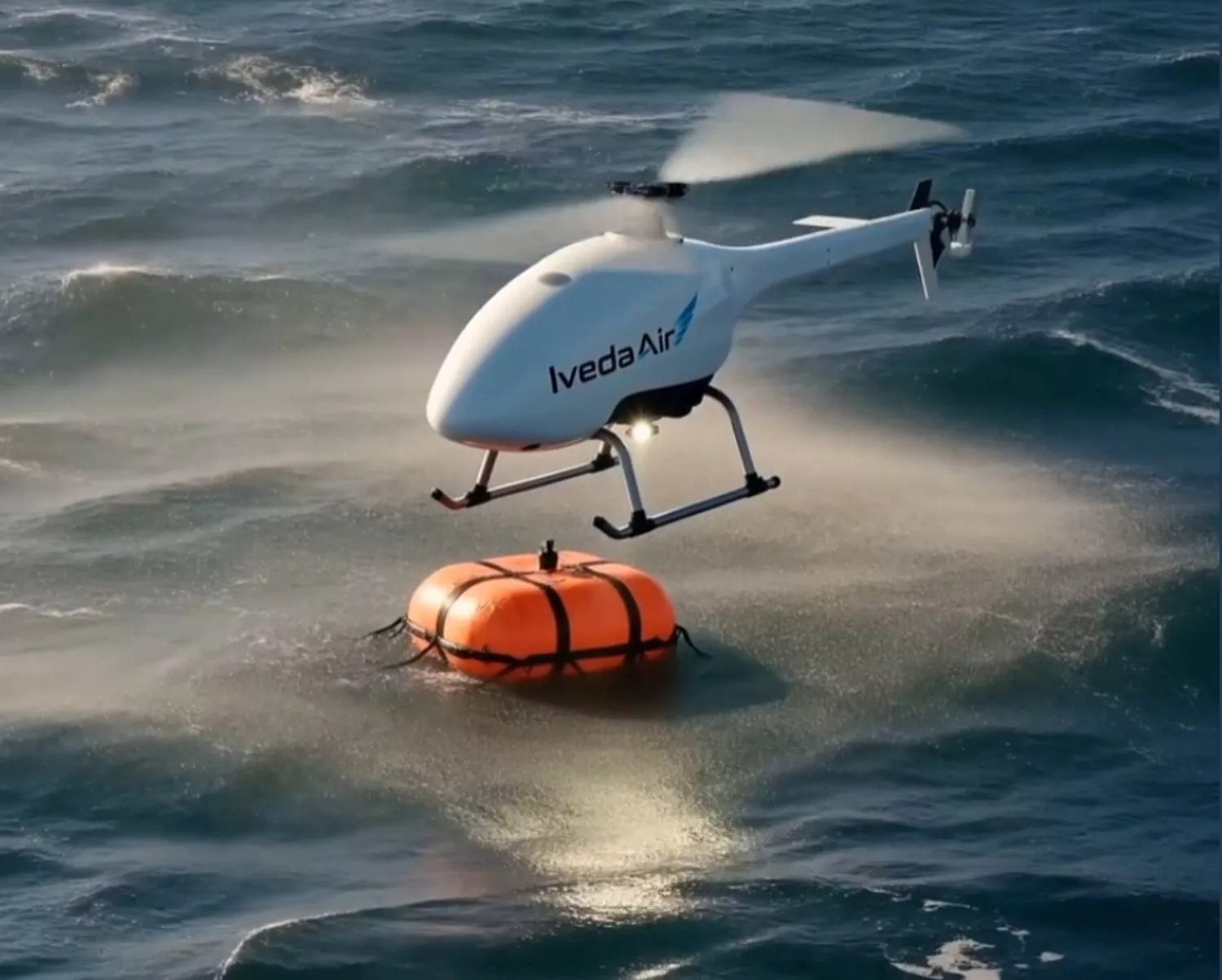
US technology company Iveda has launched the IvedaAir family of unmanned helicopters, led by the petrol-powered GX10-F100. The aircraft promises more than 150 minutes of flight time while carrying a 5.4 kg payload, with a maximum payload of 8.6 kg and a top speed of around 109 km/h. Compared with electric multirotors, it is clearly aimed at longer missions carrying heavier loads.
A helicopter layout swaps batteries for liquid fuel
At the centre of the IvedaAir range is the GX10-F100, which uses a petrol engine and a helicopter-style single-main-rotor layout rather than the conventional multirotor configuration.
According to Iveda’s latest technical data, the GX10-F100 can remain airborne for at least 150 minutes with a 12 lb, or roughly 5.4 kg, payload. Maximum payload is 19 lb, or around 8.6 kg, although Iveda notes separately that heavier external loads reduce flight time. The company quotes a top speed of 68 mph, equivalent to approximately 109 km/h.
Iveda also compares the GX10-F100 with its electric EX10-E. The electric helicopter offers more than 75 minutes of flight time and can carry up to 5.4 kg, while the range’s four-rotor commercial model flies for around 30 minutes.
For long-duration missions, liquid fuel offers a clear advantage in energy density. The trade-off is greater mechanical complexity, vibration, noise and maintenance compared with an electric powertrain.
Autonomy does not remove the human from the control loop
The GX10-F100 combines autonomous and semi-autonomous flight control with IvedaAI analytics. The system supports waypoint-based missions, stabilised hovering, encrypted live video transmission and AI-based object and anomaly detection. Connectivity can be provided over 4G, 5G and LTE networks.
Iveda’s control interface can also manage several aircraft at once, plan routes, stream live video and support automated return and landing functions. The standard camera package includes a three-axis gimbal, 2592 x 1944-pixel video at 30 frames per second and 10x zoom.
Iveda sees potential applications in search and rescue, maritime surveillance, critical-infrastructure inspection, law enforcement, emergency response and logistics.
This is therefore not an ordinary camera drone. Its longer endurance, higher payload capacity and helicopter-style aerodynamics place the GX10-F100 closer to the category of professional unmanned utility aircraft.
In the US, Iveda is targeting government procurement
Iveda highlights NDAA and TAA compliance in its materials and offers higher-security communications in certain configurations. US government agencies can procure IvedaAir systems through GlobalMed via the Defense Logistics Agency procurement channel.
That commercial focus also helps explain the aircraft’s design. For a small commercial drone, success may depend largely on price, ease of use and camera quality. In emergency-response, security and infrastructure missions, endurance, payload capacity, secure communications and system reliability become far more important.
In Europe, regulation adds another layer. The GX10-F100’s size, autonomous functions and potential use beyond the operator’s direct visual line of sight mean that practical deployment will depend on the specific operation, its risk assessment and the requirements of European drone regulations. Technical capability alone does not grant permission for long-range autonomous flights.
Iveda already has ambitions in Europe. The company opened its first European operations centre in Madrid on 10 February and is linking its expansion to public-safety and critical-infrastructure projects.
The GX10-F100’s strongest selling point, then, is not simply “150 minutes in the air”. More important is its ability to combine long endurance, a payload measured in kilograms and automated surveillance in a single working platform. That is what sets it apart from conventional electric multirotors whose endurance is typically measured in tens of minutes.


