
Europe’s electric car market in 2025, growth continues but the gap remains
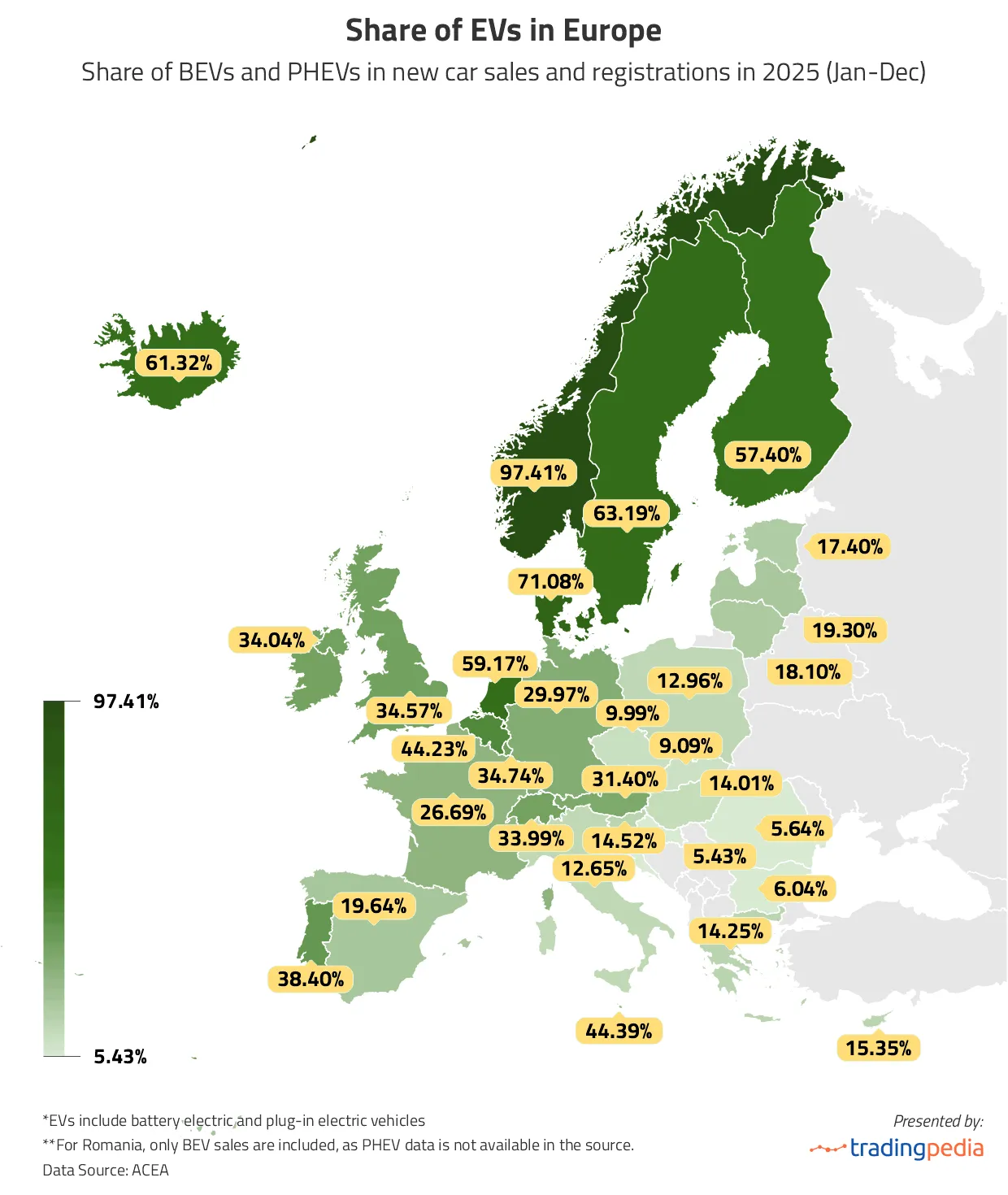
Despite a turbulent political backdrop and ongoing arguments over the EU’s 2035 emissions targets, electric car sales in Europe grew strongly in 2025. The numbers tell a clear story, but not a uniform one. The shift to electric mobility is accelerating, yet it does so at very different speeds across the continent. The Nordics are already living in an electric present, the big markets move cautiously forward, and parts of Eastern and Southern Europe are still playing catch up.
Across Europe, combined battery electric and plug in hybrid sales rose by 30.9 percent compared with 2024. In some countries, the internal combustion engine is effectively on its way out. Norway led the field with an EV share of 97.41 percent, followed by Denmark at 71.08 percent, Sweden at 63.19 percent, and Iceland at 61.32 percent. In these markets, petrol and diesel cars already feel like relics.
At the other end of the scale, electrification remains tentative. Croatia posted an EV share of just 5.43 percent, Romania reached 5.64 percent, and Bulgaria 6.04 percent. The gap between north and south, west and east, remains stark.
Volume versus penetration
In absolute numbers, Europe’s largest car markets still dominate. Germany registered 856,540 electric vehicles, while the United Kingdom followed with 698,491. Yet their EV market shares remained relatively modest at 29.97 percent and 34.57 percent respectively. Size matters, but it does not automatically translate into leadership.
France recorded 435,549 EV registrations. Growth there slowed as plug in hybrid sales fell by 25.8 percent, underlining how dependent some markets remain on transitional technologies rather than full electrification.
Eastern Europe delivered the fastest relative growth, albeit from a low base. Poland saw EV sales jump by 141 percent, Lithuania by 119 percent, and Latvia by 115 percent. Even so, EV penetration in these countries stayed below 20 percent, showing that rapid growth does not necessarily mean maturity.
Powertrains tell their own story
Looking at drivetrains, hybrids dominated the European market with a 34.4 percent share. Fully electric cars followed at 29.1 percent, while petrol and diesel sales continued their sharp decline. For many buyers, hybrids remain the compromise solution, a stepping stone rather than a final destination.
Best selling electric cars in Europe, 2025
The sales charts underline how concentrated the market still is at the top:
Tesla Model Y – 128,246
Škoda Elroq – 82,187
Renault 5 – 78,756
Tesla Model 3 – 73,805
BYD Seal U – 73,229, with a strong plug in hybrid component
Uneven, but unstoppable
The growth of electric car sales in Europe is no longer a forecast, it is a fact. What 2025 makes clear is that there is no single European pace. While the Nordic countries already operate in an electric reality, much of the continent still relies on hybrids, and some regions are only just leaving the starting blocks.
Electrification is happening, but it arrives unevenly and with compromises. Europe is not moving as one, yet the direction of travel is no longer in doubt.
At the other end of the scale, electrification remains tentative. Croatia posted an EV share of just 5.43 percent, Romania reached 5.64 percent, and Bulgaria 6.04 percent. The gap between north and south, west and east, remains stark.
Volume versus penetration
In absolute numbers, Europe’s largest car markets still dominate. Germany registered 856,540 electric vehicles, while the United Kingdom followed with 698,491. Yet their EV market shares remained relatively modest at 29.97 percent and 34.57 percent respectively. Size matters, but it does not automatically translate into leadership.
France recorded 435,549 EV registrations. Growth there slowed as plug in hybrid sales fell by 25.8 percent, underlining how dependent some markets remain on transitional technologies rather than full electrification.
Eastern Europe delivered the fastest relative growth, albeit from a low base. Poland saw EV sales jump by 141 percent, Lithuania by 119 percent, and Latvia by 115 percent. Even so, EV penetration in these countries stayed below 20 percent, showing that rapid growth does not necessarily mean maturity.
Powertrains tell their own story
Looking at drivetrains, hybrids dominated the European market with a 34.4 percent share. Fully electric cars followed at 29.1 percent, while petrol and diesel sales continued their sharp decline. For many buyers, hybrids remain the compromise solution, a stepping stone rather than a final destination.
Best selling electric cars in Europe, 2025
The sales charts underline how concentrated the market still is at the top:
Tesla Model Y – 128,246
Škoda Elroq – 82,187
Renault 5 – 78,756
Tesla Model 3 – 73,805
BYD Seal U – 73,229, with a strong plug in hybrid component
Uneven, but unstoppable
The growth of electric car sales in Europe is no longer a forecast, it is a fact. What 2025 makes clear is that there is no single European pace. While the Nordic countries already operate in an electric reality, much of the continent still relies on hybrids, and some regions are only just leaving the starting blocks.
Electrification is happening, but it arrives unevenly and with compromises. Europe is not moving as one, yet the direction of travel is no longer in doubt.


