
Italian police receive a 677 kW Lamborghini Temerario whose main job is not chasing speeders
 1/2
1/2 

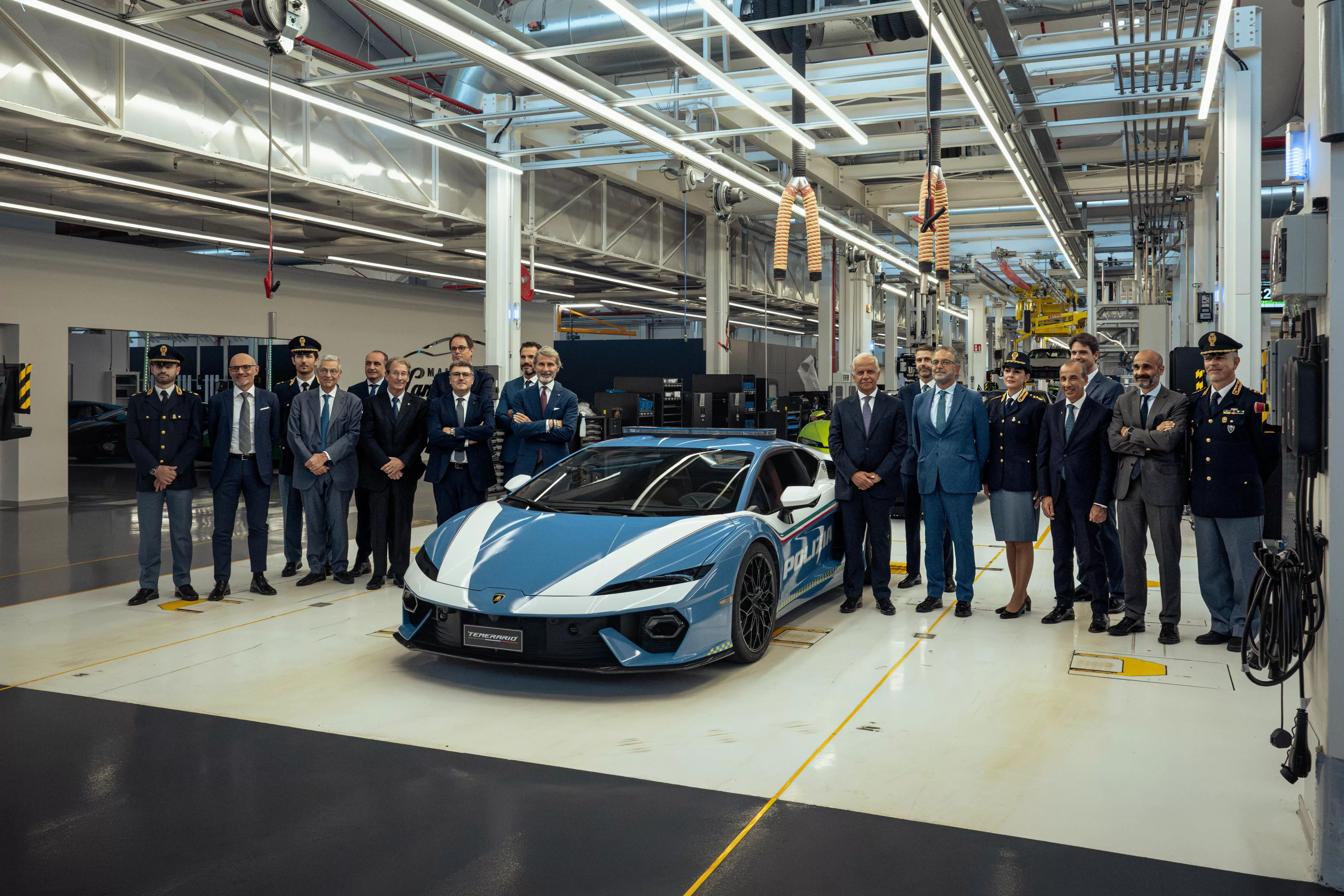
The Italian State Police fleet has gained a Lamborghini Temerario, but the 343 km/h supercar’s primary role is not pursuing offenders on motorways. Police will use the 677 kW hybrid chiefly to transport organs and medical materials. The Temerario continues a partnership between Lamborghini and the Italian police that has lasted for more than 20 years.
This time, 677 kW is quite literally life-saving power
The car will carry out duties where time truly matters. Lamborghini specifically cites the emergency transport of organs and medical materials. The blue-and-white Temerario is therefore not merely an expensive public-relations project, although it will undoubtedly attract more attention than another police van.
For this role, the Temerario has a fairly compelling technical case. Its 4.0-litre twin-turbo V8 works with three electric motors, bringing total system output to 677 kW. The petrol engine alone produces 588 kW and 730 Nm, and revs to 10,000 rpm. Lamborghini pairs the powertrain with an eight-speed dual-clutch transmission.
The Temerario accelerates from 0 to 100 km/h in 2.7 seconds and has a top speed of 343 km/h. According to the manufacturer, it needs 32 metres to brake from 100 km/h to a standstill. Those figures are, naturally, academic in normal motorway traffic, but ample power reserves and a capable braking system are hardly a disadvantage in fast medical transport.
The Gallardo entered service as early as 2004
The Temerario is not the first Lamborghini to enter service with the Italian police. The partnership began in 2004 with the first Gallardo, which transported an organ as early as September that year. It was later followed by the Gallardo LP 560-4, Huracáns and the Urus Performante in 2023.
According to Lamborghini, the Temerario is the sixth car the manufacturer has supplied to the Italian State Police over more than two decades. The previous cars have taken part in more than 200 organ transport missions and over 1,500 road-safety events. Lamborghini notes that the use of these cars has helped save lives in several cases.
Lamborghini’s exceptionally large speed reserve finds one of the few public-road applications where its use may have a socially justifiable purpose.
The Temerario also brings electrification to the police fleet
Technically, the Temerario marks an important step forward for the police. The Gallardo and Huracán used naturally aspirated V10 engines, while the Temerario belongs to Lamborghini’s new electrified generation.
The combination of a twin-turbo V8 and three electric motors offers more than just 677 kW of total output. Two electric motors are positioned on the front axle, while the third sits between the V8 and the transmission. This arrangement gives the car electric all-wheel drive and helps fill torque interruptions from the turbocharged engine and during gear changes.
The Temerario’s aluminium spaceframe has more than 20 per cent greater torsional rigidity than that of its Huracán predecessor, although the hybrid powertrain inevitably adds mass. The car’s dry weight starts at 1,690 kilograms.
By European standards, however, its plug-in hybrid status is also a reminder that 677 kW does not equal efficiency. In its current European technical data, Lamborghini lists fuel consumption with a depleted traction battery at 14.0 l/100 km and a CO2 class of G.
The Temerario is technically significant in European supercar competition
The Temerario’s significance extends far beyond its police livery. It replaced the Huracán and ended the naturally aspirated V10 era in Lamborghini’s mid-engined model range. Ferrari has already shown with the 296 GTB how effectively a smaller combustion engine supported by electric motors can be packaged into a supercar, while McLaren has moved in the same direction with the Artura. Lamborghini’s answer is different: it has retained a V8 rather than adopting a V6, while its rev limit reaches an exceptional 10,000 rpm.
The police Temerario is therefore both a practical emergency vehicle and a highly visible demonstration of where European supercar technology is heading. Electrification is not the opposite of performance here. On the contrary, the electric motors help turn the 4.0-litre V8 into a system whose 677 kW total output comfortably surpasses the capabilities of the old Huracán.


