
Lexus to end UX production, but the model’s European future remains undecided
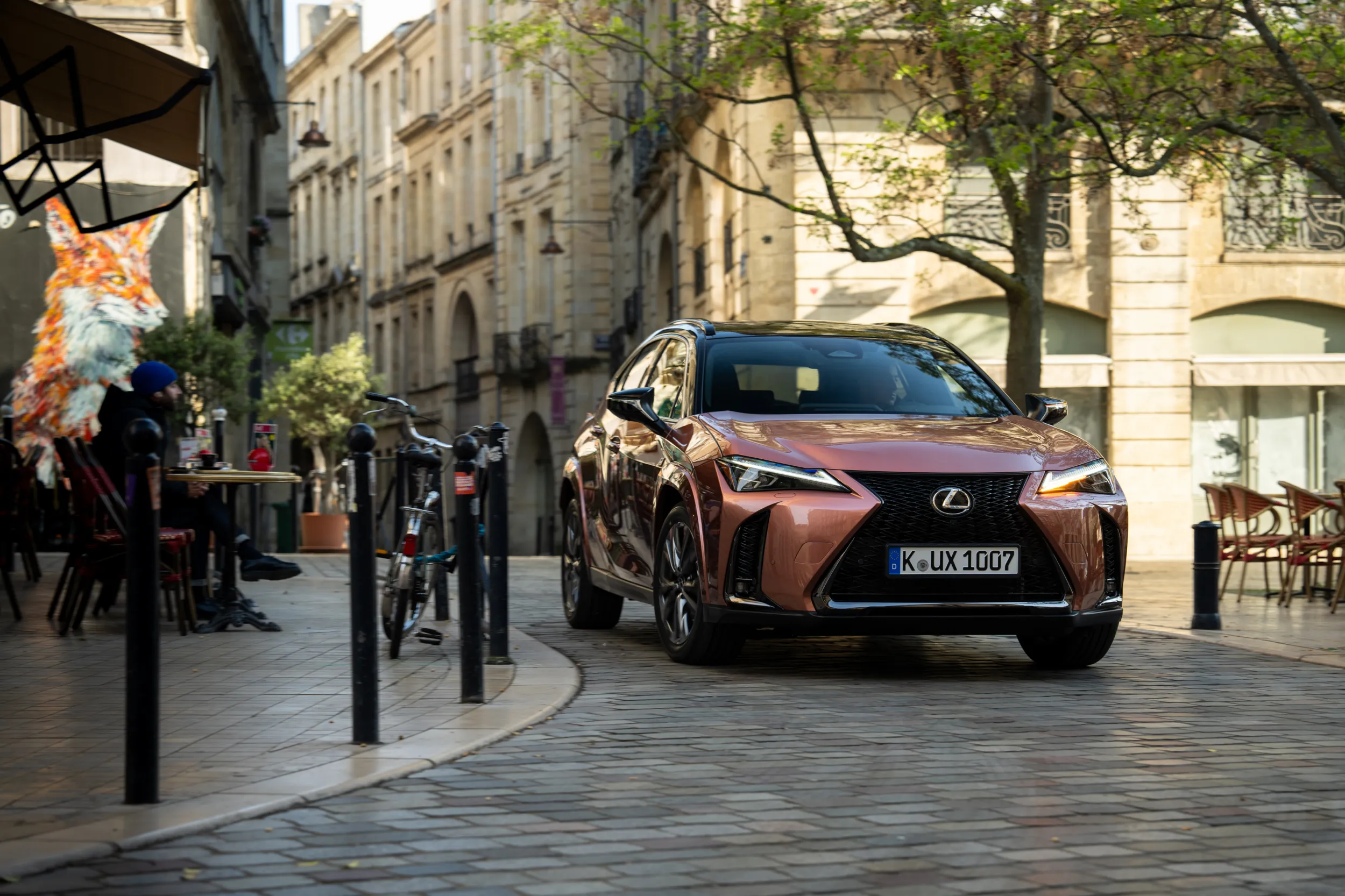
The days of Lexus’s smallest SUV are numbered, at least in Japan. The manufacturer will end UX production in February 2027 and warns that order intake could close earlier. The situation is different in Europe: the UX remains on sale, and Lexus has confirmed neither its withdrawal nor the arrival of a direct successor.
Lexus’s official Japanese UX model page now carries a clear notice that production will end in February 2027. The manufacturer adds that planned production volumes for some versions may be reached earlier, in which case dealers will stop accepting orders before February.
This brings the UX’s career, which began in 2018, to an end at least in the Japanese market. According to Lexus information published in July, around 400,000 examples of the model had been sold across more than 80 countries and regions by the end of June 2026.
It is therefore difficult to call it an outright failure.
Lexus has not yet said the UX will disappear worldwide
The most important clarification concerns the scope of the news. Lexus currently confirms the end of production on its Japanese UX page, but has not issued a global announcement stating that the UX will be withdrawn from all markets.
In Europe, the UX 300h remains part of Lexus’s official model range. In Finland, Lexus offers it with rapid delivery from €45,899.99 including local taxes/VAT in September 2026, while UX models are also currently available in stock at a Latvian dealer.
Lexus’s European website also continues to market the UX 300h hybrid. Its 2.0-litre hybrid powertrain develops 146 kW, while the rear axle of the all-wheel-drive E-FOUR version is powered by a 30 kW electric motor.
It would therefore be too early to write a global obituary for the UX. The end of Japanese production is a fact. The end of its European model range is not.
The UX received one final special edition before the end
The timing is rather unusual, as Lexus announced a new UX 300h Shining Essence special edition in Japan as recently as 2 July. Sales began on 1 September, only months before the planned end of production.
However, the Shining Essence does not bring any technical revolution. Lexus focused on new exterior colours and interior trim, suggesting a celebration of the model’s end of life rather than the start of its next phase of development.
The UX’s technical foundations are now fairly old. The model joined the Lexus range in 2018 and uses Toyota’s GA-C unibody platform. Toyota Corolla and C-HR models are among those using the same architecture family.
That is not a disadvantage in itself. The efficiency and reliability of Toyota hybrid technology are among the UX’s strongest attributes. The issue is the competition, which has moved on over eight years.
The BMW X1, Mercedes-Benz GLA, Audi Q3 and Volvo EX40 offer considerably newer technology, while electrification options in the segment have expanded. Lexus itself has meanwhile introduced the even smaller LBX below the UX.
The LBX made the UX’s position uncertain
The LBX is probably the most important model for understanding the UX’s future.
Lexus introduced the LBX in Europe in 2023 and deliberately positioned it below the existing UX. The car uses the Toyota Yaris and Yaris Cross GA-B architecture and a 1.5-litre three-cylinder hybrid powertrain.
That leaves the UX in a fairly narrow corridor. On one side sits the smaller and cheaper LBX; on the other is the considerably roomier NX. If a buyer wants a compact Lexus, the LBX meets much of that need for less money. If genuinely family-car-like space is required, the NX becomes the more logical choice.
The UX’s strength has been its position between two worlds. That has now also become its weakness.
The situation is particularly clear in Europe, where the smaller hybrid LBX is even better suited than the UX to dense urban traffic and a CO2-based tax environment.
The electric UX has already retreated
The UX model family had in fact already begun to shrink before the current announcement.
The fully electric UX 300e was Lexus’s first series-production electric car. The model was technically significant, but it was born of compromise, as Lexus adapted an internal-combustion-engine car architecture for electric drive rather than using a platform designed for an electric car from the outset.
In Europe, the electric RZ has essentially taken over the UX 300e’s role, while Lexus is preparing an increasing number of models designed specifically for electric drive.
The remaining UX 300h is a far more logical package. The current fifth-generation hybrid system uses a 2.0-litre petrol engine, a lithium-ion battery and more powerful electric motors. System output reaches 146 kW in Europe.
The technical description for the US 2026 UX 300h confirms the continuation of the same hybrid system, and Lexus offers the model there in both front-wheel-drive and all-wheel-drive forms.
The UX is therefore not leaving because its powertrain is hopelessly outdated. Rather, the model’s own place in Lexus’s increasingly crowded line-up is beginning to disappear.
400,000 cars is a solid result
The UX’s sales success should also be put into perspective. Lexus confirms that the model had found around 400,000 buyers worldwide by the end of June 2026.
On Lexus’s scale, that is a respectable result, especially for a model that entered Europe’s most crowded premium segment.
The UX’s problem was never that it was a bad car. Rather, its compact body required buyers to make compromises. The rear-seat and luggage-compartment practicality of the 4,495 mm-long car could not always keep pace with its exterior dimensions, while its low, sportier seating position distinguished the UX from conventional taller SUVs.
At the same time, the lower centre of gravity and unibody rigidity gave the UX handling that many taller rivals did not offer.
Lexus marketed it as an “Urban Explorer” for a reason, rather than as a small NX.
For Europe, the question is now a UX successor
The end of UX production does not necessarily mean Lexus is abandoning this size class. The manufacturer has simply not announced a direct successor at this point.
The LBX does not truly replace the UX. It is 4,190 mm long and clearly belongs to a smaller class. The UX measures 4,495 mm. There is a length difference of more than 300 mm between them, which in the car industry is enough space for an entire model class.
At the same time, Lexus’s next-generation electric and hybrid model range is expanding rapidly. The new ES unveiled in 2026 demonstrates the brand’s new design and technology direction, offering both hybrid and fully electric powertrains.
A similar multi-powertrain solution would make sense for Europe in the UX size class, but it would be premature to present that as fact at present.
The only certainty is that the current UX’s time is beginning to run out.
The UX is not failing; it is being squeezed between two newer Lexus models
The UX’s possible departure clearly illustrates how the market for small premium SUVs is changing.
In 2018, the UX was a necessary step below the NX for Lexus. Now the LBX does the same job more cheaply and more compactly, while much of Lexus’s technological investment is moving towards next-generation hybrids and electric cars.
As a result, a complete redesign of the eight-year-old UX appears increasingly difficult to justify.
However, there is still no basis for claiming that Lexus will abandon the UX size class entirely. The manufacturer will end production of the current model in Japan in February 2027, but the European UX 300h remains on sale in September 2026.
The current UX is beginning to retire. The question is whether its parking space will remain empty or be filled by something much more modern.


