
Louis Vuitton and Singer create two distinctive Porsche 911-based projects
 1/6
1/6 


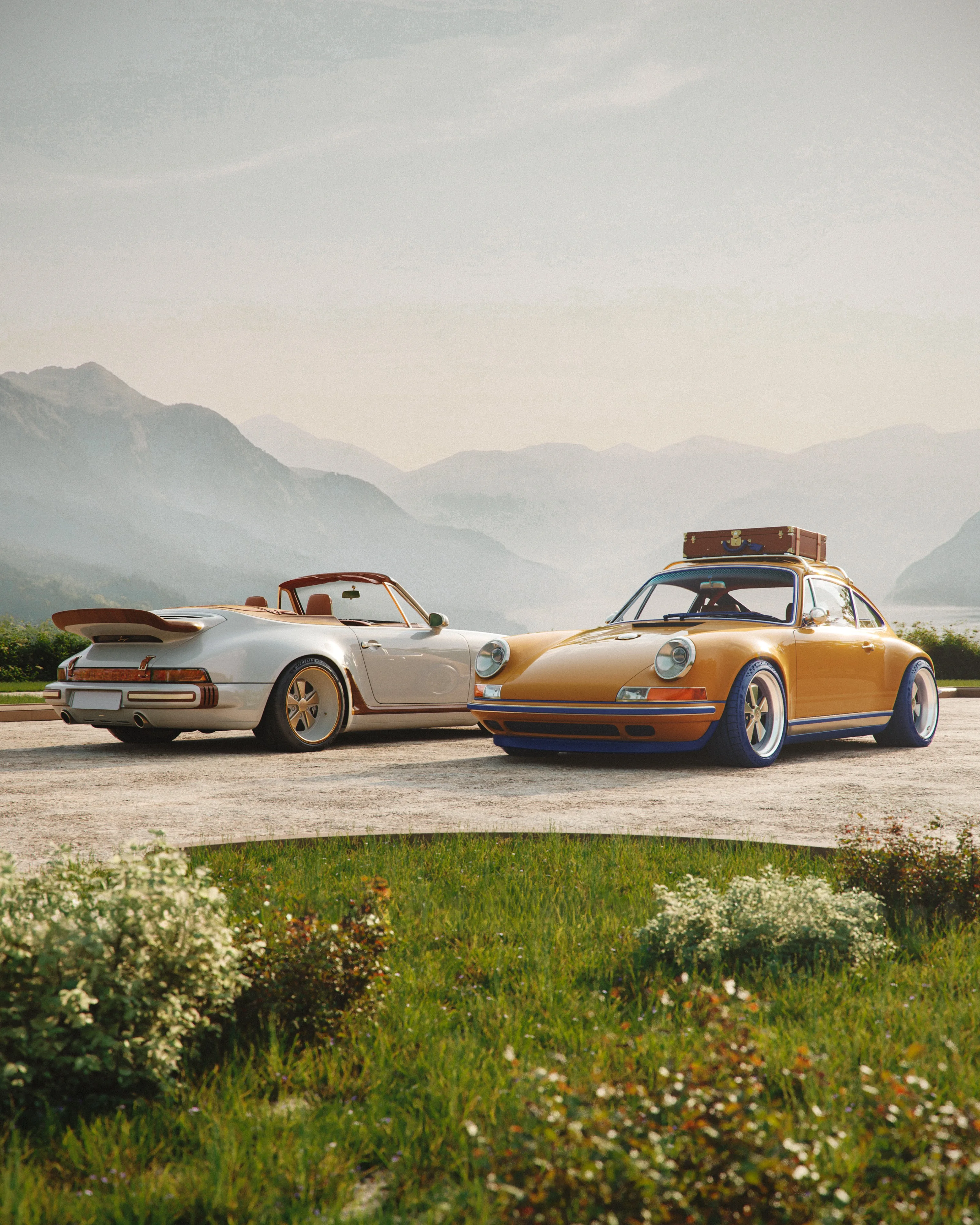
Louis Vuitton and Singer Vehicle Design unveiled two bespoke projects based on the 964-generation Porsche 911 during Monterey Car Week. The first is a Classic coupé with a 4.0-litre naturally aspirated engine, while the second is a Classic Turbo Cabriolet powered by a 3.8-litre twin-turbo flat-six. Porsche itself is not involved in the collaboration.
The project began with a request for a mechanical dashboard clock for a car reimagined by Singer. Inspired by Louis Vuitton's Tambour watch, the timepiece became the starting point for a much broader collaboration that eventually produced two fully conceived cars, complete with bespoke luggage, travel accessories and clothing.
The Classic gets a 291 kW naturally aspirated engine
The first car is based on Singer's Classic restoration services. The donor 964-generation 911 is stripped back to its steel monocoque, which is assessed, cleaned and strengthened before bespoke carbon-fibre body panels are fitted. The finished car also features a speed-activated rear wing, Öhlins adaptive dampers and carbon-ceramic brakes.
Its 4.0-litre air-cooled flat-six produces up to 291 kW, or 390 hp, and revs to 7,500 rpm. Power is sent to the rear wheels through a six-speed manual gearbox.
The car is finished in saffron with cobalt-blue and yellow accents. Inside, natural-hued leather is combined with carbon-fibre seats and diamond-pattern embossing that echoes the malletage motif found inside Louis Vuitton trunks.
A detachable mechanical timepiece inspired by the Tambour watch sits in the dashboard and can also be used as a desk clock. Louis Vuitton also created a collection of made-to-measure travel accessories for the car, including bespoke luggage, a surfboard and a pair of skis, all designed to work with a specially developed roof rack.
The Classic Turbo combines 380 kW with classic motorboat inspiration
The second car is a Singer Classic Turbo Cabriolet conceived in collaboration with Nicolas Ghesquière, Artistic Director of Women's Collections at Louis Vuitton.
Its 3.8-litre flat-six uses twin variable-geometry turbochargers and air-to-water intercooling to produce up to 380 kW, or 510 hp, and 610 Nm of torque. Power is sent to the rear wheels through a six-speed manual gearbox, while the traction-control and electronic stability-control systems were developed by Singer with Bosch.
Finished in Calcaire Lutétien white, the Cabriolet features carbon-fibre bodywork, a fixed whale-tail rear spoiler, 18-inch Fuchs-style wheels and carbon-ceramic brakes.
The design draws heavily on classic motorboats. Wood is used on the seat backs, flooring, luggage areas and even parts of the bumpers, while a teak-inspired deck forms part of the rear-opening luggage compartment. The cabin also features a removable mechanical dashboard clock, and Louis Vuitton created bespoke luggage specifically shaped to fit the car.
Porsche itself is not involved in the project
Both cars began life as 964-generation Porsche 911s, but neither is a factory Porsche special edition. Singer independently restores and reimagines customer-owned 911s and makes clear that it is not sponsored, associated with, approved or endorsed by Porsche AG.
The Louis Vuitton collaboration also shows how far Singer's 911 projects have evolved beyond conventional restoration. The engineering remains central, but materials, watchmaking, luggage and interior design are now treated as equally important parts of a single, cohesive concept.
The Classic gets a 291 kW naturally aspirated engine
The first car is based on Singer's Classic restoration services. The donor 964-generation 911 is stripped back to its steel monocoque, which is assessed, cleaned and strengthened before bespoke carbon-fibre body panels are fitted. The finished car also features a speed-activated rear wing, Öhlins adaptive dampers and carbon-ceramic brakes.
Its 4.0-litre air-cooled flat-six produces up to 291 kW, or 390 hp, and revs to 7,500 rpm. Power is sent to the rear wheels through a six-speed manual gearbox.
The car is finished in saffron with cobalt-blue and yellow accents. Inside, natural-hued leather is combined with carbon-fibre seats and diamond-pattern embossing that echoes the malletage motif found inside Louis Vuitton trunks.
A detachable mechanical timepiece inspired by the Tambour watch sits in the dashboard and can also be used as a desk clock. Louis Vuitton also created a collection of made-to-measure travel accessories for the car, including bespoke luggage, a surfboard and a pair of skis, all designed to work with a specially developed roof rack.
The Classic Turbo combines 380 kW with classic motorboat inspiration
The second car is a Singer Classic Turbo Cabriolet conceived in collaboration with Nicolas Ghesquière, Artistic Director of Women's Collections at Louis Vuitton.
Its 3.8-litre flat-six uses twin variable-geometry turbochargers and air-to-water intercooling to produce up to 380 kW, or 510 hp, and 610 Nm of torque. Power is sent to the rear wheels through a six-speed manual gearbox, while the traction-control and electronic stability-control systems were developed by Singer with Bosch.
Finished in Calcaire Lutétien white, the Cabriolet features carbon-fibre bodywork, a fixed whale-tail rear spoiler, 18-inch Fuchs-style wheels and carbon-ceramic brakes.
The design draws heavily on classic motorboats. Wood is used on the seat backs, flooring, luggage areas and even parts of the bumpers, while a teak-inspired deck forms part of the rear-opening luggage compartment. The cabin also features a removable mechanical dashboard clock, and Louis Vuitton created bespoke luggage specifically shaped to fit the car.
Porsche itself is not involved in the project
Both cars began life as 964-generation Porsche 911s, but neither is a factory Porsche special edition. Singer independently restores and reimagines customer-owned 911s and makes clear that it is not sponsored, associated with, approved or endorsed by Porsche AG.
The Louis Vuitton collaboration also shows how far Singer's 911 projects have evolved beyond conventional restoration. The engineering remains central, but materials, watchmaking, luggage and interior design are now treated as equally important parts of a single, cohesive concept.


