
A million-person city on the Moon would run out of water — even perfect recycling would not save it
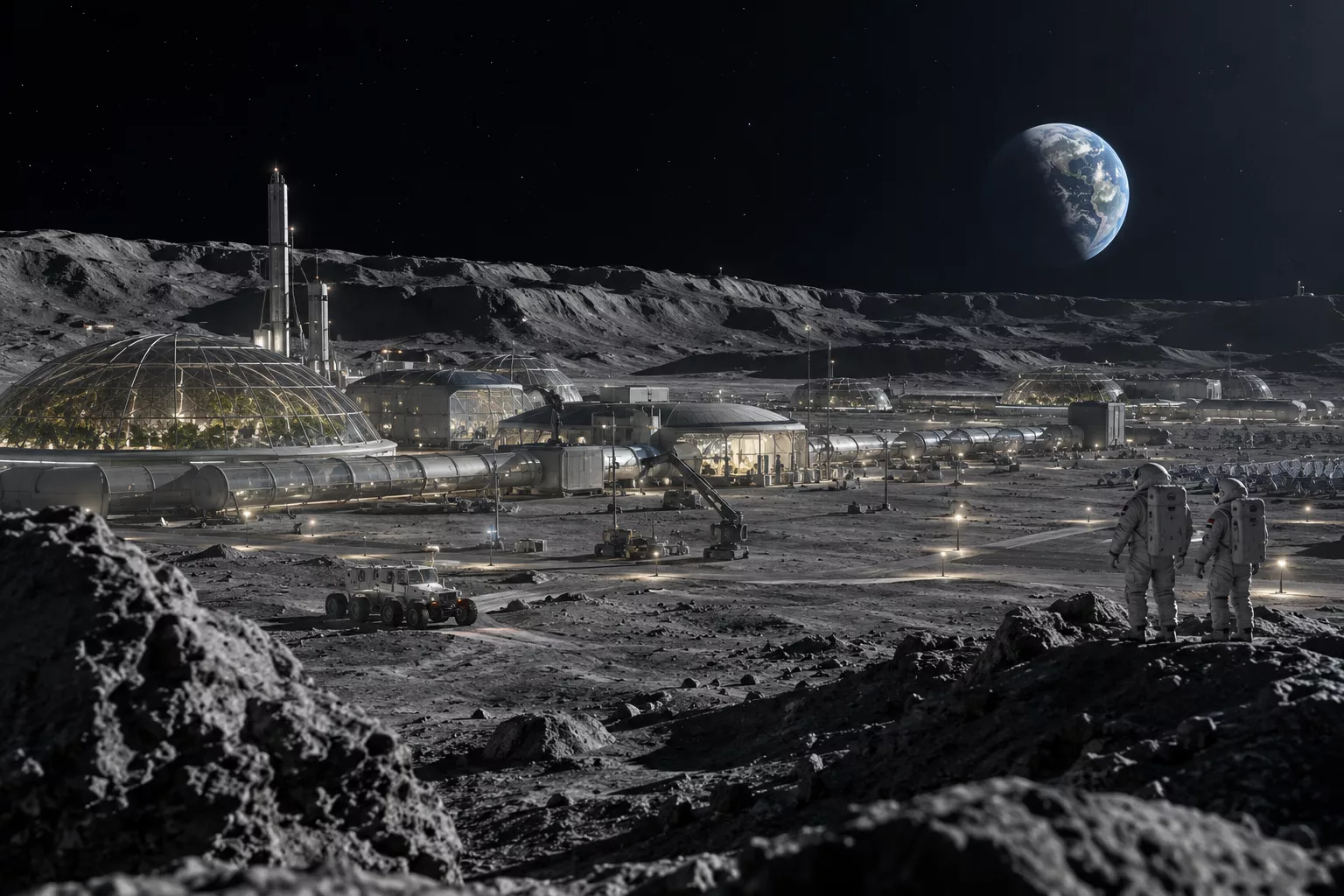
Humanity may build bases, mines and even small settlements on the Moon, but a city of one million would run up against a surprisingly terrestrial problem: there is not enough water. According to a new analysis, one million residents would exhaust even a highly optimistic water reserve in just over a century, even with 98% recycling. Current estimates of the Moon’s actual water supply may be around 30 times lower than that optimistic starting point.
The Moon’s billion tonnes of water sounds like more than it really is
Scientists Martin Elvis and Jonathan McDowell used one billion tonnes of lunar water as an optimistic starting point. Most usable ice is expected to be located in craters near the poles whose floors have not been reached by sunlight for billions of years. Temperatures there may remain below 110 K, or about -163°C, allowing ice to persist on geological timescales.
One billion tonnes seems like a vast reserve until a million people are added to the equation.
Water is needed not only for drinking and washing. It is consumed by food production, industry, and ultimately the production of oxygen and rocket fuel. Without recycling, the optimistic water supply would last a city of one million only a few years.
Even ISS-level recycling would not be enough
The most interesting part of the analysis concerns a closed water cycle. If a future lunar city could recycle 98% of its water, comparable to the level achieved on the International Space Station, a small amount would still be lost in every cycle.
For one million people, even a 2% loss becomes enormous.
With the optimistic one-billion-tonne water reserve, such a city would last just over 100 years. More problematic still is that newer estimates may put the amount of realistically accessible water around 30 times lower. In that case, even a much smaller city could exhaust its water reserves in about a decade.
Moreover, lunar ice is not a uniform underground lake where drilling a well would be enough. A recent ShadowCam study found no evidence of a widespread surface layer with high ice content in permanently shadowed regions. Ice at lower concentrations may nevertheless be present there, while deeper layers remain poorly studied.
A thousand people is an entirely different calculation
The study does not claim that permanent life on the Moon would be impossible. The problem arises primarily when thinking in terms of cities on Earth’s scale. A settlement of around a thousand residents could endure for centuries with known resources. In the authors’ calculations, even a community of 10,000 people is far more realistic than a city of one million.
This also changes the logic of lunar colonisation. Rather than vast domes and millions of residents, small scientific, industrial and mining bases may prove more realistic, with people accounting for only part of the workforce and robots carrying out much of the activity.
Energy is not necessarily the greatest obstacle. Near the poles, there are higher areas where sunlight can be used for very long periods. If necessary, the system can be supplemented with nuclear reactors. The more difficult issue is that the most valuable ice is often located in dark craters, where there is almost no solar power on site.
One discovery could turn the entire calculation upside down
The greatest weakness of the current analysis is also its most important message: we still do not know how much water the Moon actually contains. Remote sensing mainly examines near-surface layers. Lunar regolith extends much deeper, however, and cold traps may contain as-yet undiscovered ice reserves. NASA currently firmly confirms the presence of water both in permanently shadowed regions and in small quantities on the sunlit surface, but the total reserve and recoverable share remain uncertain.
A 2026 Nature Astronomy study also suggests that polar ice is not the remnant of a single ancient event. The data fit a model in which ice has accumulated continuously over at least the past 1.5 billion years, while some of it has been lost. For that reason, the claim that “there will never be cities on the Moon” would currently be too absolute.
Based on current knowledge, something more precise and more interesting can be said: an Earth-scale lunar city would not necessarily be held back first by rocket technology, energy or building materials. Water could stop it.
In principle, there are four solutions. Much more ice must be found, water recycling improved, agriculture’s water use reduced, or water transported to the Moon from elsewhere, such as asteroids. For now, the calculations simply make the Moon’s future less science-fictional. Rather than a city of one million, it makes more sense initially to think of a hybrid of an Antarctic research station, a mine and a spaceport.


