Tesla FSD can choose its own speed, but the driver still gets the ticket
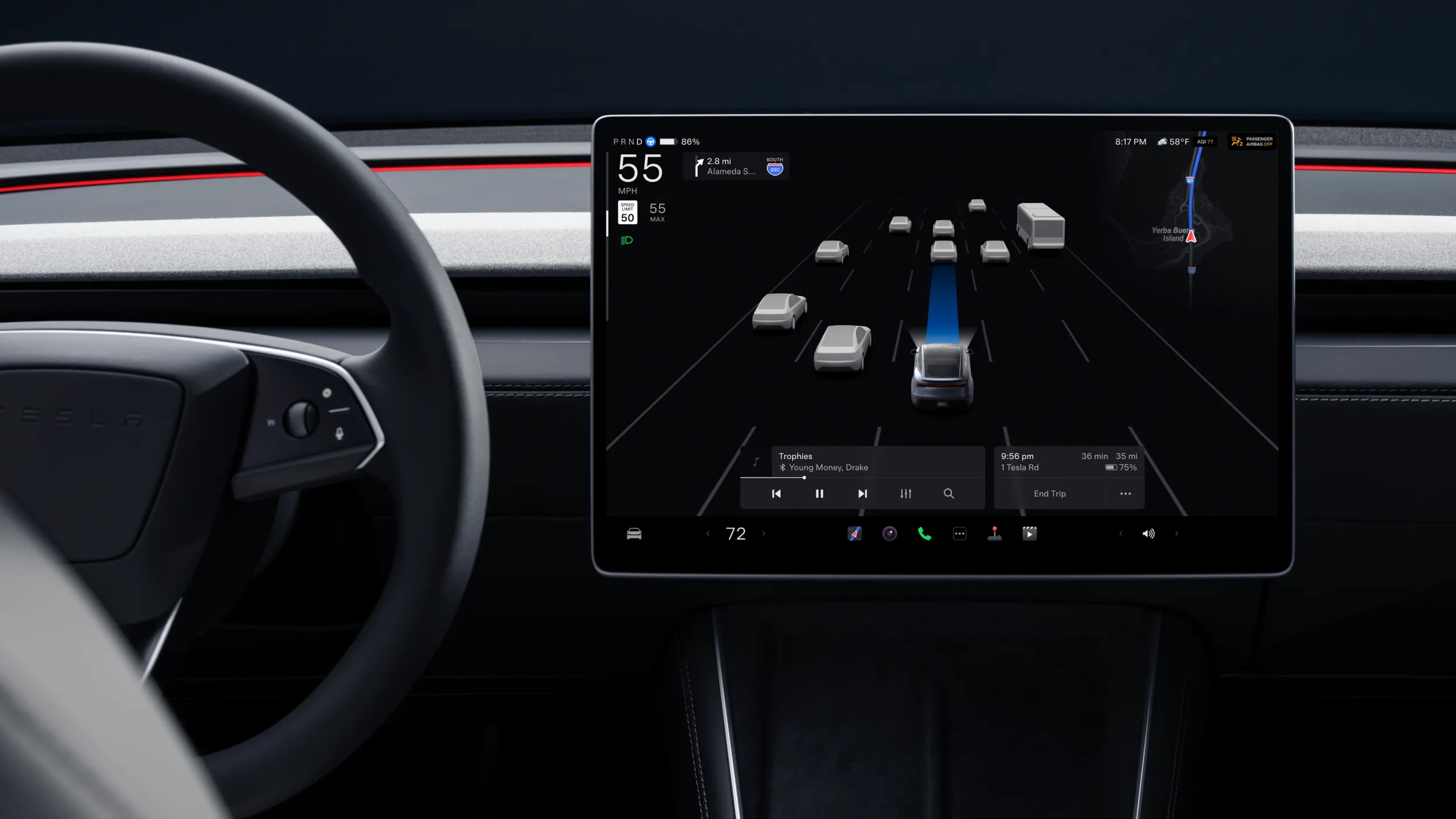
Tesla Full Self-Driving has gained increasingly aggressive speed profiles, giving the software more freedom than before to choose the vehicle’s speed based on traffic flow. The sharpest, Mad Max, drives faster than the Hurry profile and changes lanes more often. But the problem is equally obvious: if the software decides to exceed the speed limit, the person behind the wheel remains responsible.
Tesla officially calls the system Full Self-Driving (Supervised), with the word in parentheses being the most important one. FSD can steer, accelerate, brake, change lanes, follow a route and park, but Tesla states directly that the system does not make the vehicle autonomous. The driver must continuously monitor traffic and intervene immediately when necessary.
However, speed selection is increasingly being left to the software.
Rather than a numerical speed, the driver selects a character
Tesla’s current FSD uses five speed profiles: Sloth, Chill, Standard, Hurry and Mad Max. These do not only determine how assertively the car moves; they also affect lane selection and the frequency of overtaking manoeuvres.
Sloth maintains the calmest pace and drives at or below the speed limit. Chill favours slower lanes and avoids unnecessary lane changes. Standard adjusts speed to traffic flow. Hurry raises the pace and makes lane changes more frequent.
Mad Max takes the logic another step towards aggression. According to Tesla’s own description, the car drives faster in this profile than with the Hurry setting and changes lanes more often.
The name is hardly a subtle hint. “Mad Max” comes from the film world, where following traffic rules is, famously, not the characters’ biggest concern.
The more important change, however, lies in the user interface. In newer FSD versions, the right-hand steering-wheel scroll wheel no longer sets a precise maximum speed offset in km/h; instead, it switches between speed profiles. Tesla’s software determines an appropriate pace based on the driver’s selected profile, the speed limit and surrounding traffic.
In other words, the driver tells the software to “drive faster”, rather than necessarily saying “do not exceed 90 km/h”.
FSD can interpret speed limits rather creatively
Tesla’s owner’s manual clearly states that, in addition to traffic signs, FSD selects driving speed using navigation data, historical data from other Tesla vehicles and surrounding traffic. As a result, the profile selected by the driver does not correspond to one specific speed.
That is both the system’s strength and its problem.
Human drivers behave in much the same way. If all traffic on a motorway is travelling slightly faster than the speed limit, for example, a driver does not look only at the sign but also assesses the pace of surrounding vehicles. But giving an automated system the same room for judgement creates an awkward legal question: who decided to exceed the speed limit?
Tesla’s answer is simple: the driver.
The manufacturer states directly in its owner’s manual that the human is responsible for the vehicle’s speed at all times, regardless of whether FSD is operating.
The software can make more and more driving decisions, but in the event of a traffic violation, the owner cannot tell a police officer that “the computer did it”.
One driver has already received a fine for an FSD-selected speed
The issue is not merely theoretical. Electrek’s Fred Lambert described a case in Quebec in July in which his Tesla, using the FSD Standard profile, travelled at 78 km/h in a 50 km/h zone. The result was a speeding fine. Lambert’s main criticism was that the previously precisely adjustable speed offset had been replaced by profiles whose behaviour the driver could not limit as precisely.
Travelling 28 km/h above the speed limit is no longer a minor difference made to match traffic flow.
The driver can, of course, intervene. Tesla allows FSD to be disengaged using the brake pedal, steering wheel or the relevant control button. The issue is more one of principle: a driver-assistance system should reduce the human workload, but this speed logic instead forces the driver to monitor whether the car is currently earning them a fine.
This is a particularly sensitive issue for Europe
In Europe, Tesla FSD is not yet in the same position as it is in North America. However, the system’s European approval process is moving ahead rapidly in 2026. France began testing FSD on its roads at the beginning of September. This was preceded by preliminary approval in the Netherlands in April, while Belgium, Denmark, Estonia and Lithuania, among others, are carrying out similar assessments. According to Reuters, the question of Europe-wide approval could come to a vote within the next few months.
Speed control is among the issues attracting the attention of European officials. French Transport Minister Philippe Tabarot has highlighted both speed limiting and driver-attention monitoring. Tesla must therefore demonstrate not only that FSD can drive a vehicle in Europe’s more complex traffic environment, but also that the system’s behaviour complies with local rules.
From an Estonian perspective, the subject is particularly interesting because Estonia is also among the countries involved in the European FSD assessment.
“Mad Max” is a fun name, but a poor regulatory message
Technically, Tesla’s approach is understandable. Automation that rigidly sticks to the speed limit can behave awkwardly in real traffic, particularly when the rest of the flow is moving somewhat faster. To drive like a human, automated driving needs to be able to assess context.
But this is where the line between engineering and responsibility lies. If FSD chooses its own speed, changes lanes on its own, decides when to overtake and guides the car through junctions on its own, the claim that the driver is effectively making all decisions becomes increasingly artificial. Legally, however, the situation remains unambiguous for now: FSD (Supervised) remains a driver-assistance system, and the human must supervise its actions.
In Europe, this will likely become one of Tesla’s most significant regulatory tests. European officials must decide not only whether FSD can drive a car. They must decide how much freedom to interpret traffic rules can be given to software whose mistakes ultimately remain the responsibility of a human.
And in that light, the “Mad Max” speed profile seems an almost comically apt name.


