
AM General turns the Humvee into a cabinless drone truck
 1/2
1/2
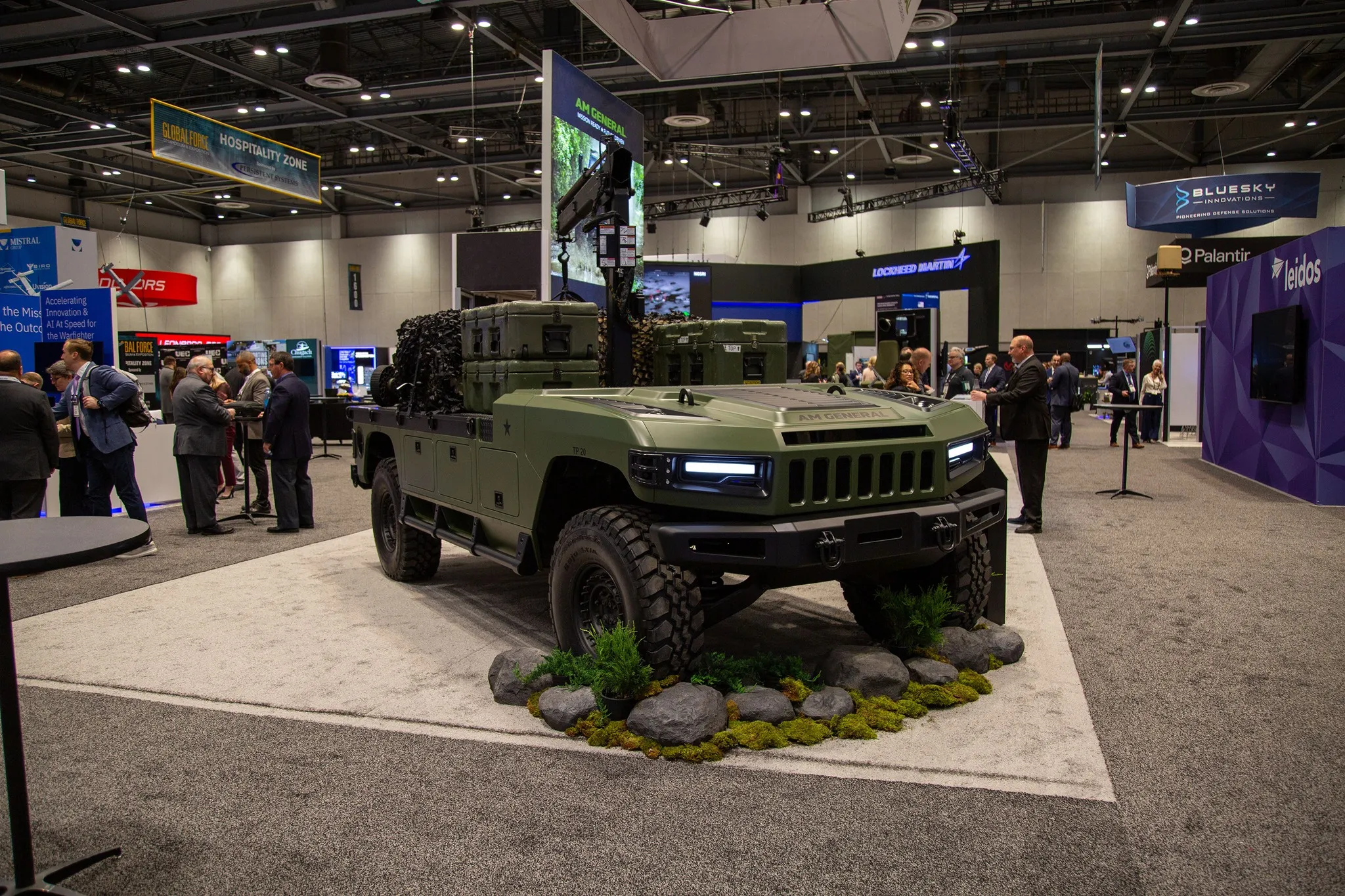
AM General used the AUSA Global Force stage to unveil a new unmanned ground vehicle that bins the classic Humvee cabin and replaces it with a modular cargo platform. The move shows exactly where the company wants to position itself, in the corner of the US Army’s future plans where autonomy is most likely to arrive first, hauling supplies, power and robotic systems out to dispersed units.
The new unmanned ground vehicle, or UGV, clearly borrows its visual logic from the wider Humvee family, but its centre of gravity sits elsewhere. In place of crew space, AM General fitted a reconfigurable cargo deck. It also added a wirelessly operated T boom service crane, an L track tie down system and even a smaller FireAnti unmanned ground vehicle, all to underline the same point. This thing is meant to work less like a traditional tactical truck and more like a logistical mothership.
Power comes from a new 6.5 litre turbocharged V8 diesel producing 250hp and more than 550 lb ft of torque. That engine is also expected to find its way into future light tactical vehicles, including the next development cycle of the Humvee itself.
The real strategic weight lies deeper than the show stand. On 14 October 2025, AM General announced a partnership with Carnegie Robotics and Textron Systems to develop an autonomous platform for the US Army’s M MET programme. Its job would be to move supplies and operational energy from brigade support areas to dispersed forward units. That earlier press release spoke of a hybrid electric powertrain, drive by wire controls and more than 30kW of exportable power. This latest debut suggests the concept has now made the jump from PowerPoint to metal.
Breaking Defense reported back in 2024 that the US Army was looking for a new unmanned logistics vehicle to fill the gap between the small S MET robotic mule and the much larger PLS supply truck. From that angle, the decision to sacrifice crew space looks entirely deliberate. AM General wanted more usable cargo volume, more modular mounting points and more room for mission equipment within roughly the same footprint. The cabinless architecture does not make this UGV a cheaper Humvee. It makes it a tool for a different job altogether.
National Defense wrote in February that the Army had repeatedly revised its ground autonomy plans over the past year, cancelled the Robotic Combat Vehicle programme and shifted towards a vehicle neutral approach to autonomy. The same report stressed that supply missions are among the roles where unmanned ground systems are likely to reach real service sooner than fully autonomous combat formations. In other words, AM General is not chasing the flashiest application. It is chasing the one the Army is most likely to buy.
That is why this matters as more than the debut of one odd looking military machine. With this UGV, AM General is trying to prove that the Humvee legacy can still be monetised even when the driver, passenger and armoured cabin disappear entirely. If the Army launches the expected competition this year, and if the company can turn this demonstrator into a production ready logistics robot, the result could become the Humvee’s next serious commercial reincarnation. If procurement logic shifts again, this UGV will still stand as a pretty clear signal of where the military ground autonomy market thinks it is heading.
Power comes from a new 6.5 litre turbocharged V8 diesel producing 250hp and more than 550 lb ft of torque. That engine is also expected to find its way into future light tactical vehicles, including the next development cycle of the Humvee itself.
The real strategic weight lies deeper than the show stand. On 14 October 2025, AM General announced a partnership with Carnegie Robotics and Textron Systems to develop an autonomous platform for the US Army’s M MET programme. Its job would be to move supplies and operational energy from brigade support areas to dispersed forward units. That earlier press release spoke of a hybrid electric powertrain, drive by wire controls and more than 30kW of exportable power. This latest debut suggests the concept has now made the jump from PowerPoint to metal.
Breaking Defense reported back in 2024 that the US Army was looking for a new unmanned logistics vehicle to fill the gap between the small S MET robotic mule and the much larger PLS supply truck. From that angle, the decision to sacrifice crew space looks entirely deliberate. AM General wanted more usable cargo volume, more modular mounting points and more room for mission equipment within roughly the same footprint. The cabinless architecture does not make this UGV a cheaper Humvee. It makes it a tool for a different job altogether.
National Defense wrote in February that the Army had repeatedly revised its ground autonomy plans over the past year, cancelled the Robotic Combat Vehicle programme and shifted towards a vehicle neutral approach to autonomy. The same report stressed that supply missions are among the roles where unmanned ground systems are likely to reach real service sooner than fully autonomous combat formations. In other words, AM General is not chasing the flashiest application. It is chasing the one the Army is most likely to buy.
That is why this matters as more than the debut of one odd looking military machine. With this UGV, AM General is trying to prove that the Humvee legacy can still be monetised even when the driver, passenger and armoured cabin disappear entirely. If the Army launches the expected competition this year, and if the company can turn this demonstrator into a production ready logistics robot, the result could become the Humvee’s next serious commercial reincarnation. If procurement logic shifts again, this UGV will still stand as a pretty clear signal of where the military ground autonomy market thinks it is heading.


