
BMW teaches AI to understand crash simulations
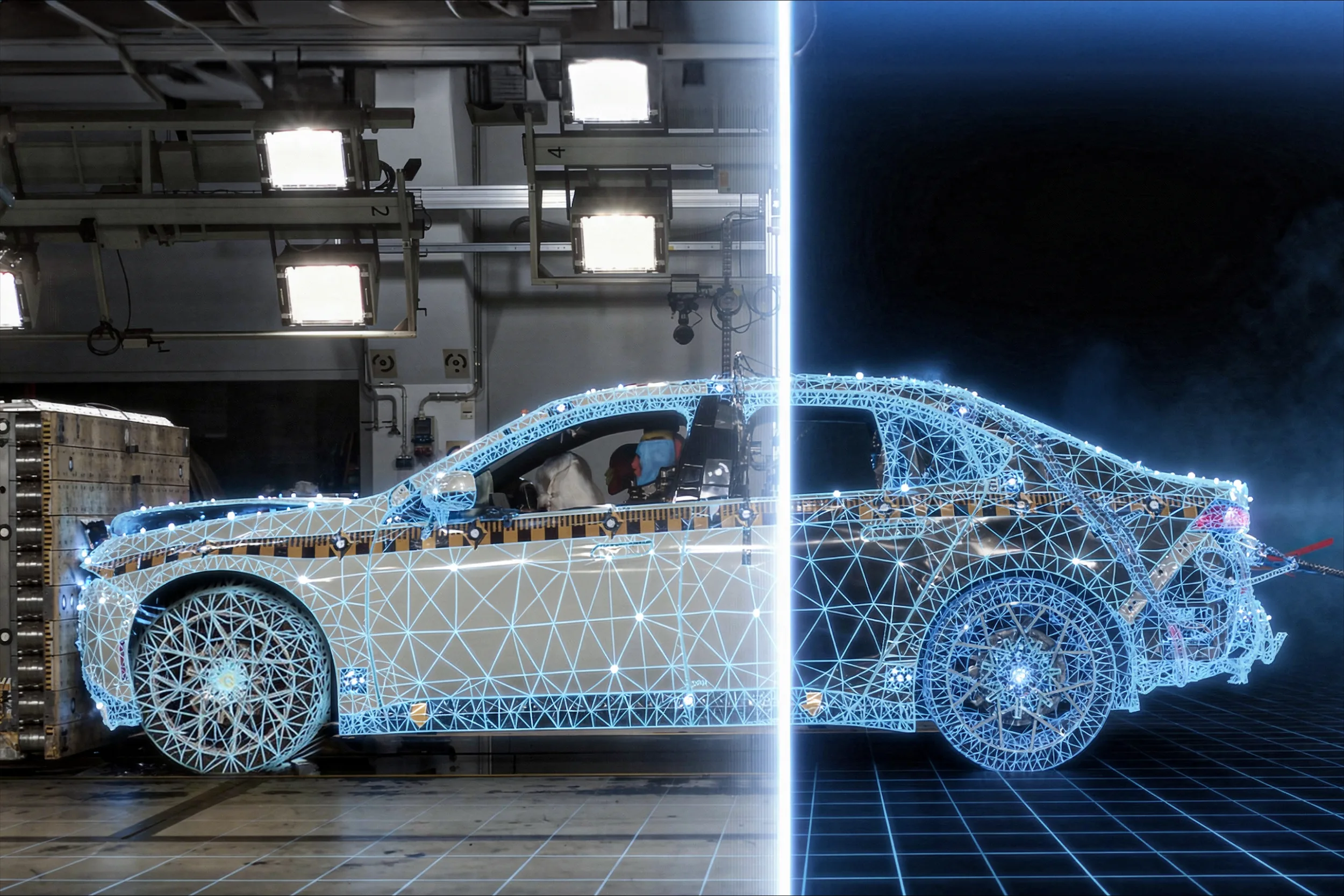
BMW Group and French AI company Mistral AI started a collaboration that takes artificial intelligence deeper into one of the most complex parts of car development: crash simulation analysis. BMW will hand over more than one petabyte of historical simulation data for model training, while Mistral AI brings the machine learning capability. The aim is not to scrap physical crash tests, but to make the development of body structures, materials and crumple zones faster and more precise.
BMW is not teaching AI to talk, but to read a crash
BMW Group will use its own industrial data to analyse crash simulations. According to the company, thousands of virtual crash simulations run each week during BMW development, and over the years it accumulated more than one petabyte of data from different crash scenarios. That data describes body structures, material behaviour and deformation patterns, giving BMW and Mistral AI the basis for training an industry specific AI model.
Crash simulation is a field where every millimetre of deformation in steel, aluminium, high strength steel, adhesive joints and battery enclosures can change cabin loads, door opening behaviour, seatbelt performance or high voltage battery protection. The value of AI here does not lie in theatrical decision making. It lies in finding patterns inside a vast mass of engineering data.
The Large Industry Model is BMW’s answer to the general chatbot
BMW describes the technical basis as a Large Industry Model approach. In practice, that means a large industrial model that does not learn from general internet text, but from engineering data, simulation meshes, material models and development logic from one specific field. Mistral AI describes the partnership in similar terms: the goal is to build industry specific AI models that begin with crash simulations and could later expand into other parts of BMW’s value chain.
That separates BMW’s project from ordinary generative AI. A chatbot can explain what a crash beam or side impact means. An industrial model must help an engineer understand why a certain body node fails in the wrong way, how loads travel through the body structure and which simulation result deserves a closer look.
Crash simulation is too complex for easy promises
A crash is not a linear problem. At the moment of impact, materials bend and tear, components meet in new places, welds and adhesive joints work at the edge of their limits and the entire process takes place within milliseconds. Recent CarCrashNet research makes the same point: structural crash simulation is difficult because of large deformations, nonlinear contact, plastic material behaviour and high resolution finite element meshes.
So BMW and Mistral AI’s promise deserves a sober reading. AI will not replace the engineer or the physical crash test. It could, however, reduce the time spent sorting simulations, finding anomalies and comparing variants. When an engineer can see sooner which body structure behaves badly, they can change the profile shape, material thickness or load path earlier in the process.
European safety rules make virtual development more valuable
BMW’s project arrives at the right time. Euro NCAP moves to a new assessment scheme in 2026, looking at safety in four stages: safe driving, crash avoidance, crash protection and post crash safety. Euro NCAP also stresses the growing role of virtual testing, especially for future safety ratings and the assessment of new technologies.
That makes car development more demanding. A strong front end and a good side airbag no longer tell the whole story. In an electric car, the high voltage battery must remain isolated after a crash, rescue crews must be able to open the vehicle quickly, and door handles or electrical systems must not obstruct escape after an impact. Euro NCAP’s post crash safety protocol also uses crash tests to check electrical safety in electric and hybrid vehicles.
BMW’s advantage lies in the scale of its data
Every major car maker runs simulation teams and physical test labs. BMW’s strength here lies in its data estate. More than one petabyte of historical crash simulation data means the model is not learning from a blank sheet. It can study years of development: which solutions worked, which body nodes behaved badly, which simulations predicted physical test results well and where the gaps appeared.
There is a risk too. Industrial AI only becomes useful when the data is high quality, correctly labelled and meaningful to engineers. A poor simulation or a misunderstood material model could teach the AI the wrong relationship. BMW’s own engineering expertise therefore remains at the centre of the project. Mistral AI provides the tool, not an automatic truth machine.
The competition is moving the same way
BMW is not alone in seeing simulation and AI as a new development accelerator. The car and aerospace industries are shifting more work into virtual environments because physical prototypes cost a great deal and every development cycle needs to become shorter. Euronews placed the news in a wider context, noting that Mistral AI also signed a partnership with Airbus, a sign that European industry wants to use local AI solutions in strategic fields.
For BMW, the stakes are especially high. Electric cars, large battery packs, multi material bodies and tougher safety protocols force manufacturers to test more variants more quickly. If AI helps BMW shorten simulation analysis and spot weak points earlier, it could bring an advantage in safety, development time and cost.
Technical summary
BMW Group and Mistral AI are developing AI for crash simulation analysis.
BMW will use more than one petabyte of historical crash simulation data to train the models.
The solution focuses on Large Industry Model style industrial models, not general chatbots.
AI should help engineers assess body deformation, material behaviour and simulation anomalies more quickly.
For Europe, the project gains extra importance from Euro NCAP’s 2026 safety scheme and the growing role of virtual testing.
BMW Group will use its own industrial data to analyse crash simulations. According to the company, thousands of virtual crash simulations run each week during BMW development, and over the years it accumulated more than one petabyte of data from different crash scenarios. That data describes body structures, material behaviour and deformation patterns, giving BMW and Mistral AI the basis for training an industry specific AI model.
Crash simulation is a field where every millimetre of deformation in steel, aluminium, high strength steel, adhesive joints and battery enclosures can change cabin loads, door opening behaviour, seatbelt performance or high voltage battery protection. The value of AI here does not lie in theatrical decision making. It lies in finding patterns inside a vast mass of engineering data.
The Large Industry Model is BMW’s answer to the general chatbot
BMW describes the technical basis as a Large Industry Model approach. In practice, that means a large industrial model that does not learn from general internet text, but from engineering data, simulation meshes, material models and development logic from one specific field. Mistral AI describes the partnership in similar terms: the goal is to build industry specific AI models that begin with crash simulations and could later expand into other parts of BMW’s value chain.
That separates BMW’s project from ordinary generative AI. A chatbot can explain what a crash beam or side impact means. An industrial model must help an engineer understand why a certain body node fails in the wrong way, how loads travel through the body structure and which simulation result deserves a closer look.
Crash simulation is too complex for easy promises
A crash is not a linear problem. At the moment of impact, materials bend and tear, components meet in new places, welds and adhesive joints work at the edge of their limits and the entire process takes place within milliseconds. Recent CarCrashNet research makes the same point: structural crash simulation is difficult because of large deformations, nonlinear contact, plastic material behaviour and high resolution finite element meshes.
So BMW and Mistral AI’s promise deserves a sober reading. AI will not replace the engineer or the physical crash test. It could, however, reduce the time spent sorting simulations, finding anomalies and comparing variants. When an engineer can see sooner which body structure behaves badly, they can change the profile shape, material thickness or load path earlier in the process.
European safety rules make virtual development more valuable
BMW’s project arrives at the right time. Euro NCAP moves to a new assessment scheme in 2026, looking at safety in four stages: safe driving, crash avoidance, crash protection and post crash safety. Euro NCAP also stresses the growing role of virtual testing, especially for future safety ratings and the assessment of new technologies.
That makes car development more demanding. A strong front end and a good side airbag no longer tell the whole story. In an electric car, the high voltage battery must remain isolated after a crash, rescue crews must be able to open the vehicle quickly, and door handles or electrical systems must not obstruct escape after an impact. Euro NCAP’s post crash safety protocol also uses crash tests to check electrical safety in electric and hybrid vehicles.
BMW’s advantage lies in the scale of its data
Every major car maker runs simulation teams and physical test labs. BMW’s strength here lies in its data estate. More than one petabyte of historical crash simulation data means the model is not learning from a blank sheet. It can study years of development: which solutions worked, which body nodes behaved badly, which simulations predicted physical test results well and where the gaps appeared.
There is a risk too. Industrial AI only becomes useful when the data is high quality, correctly labelled and meaningful to engineers. A poor simulation or a misunderstood material model could teach the AI the wrong relationship. BMW’s own engineering expertise therefore remains at the centre of the project. Mistral AI provides the tool, not an automatic truth machine.
The competition is moving the same way
BMW is not alone in seeing simulation and AI as a new development accelerator. The car and aerospace industries are shifting more work into virtual environments because physical prototypes cost a great deal and every development cycle needs to become shorter. Euronews placed the news in a wider context, noting that Mistral AI also signed a partnership with Airbus, a sign that European industry wants to use local AI solutions in strategic fields.
For BMW, the stakes are especially high. Electric cars, large battery packs, multi material bodies and tougher safety protocols force manufacturers to test more variants more quickly. If AI helps BMW shorten simulation analysis and spot weak points earlier, it could bring an advantage in safety, development time and cost.
Technical summary
BMW Group and Mistral AI are developing AI for crash simulation analysis.
BMW will use more than one petabyte of historical crash simulation data to train the models.
The solution focuses on Large Industry Model style industrial models, not general chatbots.
AI should help engineers assess body deformation, material behaviour and simulation anomalies more quickly.
For Europe, the project gains extra importance from Euro NCAP’s 2026 safety scheme and the growing role of virtual testing.


