
Chinese brands account for almost half of the 2027 World Car of the Year candidate list
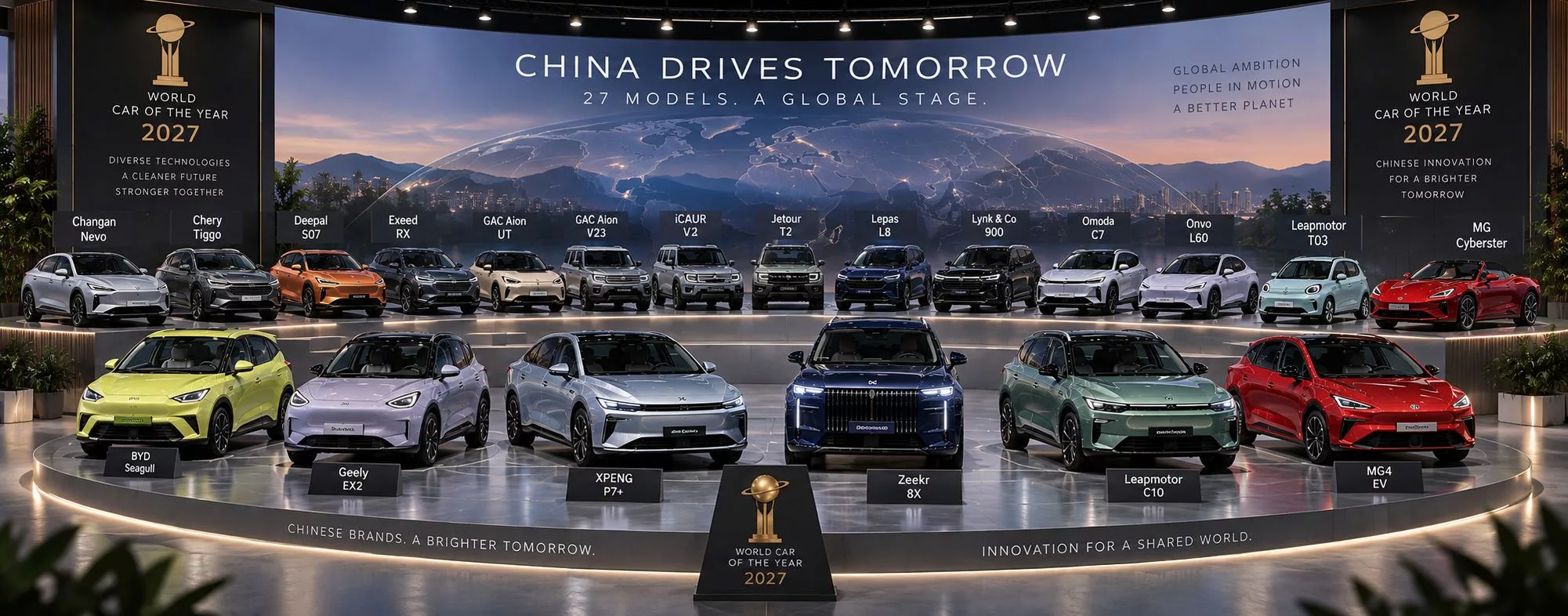
China’s global automotive push is particularly evident in the 2027 World Car of the Year selection. As of 29 September, the official list contains 55 models, 27 of them carrying brands of Chinese origin. That represents 49% of the total selection. They are not finalists yet, however.
The World Car Awards list ranges from BYD, Changan and Geely to numerous sub-brands of XPeng, Leapmotor, Zeekr and Chery. The 27 Chinese vehicles are spread across BYD, Changan Nevo, Chery, Deepal, Exeed, GAC Aion, Geely, iCAUR, Jetour, Leapmotor, Lepas, Lynk & Co, MG, Omoda, Onvo, XPeng and Zeekr, among others.
Too early to talk about finalists
The current list of 55 vehicles brings together eligible models, rather than those selected as the best by the jury. World Car of the Year requires annual production of at least 10,000 vehicles, a price point below that of luxury cars, and sales in at least two major markets and on two continents between 1 January 2026 and 19 March 2027.
The jury will test the cars until the end of the year. The 10 finalists will be announced on 5 January 2027, the final three at the end of February, and the winner will be named on 24 March at the New York International Auto Show.
The large number of Chinese cars therefore does not automatically mean equally strong success in the voting. It does, however, show how many Chinese manufacturers can now meet a fairly significant condition of the competition: selling the same model on several continents.
China no longer arrives with just one cheap electric car
Only a few years ago, Chinese exports were primarily associated with cheaper electric cars. The 2027 list is far more varied. The small Geely EX2, Leapmotor T03, MG4 EV Urban and GAC Aion UT appear alongside larger Deepal, Exeed and Jetour models. At the upper end are the Lynk & Co 900, XPeng P7+ and Zeekr 8X. The choice of powertrains ranges from fully electric cars to plug-in hybrids and range-extender models.
More telling still, 27 is a conservative figure. The Volvo EX60 and Polestar models belong to the Geely-controlled industrial group, the technical underpinnings of the Mazda CX-6e/EZ-60 link the model to Changan, and several Nissan and General Motors models are developed with the support of Chinese joint ventures. Calling them simply “Chinese cars” would distort the origins of the brands, but the real influence of China’s engineering and manufacturing base on the list is even greater.
Life is getting tougher for European manufacturers
Europe is not without an answer. The candidates include the BMW i3, Cupra Raval, DS N°7, Mercedes-Benz’s new electric C-Class and GLC, Renault Filante and Volvo EX60. Japanese and Korean manufacturers counter with the Mazda CX-5, Lexus ES, Hyundai Ioniq 3 and a whole range of Kia, Nissan and Subaru models.
For now, however, China’s advantage comes from the breadth of its offering. The same industry can send a small urban hatchback, a family SUV, a luxury model and a large SUV to international markets at the same time. European manufacturers are no longer competing with a single BYD or MG, but with an entire network of manufacturers and sub-brands.
The competition’s results in recent years have also favoured technologically fresh electric cars. The overall titles from 2022 to 2026 went in succession to the Hyundai Ioniq 5, Hyundai Ioniq 6, Kia EV9, Kia EV3 and BMW iX3. A Chinese brand has yet to win the overall World Car of the Year title, although the BYD Seagull won the city car category in 2025 and Nio sub-brand Firefly repeated the feat in 2026.
The 2027 list shows that the question is no longer whether Chinese cars will move from the fringes of the global selection into the main competition. They already make up almost half of the starting field.


