
Whose Cloud Holds the Brain of Europe’s Economy? Whose AI Will Build the Car of the Future?
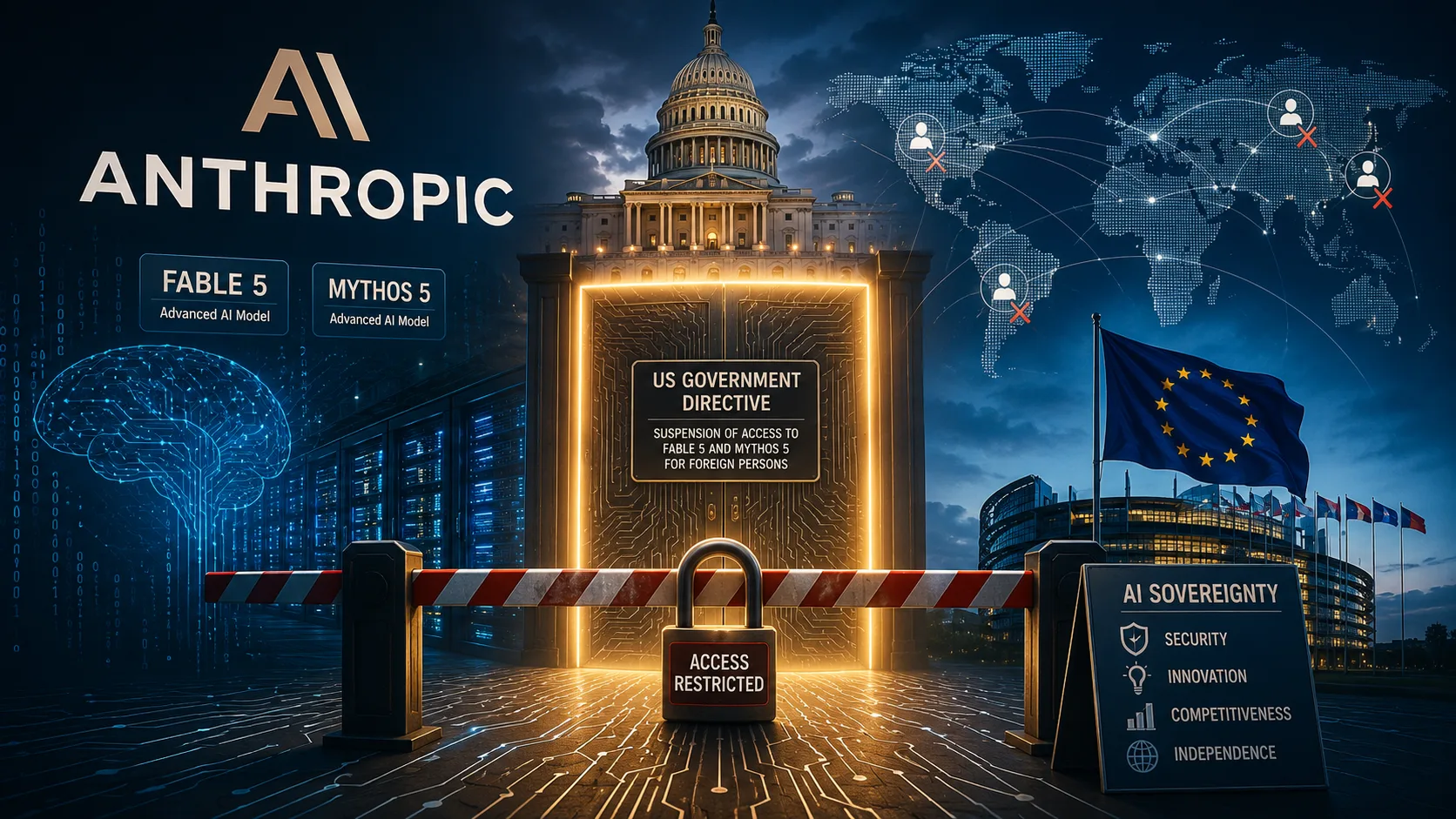
The timeline was almost absurdly short. On June 9, 2026, Anthropic publicly announced Claude Fable 5 and Claude Mythos 5. Fable 5 was presented as a Mythos-class model made safe for broad use. Mythos 5, built on the same underlying model but with some safeguards lifted, was aimed at a smaller circle of cyberdefenders and infrastructure providers through Project Glasswing and a planned trusted-access programme.
Three days later, on June 12, 2026, Anthropic said the United States government had issued an export-control directive requiring access to Fable 5 and Mythos 5 to be suspended for all foreign nationals, whether inside or outside the United States. To comply, Anthropic said it had to disable both models for all customers.
In other words, one of the world’s most advanced AI systems moved from launch to geopolitical restriction in less than a week.
At first glance, this may look like just another clash between Silicon Valley and Washington: the technology company talks about innovation, the government talks about national security, and customers are left staring at their screens in frustration.
But it is more than that. The Anthropic case is one of the clearest warnings yet that artificial intelligence is becoming a strategic resource. Not just software. Not just another cloud service. Not a convenient chatbot that writes emails, translates documents or helps debug code. Frontier AI is increasingly being treated like chips, satellites, cryptography, defence technology and energy.
And if that is the reality, Europe has to ask itself a blunt question: are we building our future with our own tools, or are we renting the brain of our own economy from America?
This Is Not Just an Anthropic Problem
At the centre of the Anthropic case was a US government order to suspend access by foreign nationals to the Fable 5 and Mythos 5 models. According to Anthropic, the government’s concern appeared to relate to a possible way of bypassing Fable 5’s safeguards — in other words, jailbreaking the model. The company argued that the example was narrow rather than universal, and involved capabilities that other publicly available models could also reproduce under certain conditions.
From the government’s perspective, the concern is understandable. The most powerful AI models are no longer just chatbots. They can analyse code, identify software vulnerabilities, draft attack scenarios, help automate intelligence work, process enormous datasets and accelerate tasks that once required entire teams of engineers, analysts or cybersecurity specialists. If such a tool falls into the hands of a hostile state, a criminal group or a well-funded attacker, the damage could be real.
The US government increasingly views this not as consumer technology, but as a question of power balances, national security and economic advantage. From that logic, it is not difficult to understand why Washington wants to control who gets access to the most capable models.
But that is exactly where the problem begins.
If a state can, with a single order, cut off access to a tool around which companies, researchers, engineers and software developers have already built workflows, then this is no longer an ordinary service. It is starting to look like critical infrastructure. And if that infrastructure is subject to another country’s political decisions, the dependency is no longer theoretical.
Europe Talks Sovereignty, But Acts Like a User
The European Union has spent recent years talking a great deal about digital sovereignty. It sounds good. It works well at conferences, in strategy papers and in political speeches. But sovereignty does not mean having elegant rules. Sovereignty means being able to act when others decide to close the door.
Europe’s position today is uncomfortable. It has strong industry, good universities, plenty of engineers, a serious research base and vast amounts of high-quality data. But when it comes to frontier AI models, cloud infrastructure and scalable platforms, Europe still depends heavily on American companies.
That does not make the United States Europe’s enemy. Quite the opposite: the US remains Europe’s most important ally. But that is precisely why the question is so serious. Recent experience in energy, semiconductors and defence has shown that even friendly dependence can become a vulnerability in a crisis. When dependence becomes too great, the decisive question is not whether the partner is good or bad. It is who gets to decide.
With AI, this matters especially because artificial intelligence is not just one sector among many. It is beginning to reshape every sector: banking, medicine, public administration, defence, energy, logistics and, of course, the automotive industry.
The Automotive Industry Is the First Big Test
Today’s car is no longer just an engine, a body and a gearbox. It is a sensor-packed computer on wheels, and its value depends increasingly on software. Driver-assistance systems, autonomous-driving functions, battery management, energy efficiency, cybersecurity, user interfaces, voice control, service diagnostics, over-the-air updates, product development and simulation are all moving deeper into AI.
When a European carmaker talks about the software-defined vehicle, but relies mainly on US model providers to develop it, test it, analyse code and accelerate engineering workflows, a simple question follows: if the brain of the software-defined car is born in someone else’s cloud, how independent is that car really?
This is no longer an abstract concern. The automotive industry is already under pressure on multiple fronts. China is moving quickly in combining electric vehicles, batteries and software. US technology companies control large parts of the cloud, chip and AI ecosystem. European carmakers remain strong in mechanical engineering, manufacturing, safety, quality and brand value, but they have often struggled to match the software speed of their fastest competitors.
Add dependence on AI infrastructure to that picture and the problem becomes sharper. The competitive advantage of the future will not lie only in who makes the better car. It will lie in who can develop, test, fix, localise, secure and update faster. That is where AI offers a huge advantage. If that advantage is rented, it is not fully your advantage.
The US View: Better a Hard Decision Than a Late Regret
Seen from the US government’s side, the question is simpler. If a model could increase cyberattack capability, access may need to be restricted before damage is done. For a national-security agency, it is not a complete answer to say that other models can do similar things. If one model is especially capable, widely used or sensitive, the government may decide that the risk is too high.
That view cannot simply be dismissed. AI safety has been discussed in abstract terms for years. Now it is starting to produce practical decisions. If a model can help find software vulnerabilities, it can help both defenders and attackers. The same tool that helps secure a hospital’s IT system could also help attack that same hospital. The same tool that helps a carmaker fix a vehicle software flaw could help a criminal exploit it.
Governments have to think about worst-case scenarios. If they do not, the question after the first major incident will be why nobody acted.
So the problem is not that the security argument is ridiculous. It is not. The problem is how that argument is used. When transparency is limited, evidence remains vague and a decision suddenly affects broad categories of customers — including allies and law-abiding companies — security policy risks looking less like a narrow safety measure and more like a tool of economic power.
The Technology Companies’ View: Rules Must Be Predictable
For Anthropic and other AI companies, the greatest danger is not government intervention itself. Major technology companies know perfectly well that their models have entered the zone of political control. The danger is unpredictability.
If a company spends billions developing a model, signs customer contracts, builds products, creates access programmes, runs safety tests, imposes usage restrictions and then receives a government letter requiring access to be abruptly switched off, that sends a chilling signal to the entire market.
Companies need clear boundaries. At what capability threshold does export control apply? Which users need authorisation? Are allies in a separate category? Is a European research institution treated the same way as the state cyber unit of a hostile country? Is using a model through an API the same as exporting model weights? Do closed access, logging and monitoring reduce the risk sufficiently? Who audits the system? How can a decision be challenged?
Without answers to those questions, the whole sector is forced to operate in a political fog. Investment does not accelerate in that kind of fog. It becomes more cautious, more expensive and more concentrated.
The European Company’s View: A Contract Does Not Protect You From Politics
For European companies, the most important lesson from the Anthropic case is simple: terms of service are not a strategy.
You may pay your invoices on time. You may comply with every usage policy. You may be a company from an allied country. You may be developing a perfectly legal product. But if the service is under another jurisdiction and that country’s government decides access must be suspended, no polished interface or service-level agreement will fully protect you.
Every European company building AI into product development, customer service, software engineering, translation workflows, documentation, cybersecurity or data analysis should take this seriously. The question is not whether American models are good. They are very good — often among the best in the world. The question is whether a company can afford to let a critical workflow depend on a single externally controlled, politically governed gateway. For strategic functions, the answer should be no.
Open Models Help, But They Do Not Solve Everything
One simple answer would be to say: use only open-source or open-weight models. That is an important part of the solution, but it is not the whole solution.
Open models bring transparency, independence and the ability to run systems on your own infrastructure. They are especially important for the public sector, research, defence and companies whose data cannot move into third-party clouds. Europe should support the development of open models far more seriously.
But open models have two problems. First, they may not always be the most capable models available. Second, the risks do not disappear. If a highly capable model is widely available in open form, it also becomes harder to control. From a national-security perspective, a fully open frontier model is not always a convenient solution. It may become a new problem.
Europe should therefore avoid the simplistic slogan that “open is good, closed is bad”. What is needed is a layered strategy. Some models should be open and governed in Europe. Some should operate under controlled access. Some should run in European clouds. Some may come from partners — but only if contracts, regulation and architecture genuinely provide access, data protection and a fallback plan.
What Should Europe Do?
First, Europe has to stop deceiving itself. It will not become digitally sovereign through press releases, committees and slogans. Sovereignty costs money. It requires compute capacity, data centres, energy, chips, engineers, capital, a simpler business environment and the courage to pursue industrial policy without embarrassment.
The European Commission already has plans for AI factories and AI gigafactories. That is necessary, but not sufficient. A supercomputer is not yet an ecosystem. If access is clumsy, developer-unfriendly and slow for companies, it will remain a research project rather than an industrial platform.
Europe needs AI infrastructure that companies can actually use. Not only researchers, not only consortia, not only large corporations, but also mid-sized companies, software houses, automotive supply-chain firms, engineering consultancies and start-ups. That means APIs, documentation, support, pricing, reliability, data protection and the ability to adapt models to specific needs.
Second, the public sector and strategic industries must stop walking into single-vendor traps. Every major AI procurement should include a fallback plan. Data must be portable. Workflows should be built so that models can be changed when necessary. That is not convenient, but it is cheaper than rebuilding the entire system during a crisis.
Third, Europe needs its own AI security and auditing system. Not checkbox compliance, but technically serious model testing. If a model could help increase cyber capability, that should be assessed using transparent and repeatable methodology. High-risk capabilities may require a trusted-access programme in which defence, critical infrastructure and vetted research institutions can gain access, but with logging, auditing and accountability.
Fourth, allies need a new agreement. If the US wants to treat frontier AI as security technology, Europe should press for a clear transatlantic framework. NATO and EU allies should not be placed in the same practical category as the countries against which security policy is being designed. If American models matter to Europe’s critical sectors, allied access should be predictable rather than dependent on the wording of a late-evening letter.
Fifth, Europe has to improve its capital markets and business environment. In AI, the winner is not the one with the most polished strategy document. The winner is the one that can scale fast. Europe’s problem is not only technological, but also financial and administrative. It has too much fragmentation, too little growth capital and too slow a path from laboratory to market.
Sixth, the automotive industry must take this issue seriously in its own right. European carmakers and suppliers should treat AI as a strategic input on the same level as batteries, semiconductors and software platforms. Europe needs shared sector-specific AI solutions: models for product development, software validation, cybersecurity, homologation, repair documentation, spare-parts logistics and multilingual customer communication.
If every carmaker tries to do this alone, Europe will lose on speed. If everyone continues to rely exclusively on US cloud services, Europe will lose on control. The solution has to sit somewhere in between: cooperation where scale matters, and competition where it creates better cars.
The Role of Smaller European States
A smaller European state cannot build the world’s most powerful AI model on its own. There is no point pretending otherwise. But smaller states still have a role in this game.
Their strengths can lie in practical deployment, public-sector digital services, cybersecurity, data exchange, language resources and trustworthy smaller models for specific tasks. They do not have to build everything. But they do have to know what they depend on, where the fallback plan is and which services must not be built entirely on top of a single external model.
For a smaller state, dependence is especially dangerous because, in a crisis, it may not have the purchasing power or political weight to push itself to the front of the queue. If geopolitical shortages emerge in access to models or compute capacity, major powers, large corporations and strategic customers will be served first. A small market may be left waiting.
That is why smaller European countries should support the development of European AI infrastructure in a practical way — not merely as part of broad digital policy. They need the ability to connect European infrastructure with the real needs of their companies, public services and strategic sectors.
Panic Would Be the Worst Response
The Anthropic case does not mean Europe should switch off all US AI services tomorrow. That would be foolish. American models are currently among the best in many areas, and European companies need to use them if they want to remain competitive.
But it would be just as foolish to pretend nothing happened.
The right response is not panic, but risk management. Use the best tools, but do not build the whole house around one external key. Use US models, but develop European alternatives. Cooperate, but do not give up the ability to decide for yourself. Regulate risks, but do not kill innovation. Build security, but do not turn security into an opaque political club.
Ultimately, This Is About Power
The dispute around artificial intelligence is no longer just technological. It is about power. Who develops? Who owns the infrastructure? Who gets access? Who decides what is dangerous? Who can change the rules? Who is left outside the door?
For too long, Europe has behaved as though technology were something that could simply be bought from the market whenever needed. That mindset worked when globalisation seemed secure, energy was cheap, the security order was stable and digital platforms appeared politically neutral. That era is over.
If the car, factory, hospital, power grid and public administration of the future all come to depend on AI, then AI is no longer a convenient add-on service. It is part of the economy’s nervous system. And you do not rent a nervous system without a backup plan.
The suspension of access to Anthropic’s Fable 5 and Mythos 5 may, in a few months, look like a small episode in the fast-moving history of AI. Perhaps access will be restored, perhaps a compromise will be found, perhaps the specific names will quickly be forgotten. But the precedent will remain.
That precedent tells Europe something very simple: if the most powerful technology is in someone else’s hands, the final decision may be in someone else’s hands too.
Europe does not have to turn its back on America. Europe simply has to grow up.
Sources: Anthropic; Reuters; Axios; The White House; European Commission AI Continent Action Plan; European Commission Vehicle of the Future initiative; Mario Draghi, The future of European competitiveness; McKinsey, The automotive software and electronics market through 2035; McKinsey, The rise of edge AI in automotive; Federate SDV Technology Roadmap 2025.
In other words, one of the world’s most advanced AI systems moved from launch to geopolitical restriction in less than a week.
At first glance, this may look like just another clash between Silicon Valley and Washington: the technology company talks about innovation, the government talks about national security, and customers are left staring at their screens in frustration.
But it is more than that. The Anthropic case is one of the clearest warnings yet that artificial intelligence is becoming a strategic resource. Not just software. Not just another cloud service. Not a convenient chatbot that writes emails, translates documents or helps debug code. Frontier AI is increasingly being treated like chips, satellites, cryptography, defence technology and energy.
And if that is the reality, Europe has to ask itself a blunt question: are we building our future with our own tools, or are we renting the brain of our own economy from America?
This Is Not Just an Anthropic Problem
At the centre of the Anthropic case was a US government order to suspend access by foreign nationals to the Fable 5 and Mythos 5 models. According to Anthropic, the government’s concern appeared to relate to a possible way of bypassing Fable 5’s safeguards — in other words, jailbreaking the model. The company argued that the example was narrow rather than universal, and involved capabilities that other publicly available models could also reproduce under certain conditions.
From the government’s perspective, the concern is understandable. The most powerful AI models are no longer just chatbots. They can analyse code, identify software vulnerabilities, draft attack scenarios, help automate intelligence work, process enormous datasets and accelerate tasks that once required entire teams of engineers, analysts or cybersecurity specialists. If such a tool falls into the hands of a hostile state, a criminal group or a well-funded attacker, the damage could be real.
The US government increasingly views this not as consumer technology, but as a question of power balances, national security and economic advantage. From that logic, it is not difficult to understand why Washington wants to control who gets access to the most capable models.
But that is exactly where the problem begins.
If a state can, with a single order, cut off access to a tool around which companies, researchers, engineers and software developers have already built workflows, then this is no longer an ordinary service. It is starting to look like critical infrastructure. And if that infrastructure is subject to another country’s political decisions, the dependency is no longer theoretical.
Europe Talks Sovereignty, But Acts Like a User
The European Union has spent recent years talking a great deal about digital sovereignty. It sounds good. It works well at conferences, in strategy papers and in political speeches. But sovereignty does not mean having elegant rules. Sovereignty means being able to act when others decide to close the door.
Europe’s position today is uncomfortable. It has strong industry, good universities, plenty of engineers, a serious research base and vast amounts of high-quality data. But when it comes to frontier AI models, cloud infrastructure and scalable platforms, Europe still depends heavily on American companies.
That does not make the United States Europe’s enemy. Quite the opposite: the US remains Europe’s most important ally. But that is precisely why the question is so serious. Recent experience in energy, semiconductors and defence has shown that even friendly dependence can become a vulnerability in a crisis. When dependence becomes too great, the decisive question is not whether the partner is good or bad. It is who gets to decide.
With AI, this matters especially because artificial intelligence is not just one sector among many. It is beginning to reshape every sector: banking, medicine, public administration, defence, energy, logistics and, of course, the automotive industry.
The Automotive Industry Is the First Big Test
Today’s car is no longer just an engine, a body and a gearbox. It is a sensor-packed computer on wheels, and its value depends increasingly on software. Driver-assistance systems, autonomous-driving functions, battery management, energy efficiency, cybersecurity, user interfaces, voice control, service diagnostics, over-the-air updates, product development and simulation are all moving deeper into AI.
When a European carmaker talks about the software-defined vehicle, but relies mainly on US model providers to develop it, test it, analyse code and accelerate engineering workflows, a simple question follows: if the brain of the software-defined car is born in someone else’s cloud, how independent is that car really?
This is no longer an abstract concern. The automotive industry is already under pressure on multiple fronts. China is moving quickly in combining electric vehicles, batteries and software. US technology companies control large parts of the cloud, chip and AI ecosystem. European carmakers remain strong in mechanical engineering, manufacturing, safety, quality and brand value, but they have often struggled to match the software speed of their fastest competitors.
Add dependence on AI infrastructure to that picture and the problem becomes sharper. The competitive advantage of the future will not lie only in who makes the better car. It will lie in who can develop, test, fix, localise, secure and update faster. That is where AI offers a huge advantage. If that advantage is rented, it is not fully your advantage.
The US View: Better a Hard Decision Than a Late Regret
Seen from the US government’s side, the question is simpler. If a model could increase cyberattack capability, access may need to be restricted before damage is done. For a national-security agency, it is not a complete answer to say that other models can do similar things. If one model is especially capable, widely used or sensitive, the government may decide that the risk is too high.
That view cannot simply be dismissed. AI safety has been discussed in abstract terms for years. Now it is starting to produce practical decisions. If a model can help find software vulnerabilities, it can help both defenders and attackers. The same tool that helps secure a hospital’s IT system could also help attack that same hospital. The same tool that helps a carmaker fix a vehicle software flaw could help a criminal exploit it.
Governments have to think about worst-case scenarios. If they do not, the question after the first major incident will be why nobody acted.
So the problem is not that the security argument is ridiculous. It is not. The problem is how that argument is used. When transparency is limited, evidence remains vague and a decision suddenly affects broad categories of customers — including allies and law-abiding companies — security policy risks looking less like a narrow safety measure and more like a tool of economic power.
The Technology Companies’ View: Rules Must Be Predictable
For Anthropic and other AI companies, the greatest danger is not government intervention itself. Major technology companies know perfectly well that their models have entered the zone of political control. The danger is unpredictability.
If a company spends billions developing a model, signs customer contracts, builds products, creates access programmes, runs safety tests, imposes usage restrictions and then receives a government letter requiring access to be abruptly switched off, that sends a chilling signal to the entire market.
Companies need clear boundaries. At what capability threshold does export control apply? Which users need authorisation? Are allies in a separate category? Is a European research institution treated the same way as the state cyber unit of a hostile country? Is using a model through an API the same as exporting model weights? Do closed access, logging and monitoring reduce the risk sufficiently? Who audits the system? How can a decision be challenged?
Without answers to those questions, the whole sector is forced to operate in a political fog. Investment does not accelerate in that kind of fog. It becomes more cautious, more expensive and more concentrated.
The European Company’s View: A Contract Does Not Protect You From Politics
For European companies, the most important lesson from the Anthropic case is simple: terms of service are not a strategy.
You may pay your invoices on time. You may comply with every usage policy. You may be a company from an allied country. You may be developing a perfectly legal product. But if the service is under another jurisdiction and that country’s government decides access must be suspended, no polished interface or service-level agreement will fully protect you.
Every European company building AI into product development, customer service, software engineering, translation workflows, documentation, cybersecurity or data analysis should take this seriously. The question is not whether American models are good. They are very good — often among the best in the world. The question is whether a company can afford to let a critical workflow depend on a single externally controlled, politically governed gateway. For strategic functions, the answer should be no.
Open Models Help, But They Do Not Solve Everything
One simple answer would be to say: use only open-source or open-weight models. That is an important part of the solution, but it is not the whole solution.
Open models bring transparency, independence and the ability to run systems on your own infrastructure. They are especially important for the public sector, research, defence and companies whose data cannot move into third-party clouds. Europe should support the development of open models far more seriously.
But open models have two problems. First, they may not always be the most capable models available. Second, the risks do not disappear. If a highly capable model is widely available in open form, it also becomes harder to control. From a national-security perspective, a fully open frontier model is not always a convenient solution. It may become a new problem.
Europe should therefore avoid the simplistic slogan that “open is good, closed is bad”. What is needed is a layered strategy. Some models should be open and governed in Europe. Some should operate under controlled access. Some should run in European clouds. Some may come from partners — but only if contracts, regulation and architecture genuinely provide access, data protection and a fallback plan.
What Should Europe Do?
First, Europe has to stop deceiving itself. It will not become digitally sovereign through press releases, committees and slogans. Sovereignty costs money. It requires compute capacity, data centres, energy, chips, engineers, capital, a simpler business environment and the courage to pursue industrial policy without embarrassment.
The European Commission already has plans for AI factories and AI gigafactories. That is necessary, but not sufficient. A supercomputer is not yet an ecosystem. If access is clumsy, developer-unfriendly and slow for companies, it will remain a research project rather than an industrial platform.
Europe needs AI infrastructure that companies can actually use. Not only researchers, not only consortia, not only large corporations, but also mid-sized companies, software houses, automotive supply-chain firms, engineering consultancies and start-ups. That means APIs, documentation, support, pricing, reliability, data protection and the ability to adapt models to specific needs.
Second, the public sector and strategic industries must stop walking into single-vendor traps. Every major AI procurement should include a fallback plan. Data must be portable. Workflows should be built so that models can be changed when necessary. That is not convenient, but it is cheaper than rebuilding the entire system during a crisis.
Third, Europe needs its own AI security and auditing system. Not checkbox compliance, but technically serious model testing. If a model could help increase cyber capability, that should be assessed using transparent and repeatable methodology. High-risk capabilities may require a trusted-access programme in which defence, critical infrastructure and vetted research institutions can gain access, but with logging, auditing and accountability.
Fourth, allies need a new agreement. If the US wants to treat frontier AI as security technology, Europe should press for a clear transatlantic framework. NATO and EU allies should not be placed in the same practical category as the countries against which security policy is being designed. If American models matter to Europe’s critical sectors, allied access should be predictable rather than dependent on the wording of a late-evening letter.
Fifth, Europe has to improve its capital markets and business environment. In AI, the winner is not the one with the most polished strategy document. The winner is the one that can scale fast. Europe’s problem is not only technological, but also financial and administrative. It has too much fragmentation, too little growth capital and too slow a path from laboratory to market.
Sixth, the automotive industry must take this issue seriously in its own right. European carmakers and suppliers should treat AI as a strategic input on the same level as batteries, semiconductors and software platforms. Europe needs shared sector-specific AI solutions: models for product development, software validation, cybersecurity, homologation, repair documentation, spare-parts logistics and multilingual customer communication.
If every carmaker tries to do this alone, Europe will lose on speed. If everyone continues to rely exclusively on US cloud services, Europe will lose on control. The solution has to sit somewhere in between: cooperation where scale matters, and competition where it creates better cars.
The Role of Smaller European States
A smaller European state cannot build the world’s most powerful AI model on its own. There is no point pretending otherwise. But smaller states still have a role in this game.
Their strengths can lie in practical deployment, public-sector digital services, cybersecurity, data exchange, language resources and trustworthy smaller models for specific tasks. They do not have to build everything. But they do have to know what they depend on, where the fallback plan is and which services must not be built entirely on top of a single external model.
For a smaller state, dependence is especially dangerous because, in a crisis, it may not have the purchasing power or political weight to push itself to the front of the queue. If geopolitical shortages emerge in access to models or compute capacity, major powers, large corporations and strategic customers will be served first. A small market may be left waiting.
That is why smaller European countries should support the development of European AI infrastructure in a practical way — not merely as part of broad digital policy. They need the ability to connect European infrastructure with the real needs of their companies, public services and strategic sectors.
Panic Would Be the Worst Response
The Anthropic case does not mean Europe should switch off all US AI services tomorrow. That would be foolish. American models are currently among the best in many areas, and European companies need to use them if they want to remain competitive.
But it would be just as foolish to pretend nothing happened.
The right response is not panic, but risk management. Use the best tools, but do not build the whole house around one external key. Use US models, but develop European alternatives. Cooperate, but do not give up the ability to decide for yourself. Regulate risks, but do not kill innovation. Build security, but do not turn security into an opaque political club.
Ultimately, This Is About Power
The dispute around artificial intelligence is no longer just technological. It is about power. Who develops? Who owns the infrastructure? Who gets access? Who decides what is dangerous? Who can change the rules? Who is left outside the door?
For too long, Europe has behaved as though technology were something that could simply be bought from the market whenever needed. That mindset worked when globalisation seemed secure, energy was cheap, the security order was stable and digital platforms appeared politically neutral. That era is over.
If the car, factory, hospital, power grid and public administration of the future all come to depend on AI, then AI is no longer a convenient add-on service. It is part of the economy’s nervous system. And you do not rent a nervous system without a backup plan.
The suspension of access to Anthropic’s Fable 5 and Mythos 5 may, in a few months, look like a small episode in the fast-moving history of AI. Perhaps access will be restored, perhaps a compromise will be found, perhaps the specific names will quickly be forgotten. But the precedent will remain.
That precedent tells Europe something very simple: if the most powerful technology is in someone else’s hands, the final decision may be in someone else’s hands too.
Europe does not have to turn its back on America. Europe simply has to grow up.
Sources: Anthropic; Reuters; Axios; The White House; European Commission AI Continent Action Plan; European Commission Vehicle of the Future initiative; Mario Draghi, The future of European competitiveness; McKinsey, The automotive software and electronics market through 2035; McKinsey, The rise of edge AI in automotive; Federate SDV Technology Roadmap 2025.


