
Fullscreen Image

Hermeus breaks the sound barrier with its unmanned Quarterhorse and brings new pace to hypersonic development
Author auto.pub | Published on: 30.05.2026

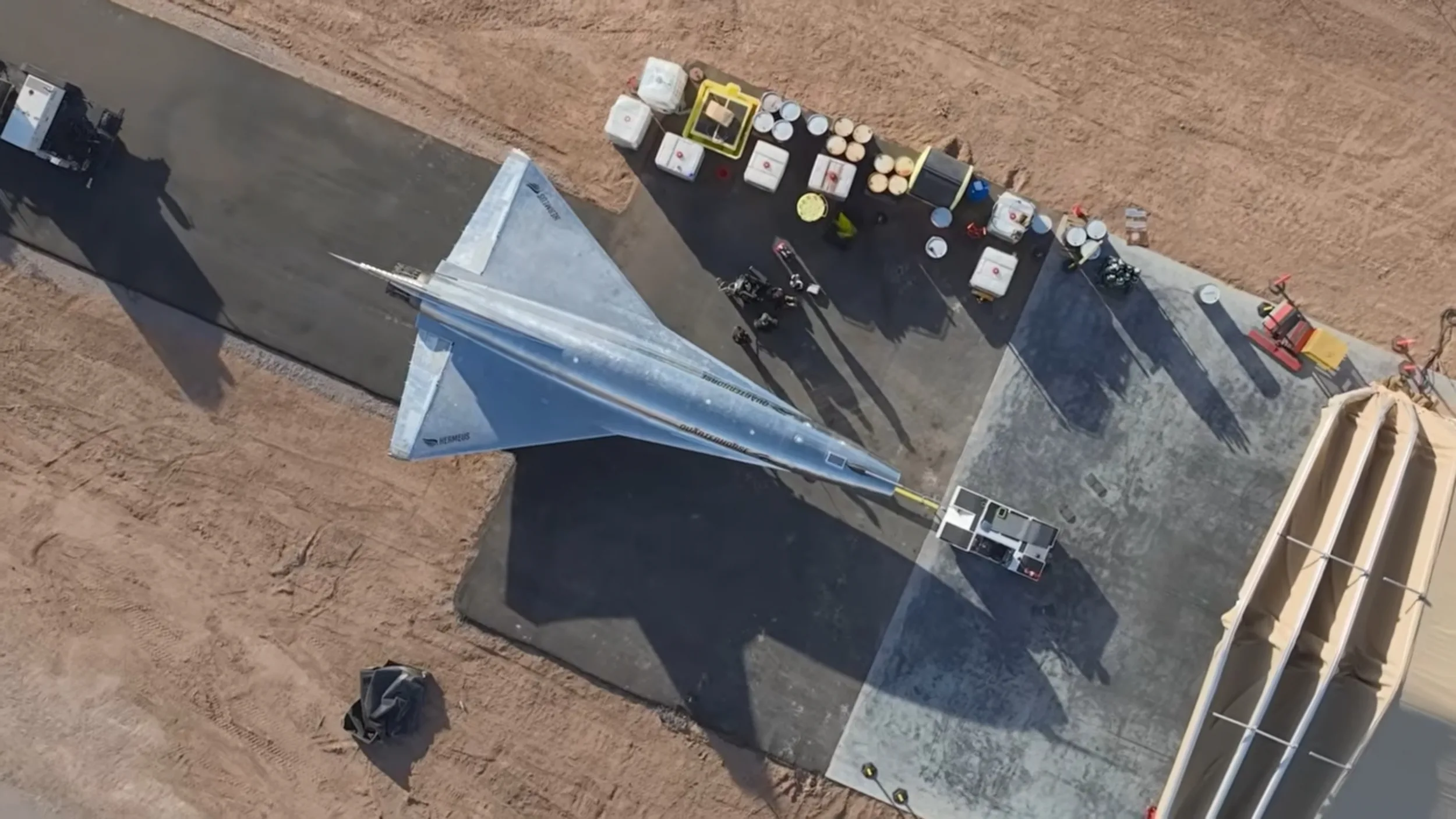
Hermeus’s Quarterhorse Mk 2.1 reached Mach 1.21 on its third test flight. That is not hypersonic speed yet, but it matters because the US company took a remotely piloted jet aircraft past the sound barrier less than three months after its first flight, while already building the next, faster prototypes.

Hermeus is not selling the airliner of the future yet. It is proving development speed

According to Hermeus, the Quarterhorse Mk 2.1 took off from Spaceport America in New Mexico and exceeded the speed of sound in the airspace above White Sands Missile Range. The company gives the top speed as Mach 1.21. In standard sea level atmosphere, that would equal roughly 1490 km/h, although the real figure depends on altitude and air temperature. Hermeus published the Mach number, but not the altitude, flight duration or time spent above the sound barrier.

Quarterhorse Mk 2.1 is not a hypersonic aircraft yet, since hypersonic speed generally starts at Mach 5. Hermeus is using it as an intermediate step, collecting data on transonic and supersonic flight, handling, inlet behaviour and remote operation procedures.

The technology is simpler than the hypersonic dream suggests

Quarterhorse Mk 2.1 is a remotely piloted aircraft roughly the size of an F 16, with a delta wing, variable geometry air intake and a Pratt & Whitney F100 engine. Hermeus is not yet using the Chimera turbine ramjet hybrid engine needed for its final goal. First, it is proving the airframe, intake, control systems and flight test infrastructure.

That makes the flight more sober technically, but more interesting industrially. Many hypersonic programmes spend years in wind tunnels and simulation models. Hermeus pushes prototypes into real flight, brings the data back and builds the next aircraft. Mk 2.1 will be followed by Mk 2.2 and Mk 2.3, whose job is to move the speed limit higher and reduce risk ahead of the next generation systems.

Boom XB 1 and NASA X 59 show how narrow this niche really is

Boom Supersonic’s XB 1 broke the sound barrier in January 2025, reaching Mach 1.18 at 36,514 feet, or about 11,130 metres. The distinction matters. XB 1 was a piloted civil demonstrator. Quarterhorse Mk 2.1 is an unmanned test aircraft with a military direction.

NASA’s X 59 is moving in another direction. NASA is not chasing outright speed with that aircraft, but quieter supersonic flight. The X 59 was expected to go supersonic for the first time in early summer, before later targeting Mach 1.4 at about 16,800 metres to test a flight profile with a softer sonic boom.

NASA’s unmanned X 43A already reached Mach 9.6 in 2004, but that was a rocket boosted, short duration scramjet experiment, not a reusable, remotely piloted jet aircraft taking off from a runway. Hermeus therefore has not built the fastest unmanned aircraft of all time, but it does have one of the fastest privately developed platforms now active in flight testing.

The money shows the Pentagon is taking it seriously

Two days after the supersonic flight, Hermeus confirmed that the Defense Innovation Unit had expanded the contract by 159 million dollars. The total ceiling rose to 219 million dollars (about 188 million euros). The programme is not only about building a fast aircraft. Its goals include high Mach flight, payload release at speed and data for the US Air Force and Navy.

That makes Quarterhorse more of a military technology accelerator than a spiritual successor to Concorde. If Hermeus can take a reusable unmanned platform into flight testing quickly and at lower cost, it shortens the development cycle for weapons systems, sensors and future hypersonic aircraft.

From Europe, the civil bottleneck remains the sonic boom

In European passenger aviation, crossing Mach 1 is not enough. EASA stresses that, before supersonic flight over land can be allowed, industry must prove sonic boom levels acceptable to the public. ICAO, meanwhile, is working on certification procedures for en route noise from supersonic aircraft.

That means Hermeus technology will reach Europe’s civil market only when speed, noise, emissions and certification can fit inside the same business model. In defence, the path is shorter. Europe already needs fast sensor, target and test platforms, but Hermeus’s advantage will for now remain tied to the US defence and flight test ecosystem.

Technical snapshot

Aircraft: Hermeus Quarterhorse Mk 2.1, a remotely piloted unmanned supersonic prototype.

Test flight: third flight from Spaceport America, with supersonic speed reached in White Sands Missile Range airspace.

Top speed: Mach 1.21, roughly 1490 km/h in standard sea level conditions as a guide.

Powerplant: Pratt & Whitney F100, with Hermeus still aiming for its Chimera turbine ramjet hybrid engine in the future.

Programme scale: DIU contract ceiling of 219 million dollars (about 188 million euros).

Quarterhorse has not made hypersonic travel real. What it has done is more practical, and perhaps more useful: it proved that Hermeus can get hardware into the air, learn quickly and come back for the next, faster attempt.