
Kia launches three electric GT models in Europe at once
 1/2
1/2

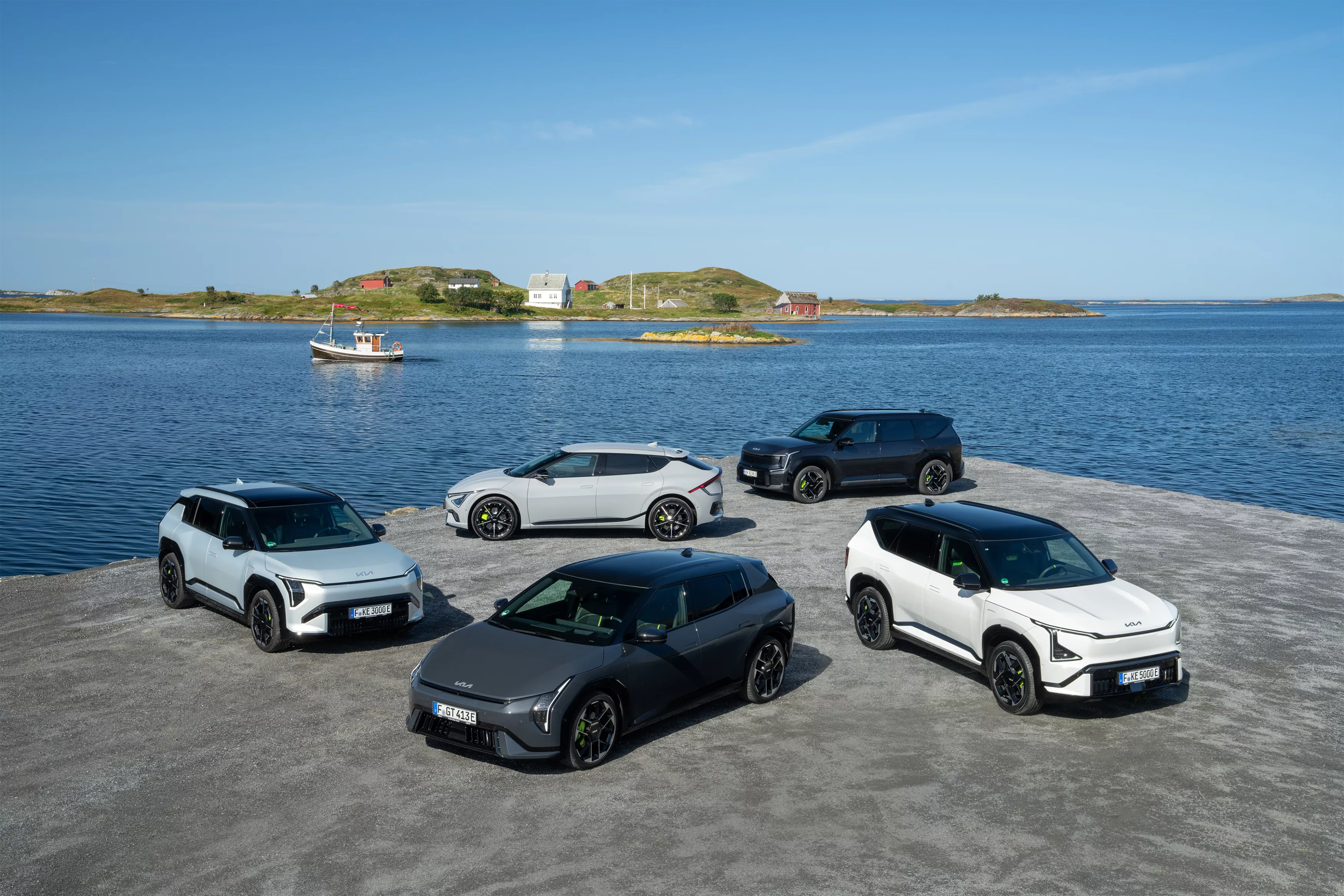
Kia is turning the GT badge from a rare flagship in its electric-car line-up into a full model family. The EV3 GT, EV4 GT and EV5 GT bring dual-motor all-wheel drive, up to 225 kW and electronically controlled sport suspension to a price bracket where range has traditionally been discussed more often than speed.
According to market information released by Kia, the three new GT models will go on sale following their January debut at the Brussels Motor Show. They expand Kia's electric GT family to five models, joining the considerably more extreme EV6 GT and EV9 GT.
EV3 GT and EV4 GT receive the same 215 kW powertrain
The EV3 GT and EV4 GT use essentially the same powertrain. Each axle is driven by an electric motor, with peak system output of 215 kW and torque of 468 Nm.
The compact EV3 GT accelerates from 0-100 km/h in 5.7 seconds. The EV4 GT trims another tenth from that figure, completing the same sprint in 5.6 seconds. It is not head-spinning, but Kia wants to make the GT accessible below the 478 kW EV6 GT power class.
For the EV3, the change represents a substantial leap. The regular long-range version with an 81.4 kWh battery offers 150 kW and front-wheel drive; the GT adds a rear electric motor and raises total output to 215 kW. In Germany, the EV3 GT costs €53,990. Its WLTP range is around 501 km, while the most efficient large-battery EV3 can cover up to 605 km. The price of speed is therefore paid not only in euros, but also in roughly 100 km of range.
The EV4 GT also uses an 81.4 kWh battery. The hatchback has a WLTP range of up to 505 km, while the more aerodynamic Fastback reaches 537 km. That makes the EV4 GT the most convincing long-distance model of the trio.
In a European context, 215 kW is already serious hot-hatch territory. However, Kia is not trying to squeeze the EV6 GT into a smaller body. Instead, the brand is targeting the territory occupied by faster Volkswagen ID family models and other sport-tuned 400-volt electric cars, where chassis quality becomes decisive alongside straight-line performance.
EV5 GT is the most powerful, but not the quickest
The larger EV5 GT raises system output to 225 kW and torque to 480 Nm. The 0-100 km/h sprint takes 6.2 seconds, while top speed is 180 km/h.
The figures reveal the longstanding problem faced by electric SUVs: mass cannot be cheated. The EV5 GT is more powerful than its EV3 and EV4 relatives, but its larger body and greater weight erase that advantage in acceleration.
The 81.4 kWh battery gives the EV5 GT a WLTP range of up to 476 km. Kia's official combined energy consumption is 18.6 kWh/100 km. Charging the battery from 10% to 80% takes approximately 30 minutes using a suitable DC charger. In Germany, prices start at €59,990.
A comparison with the regular EV5 shows the real price of the GT especially clearly. The 160 kW front-wheel-drive EV5 can travel up to 530 km, while the 195 kW all-wheel-drive EV5 reaches up to 491 km. The GT adds power, a sharper chassis and 6.2-second acceleration, but gives up some efficiency.
Kia goes beyond simply adding more power
The more important work has been done to the chassis and software. All three GTs receive stiffer springs, revised anti-roll bar tuning and electronically controlled suspension tailored for the GT.
Preview Electronic Controlled Suspension uses a front camera to assess the road surface and prepares the dampers for imperfections. Kia tested the settings on roads in Germany, Italy, Spain, Sweden and the UK to avoid a situation in which the sport mode works well only on perfect asphalt.
Drivers also get GT mode, Launch Control and electronic torque vectoring control. The stability-control logic also changes. The aim is not simply to run both electric motors at maximum output simultaneously, but to make the car's responses more predictable and let the driver genuinely use the capabilities of all-wheel drive.
Virtual gears now arrive in smaller GTs
One of Kia's most controversial features from the EV6 GT, Virtual Gear Shift, has been carried over. The system simulates gear changes by altering the powertrain response during acceleration and linking it to sound and visual feedback.
Active Sound Design adds an artificial powertrain sound that varies with load and speed. Purists may raise an eyebrow, but Kia faces a real issue: an electric car that accelerates smoothly and almost silently can be objectively fast yet subjectively dull. The purpose of virtual gears is to give the driver back something to do. The systems can be switched off if desired.
The GT models also receive a Performance Timer, dedicated instrument graphics, semi-bucket seats, neon-green details and a Harman Kardon sound system. The EV5 GT uses 20-inch wheels and its equipment includes, among other features, a heat pump, V2L, a head-up display and V2X hardware preparation.
400-volt architecture sets the limits
The three new GTs also show Kia's electric-car hierarchy quite clearly. The EV3, EV4 and EV5 use 400-volt technology and remain behind the 800-volt EV6 GT and EV9 GT in terms of performance and charging speed.
The EV3 GT's maximum DC charging power is around 128 kW, and a 10-80% charge takes approximately 31 minutes. The EV5 GT manages the same in around 30 minutes. That is no longer technical state of the art in the 2026 European market, especially when Hyundai Motor Group itself has shown how much faster its E-GMP 800-volt models can charge.
However, Kia's strategy is understandable. The EV3 GT, EV4 GT and EV5 GT do not need to replace the EV6 GT. They need to bring the GT badge to more customers and give enthusiasts a reason to choose a practical electric car for more than just what it shows on an Excel spreadsheet.
This matters in the European market. Chinese manufacturers can offer ever more power for ever less money, and a simple kilowatt figure is no longer a particularly strong selling point. Kia's answer is to sell a complete driving experience: all-wheel drive, controlled dampers, torque vectoring, Launch Control and software-created emotion. If the chassis tuning lives up to its promises, that may prove to be the most valuable attribute of the new GTs.


