
Kia PV5 Cargo: is this really the van of the future?
 1/94


A good van earns its keep by doing a job, not by looking like a fridge that escaped from the desk of a designer predicting the future. The Kia PV5 Cargo manages both: its looks are striking, but its most valuable features lie inside its boxy body and in its exceptionally low loading sill. But does using an electric van really make the working day easier and reduce a business’s costs?
By that measure, the Kia PV5 Cargo is one of the most interesting new vehicles of 2026. It is the company’s first production model designed from the outset as an electric commercial vehicle. Not an old van with its diesel engine forcibly pulled out and a battery squeezed beneath the floor, but a vehicle whose dimensions, door openings and load floor were shaped around an electric architecture from the start.
The version under review is the two-seat PV5 Cargo L2H1, a long-body, low-roof panel van. The main focus is the front-wheel-drive version with a 71.2 kWh battery and a 120 kW, or 163 PS, motor, offered in EX trim. The 51.5 kWh battery also comes into the comparison, because the difference between the two versions is not just the time spent plugged in. The larger battery changes performance, price and how much cargo the van can actually carry.
Not another converted passenger car
The PV5 is part of Kia’s PBV programme. The abbreviation stands for Platform Beyond Vehicle, and the idea behind it is to build a family of vehicles adaptable to different jobs. The passenger version, enclosed Cargo, shorter and taller bodies and future specialist variants share a common technical foundation. In principle, a business can choose a vehicle to suit the job, rather than reorganising its work around the vehicle’s shortcomings after buying it.
The technical foundation is E-GMP.S, a platform designed specifically for electric commercial vehicles. The two-seat Cargo’s battery pack sits beneath the floor, an electric motor drives the front wheels, and the rear is devoted to a load space that is as large and uniform as possible. There is no combustion engine, its gearbox or exhaust system at the front. The arrangement of the electronics, battery and drive motor gives the body designers more freedom.
Exterior
A body that makes no secret of its job
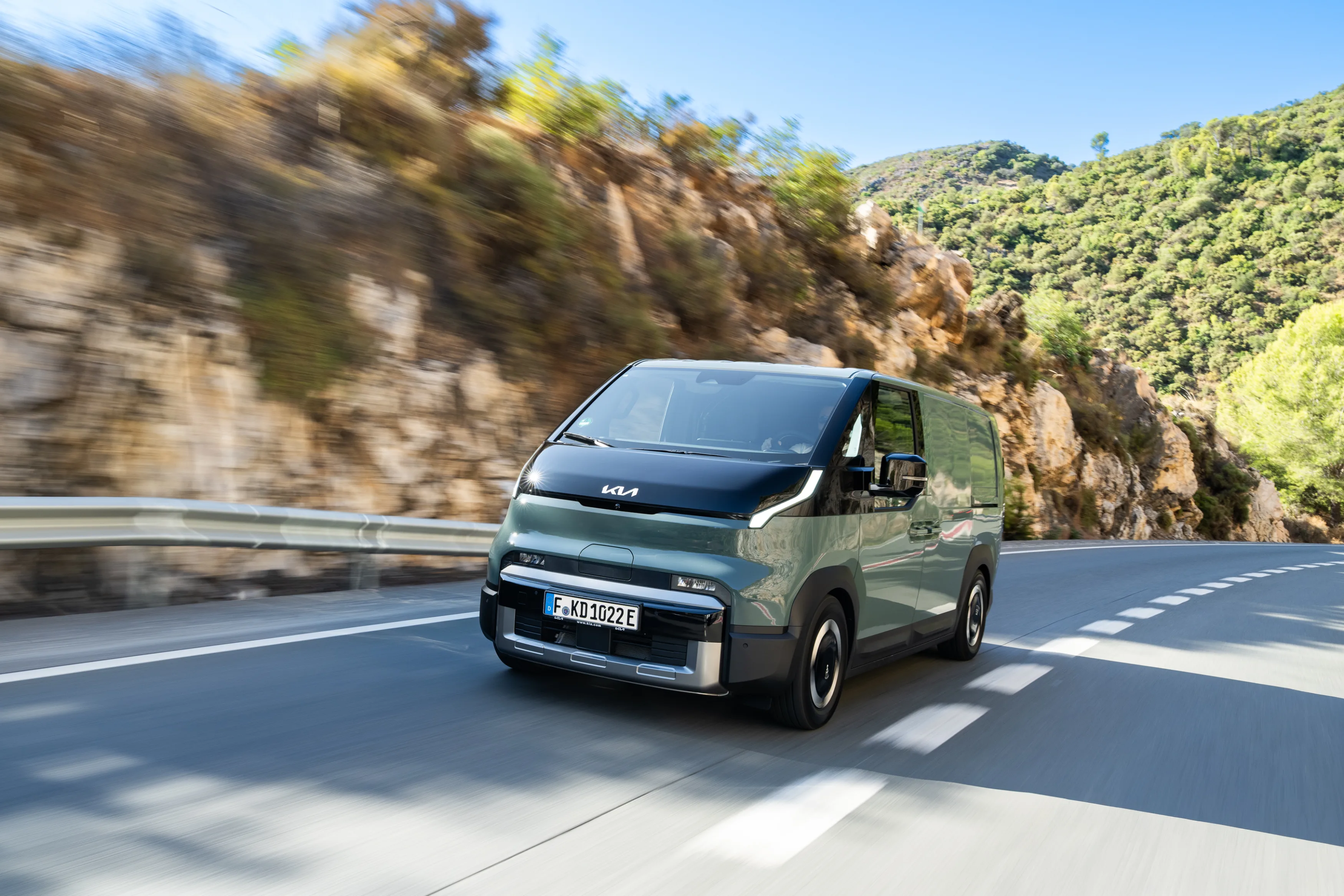
The PV5 looks like a concept car that nobody remembered to tell the motor show was over. The nose is short, the windscreen large and the sides straight, while the lower body is covered in plastic trim that emphasises durability. The lighting signature has the sharp look of a modern Kia, but the rest of the body does not try to sacrifice cargo space for a wedge-shaped design.
The L2H1 is 4695 mm long, 1895 mm wide and, according to the manufacturer’s European specification, 1923 mm tall. Its wheelbase stretches to 2995 mm. That puts almost three metres of the vehicle’s length between the axles. These proportions help maximise cargo space while keeping overall length manageable for working between buildings in town.
The turning circle is 11 metres. That is a strong result for a van of this size. In theory, it means not having to hold an entire street hostage every time you manoeuvre. In practice, the mirrors, body corners and rear overhang matter too.
Load space
419 millimetres that say more than a whole lecture
The PV5’s most telling number is not 163 PS or 416 km. It is 419 mm, the height of the rear loading sill. At the side opening, the equivalent height is 399 mm. These numbers stick in the mind because they directly describe someone’s work.
Imagine a courier lifting boxes into and out of the van all day. One heavier lift is nothing remarkable. Dozens of similar lifts start to cost time and energy by the end of the day. If the load floor is lower, the cargo does not have to be lifted as far. That does not turn an unwieldy box into a feather, but it can make the working day easier. Assumed time savings and reduced physical effort should not be confused with an ergonomics test measured by the manufacturer; this is a practical advantage arising from the design.
The load floor is 2255 mm long and the cargo area 1520 mm high. Maximum internal width is 1565 mm, with 1330 mm between the wheel arches. The latter is especially important for those using standard-sized pallets or wanting to make full use of the width when fitting furniture and shelving.
Kia says there is room for two Euro pallets. A standard Euro pallet measures 1200 × 800 mm, and the PV5’s floor dimensions are suitable for the task. But the key word here is fit, not carry regardless of weight. Two extremely heavy pallets may fit inside but exceed the van’s permitted payload. Cargo volume and permitted load weight are two different things, rarely shown on the same page in promotional images.
The manufacturer lists a rear opening width of up to 1343 mm, while the side door opening is 775 mm wide. Access to the load space from both sides can be worth more in town than the size of an extra cabin screen. When parking on a busy street, it matters a great deal which side the goods can be unloaded from.
The straight walls of the load space lend themselves to fitting shelves, tool mounts and partitions. Kia offers additional securing rails and AddGear accessories, among other items. However, these options do not mean that every shelf or mounting shown is standard equipment. The cost of the necessary conversion must be added to the vehicle’s purchase price, because an empty cargo area is not yet a ready-to-use workplace for many businesses.
Payload: the least romantic but most important chapter
In an electric van, a large battery is often a marketing win and a logistical compromise. The PV5 demonstrates this with straightforward figures.
With the smaller 51.5 kWh battery and one side door, payload reaches 790 kg. For the version with two side doors, it is 745 kg. With the larger 71.2 kWh battery, Kia quotes 690 kg for the single-side-door van and 645 kg for the version with two side doors.
Buyers therefore have to choose between greater range and a higher permitted load. According to the manufacturer’s table, the longest-range PV5 with two side doors carries 145 kg less than the small-battery version with one side door. That is no small matter. Those 145 kilograms could represent several tool cases, a shelving system or part of a customer’s goods.
For the 71.2 kWh four-door version, it makes sense to use 645 kg as the starting point and check the specific vehicle’s registration data for its final permitted load. Payload calculations must not stop at a rounded figure in a price list, especially when heavy shelving, tools, partitions or a towbar are added.
Kia permits a roof load of up to 100 kg and a braked trailer weight of up to 750 kg for the larger-battery version. That allows it to tow a small trailer, but the PV5 is not a workhorse intended to haul building materials on a large trailer. And a trailer, especially one with a tall, wide front, can significantly increase an electric vehicle’s energy consumption.
Motors, charging and driving dynamics
An electric motor with nothing to prove at the traffic lights
The large-battery PV5 uses a 120 kW, or 163 PS, electric drive motor delivering 250 Nm to the front wheels. The small-battery version produces 89.4 kW, or 122 PS, with the same torque. Both use a single-speed reduction gear, and all-wheel drive is not offered.
According to the factory figures, the large-battery van accelerates from 0–100 km/h in 12.4 seconds; the small-battery version takes 16.2 seconds. Both have a top speed of 135 km/h. None of these figures makes the PV5 a drag-strip star, nor would that be a particularly desirable aim. A small commercial vehicle must above all be able to join traffic safely and predictably, move with a load and maintain a reasonable speed.
The electric motor’s advantage shows at low speeds. There is no gearbox hunting for the right ratio, no engine needing to build revs and no sense of turbo lag when the load changes. In general, the PV5 feels more responsive in town than its official acceleration times might suggest. That is consistent with how an electric drive motor works, but it does not mean 163 PS provides limitless reserves of power on the open road with a load aboard.
Battery and range: 416 kilometres is not a promise for the working day
The manufacturer’s specification lists the large battery pack at 71.2 kWh, with a nominal voltage of 402 V. The smaller pack is 51.5 kWh, with a nominal voltage of 290 V. The published capacity figures should be treated as the manufacturer’s stated battery capacities, not as usable or net capacities without further clarification.
The large-battery L2H1 van has an official combined WLTP range of 416 km and energy consumption of 19.1 kWh/100 km. The corresponding figures for the small-battery van are 297 km and 19.0 kWh/100 km. These are laboratory values for comparable homologated versions, not a promise to travel exactly that far on a winter morning with a full load and the cabin heating on.
In reality, three things largely determine the working day: speed, load and temperature. A fourth is the driver’s habits. In town, frequent slowing helps recover braking energy into the battery. On the open road, the boxy body’s aerodynamic drag becomes more important, particularly as speed rises. An electric van’s slab sides are good for cargo space, rather less welcome for aerodynamics.
Take a simple theoretical calculation. If the large-battery van consumed 22 kWh/100 km during a working day, covering 200 km would use approximately 44 kWh. At 28 kWh/100 km, the same distance would require 56 kWh. Even a moderate difference in consumption therefore makes a noticeable difference to operational flexibility.
Charging: downtime costs more than an impressive headline figure is worth
According to the manufacturer, charging the battery from 10 to 80 per cent takes about 30 minutes on a suitable DC charger. For the working day, what matters is how long the van actually remains plugged in.
Charging time depends on battery temperature, the charging station and whether the battery has reached a suitable temperature range before charging begins. Energy flows faster when the system allows it; a cold battery, a very high state of charge or an overloaded charging station can produce a different result in practice. Kia offers battery temperature management and preheating solutions for the PV5.
For AC charging, the usual onboard charger is rated at 11 kW, with a 22 kW option potentially available depending on configuration. According to the manufacturer, charging the large battery at 11 kW takes approximately 6 hours and 30 minutes, and the smaller battery about 4 hours and 45 minutes. These charging times are also conditional.
For business use, charging at home or work changes the entire calculation. A van that sits on company premises every evening and starts the morning with a suitable charge rarely needs public rapid charging. But if the driver has to make a separate trip to find a charging station every day, a low cost per kilometre quickly becomes a cost in working time. Electricity may be cheap, but people’s time is not free.
When appropriately equipped, the PV5 supports V2L, allowing the battery pack to supply electricity to external devices. In a working van, that has far more substance than running a waffle maker at a picnic. The battery can power a tool, computer or another device with suitable power requirements.
What is it actually like to drive?
The first impression is of car-like ease. Sitting high up, the driver has a good view ahead through the large windscreen, the electric motor moves the van off smoothly, and the steering takes little getting used to. The van’s size is felt more through its sides and rear overhang than through any sense of clumsiness behind the wheel.
The PV5’s good manoeuvrability and pleasing response stand out. Its steering precision and natural feel in urban driving deserve praise.
Suspension matters more than acceleration. Kia uses independent double-wishbone suspension at the front and a torsion beam at the rear. The latter fits the logic of a van: a simple, space-saving solution suited to carrying loads. The front suspension design is noteworthy in a working vehicle of this class and helps control wheel movement, but the number of wishbones alone is not enough to declare a vehicle comfortable or sporty.
Test drives suggest the unladen PV5’s suspension can be on the firm side. Short, sharp bumps and undulations make themselves felt in the cabin more than its car-like overall impression might suggest. That is not surprising: a van’s suspension has to cope with a large difference between empty and laden weight. If it were set up so softly that an empty load bay felt like a floating sofa on every road, a full load could make body movement dangerously excessive.
With a load aboard, the van feels more settled as the suspension operates under different conditions, but even with a moderate load the PV5 retains its pleasant underlying character.
It remains composed in corners, the steering responds with sufficient precision, and the driver can easily choose the desired line. But a body more than 1.9 metres tall, a cargo area and commercial-vehicle tyres give no reason to talk about a sports car. Very fast cornering is not the PV5’s territory. Good handling here means predictable behaviour rather than the ability to shock coupés on the open road.
Noise is a particular issue in an electric van. There is no petrol engine, so the cabin is quieter at low speeds. On the open road, however, wind, tyres and running gear make themselves heard. The large body and broad front give the air plenty to contend with, and tyre and wind noise becomes audible at higher speeds.
Regenerative braking is another consideration. Paddles behind the steering wheel adjust the strength of energy recovery, while i-Pedal allows stronger deceleration and, in suitable conditions, reduces the need to use the brake pedal. In town, where the van repeatedly moves from one set of lights to the next junction, this helps make driving smoother. For a van driver making dozens of stops, the convenience of one-pedal driving is a thoroughly practical advantage.
Interior
A cab that does not make the driver feel punished
The PV5’s two-seat cab differs from a traditional budget work vehicle primarily in being designed around the way a modern electric vehicle is used. Ahead of the driver is a 7.5-inch digital instrument display, with a 12.9-inch infotainment screen in the centre. The gear selector is mounted by the steering column, leaving more room in place of a centre console for small items and the things drivers carry every day.
Kia has provided several storage spaces in the cab. There is a tray for small items on top of the dashboard, a pull-out surface lower down and handy places for documents, a phone and work equipment. USB-C ports and, depending on specification, wireless phone charging serve the same purpose: keeping the working day’s essentials within reach.
The seats attract both praise and criticism. They support the body well, and the cab does not feel as spartan as budget vans often do. However, the cushions are rather firm, and the gap between the door and seat makes it uncomfortable for the driver to rest their left arm. These are entirely subjective points, but important observations for everyday work.
Visibility: a large windscreen ahead, a closed box behind
One of the PV5’s most successful features is its large windscreen and low-looking dashboard. The driver has an expansive view ahead, and the short nose helps judge the vehicle’s position. In a city with cyclists, pedestrians and scooters, that is a fundamental asset.
The rearward view, by contrast, depends on mirrors and cameras. A panel van has no rear side windows through which to make the over-the-shoulder check familiar from a passenger car. Side blind spots and straight walls designed for loading goods take some getting used to. The benefit of a large glass area at one end does not cancel out the missing windows at the other.
A digital work tool, but software must not get in the way
The PV5 uses an Android Automotive-based software platform. This means the infotainment system has its own app environment and the ability to support various connected services. Apple CarPlay and Android Auto add phone-based functionality. The exact range of functions and services depends on specification and market.
For the driver, menu logic matters too. Finding a charging station, preparing the battery and adjusting driver assistance settings should be understandable without a learning curve that extends the working day. In a work vehicle especially, the best technology is technology that does not draw attention to itself.
Safety systems
Safety: five stars, but in the right category
The PV5 Cargo received five stars in Euro NCAP’s assessment of active safety assistance systems for commercial vans in 2025. The vehicle tested was a left-hand-drive L2H1 Cargo. This is a strong result and shows that Kia has not regarded cutting back on a commercial vehicle’s driver assistance systems as inevitable.
An important clarification must accompany that result, however. This is not a five-star Euro NCAP passenger-car crash-test rating. The Commercial Van Safety assessment primarily evaluates how well the vehicle helps prevent accidents.
The PV5’s active safety systems include automatic emergency braking, pedestrian and cyclist detection, lane-keeping assistance and speed-limit alerts. Depending on specification, adaptive cruise control, blind-spot monitoring and parking assistance are added. Euro NCAP particularly highlighted the emergency braking system’s good performance with both other vehicles and vulnerable road users.
Some warnings, however, seem absurdly over-eager. Wearing drivers down with incessant beeping is not a good safety strategy. A vehicle should tell the driver important things at the right moment, not turn everyday driving into a continuous test of attention.
Even the best emergency braking cannot replace a properly secured load. If cupboards and tools in the load bay lack suitable restraints, the risk in a collision is much greater than a driver-assistance brochure would like to admit. When buying a PV5, it is therefore important to assess the cargo restraints and the conversion company’s workmanship alongside the safety equipment.
Summary
A cheaper battery or a longer range?
The most important question when choosing a PV5 is not even whether to have one side door or two. The battery decision comes first.
The main arguments for the 51.5 kWh version are a lower price, higher payload and lower vehicle weight. It suits a business with predictable routes, moderate daily mileage and regular charging at a fixed location. Its 297 km WLTP range should not be treated as a guaranteed working day’s distance, but many urban rounds are considerably shorter.
The 71.2 kWh version costs more, weighs more and carries less. In return, it offers a 416 km WLTP range and a 120 kW drive motor. For longer intercity journeys, changing routes and less certain charging opportunities, it may be the more sensible choice. A bigger battery also often means not just a longer journey, but greater flexibility in planning the day’s driving.
The choice of doors involves a similar compromise. Two sliding side doors make access easier. If the work takes place on busy streets and parking locations constantly change, that can be a major advantage. The single-side-door version is cheaper and carries more. Here too, it is the business’s daily work, not a vehicle ranking, that determines the better choice.
Rivals: whose money is Kia chasing?
The PV5 enters a crowded market. The Renault Kangoo E-Tech Electric and its close relatives represent the familiar small-van format. The Peugeot E-Partner, Citroën ë-Berlingo Van and Opel Combo Electric use related technical architectures and offer work-vehicle buyers familiar model names, a broad choice of body configurations and established servicing experience.
The Ford E-Transit Courier takes a more compact approach to the same task. If a business needs a smaller vehicle for very narrow streets and does not make use of 4.4 m³ of cargo space, a smaller vehicle may be more efficient. More cargo space is not automatically useful if it travels almost empty every day.
The Volkswagen ID. Buzz Cargo is the most emotionally appealing rival. Its design brings people into showrooms even when they have no Euro pallets to carry. The Kia’s exterior is at least as distinctive, but its strongest argument is not nostalgia. The PV5 offers a low load floor, practical access and a work-focused use of space. A sensible buyer will check prices, payload and the right battery for their route before deciding, rather than simply asking which vehicle makes the better social-media photograph.
Does the PV5 suit an average working day?
Life with an electric van becomes easier when distances between towns are often moderate. A cold winter and slippery roads, however, can mean that using charging infrastructure requires planning. Many businesses also have varied workloads: ten stops in town in the morning, followed by a job in another county in the afternoon.
The PV5 is most naturally suited to work within a defined area, returning to a charging location in the evening. Daytime urban logistics, courier services, maintenance work and small-business deliveries fit its concept well. There are better tools for fast, long-distance transport with heavy loads and no reliable charging opportunity.
Interesting facts that are more than advertising lines
The PV5 is the first production model in Kia’s PBV family. That means it is not an isolated side project, but the manufacturer’s attempt to create an entire system of vehicles and services for business use. Its success will ultimately depend more on earning commercial-vehicle buyers’ trust repeatedly than on a single model with a novel design.
The PV5 Cargo set a Guinness World Record in 2025: according to Kia, a fully laden Long Range van travelled 693.38 km on a single charge. The record attempt took place under controlled conditions and is neither a WLTP result nor a promise of open-road driving at normal speeds. Such figures are particularly easy to misuse: a record demonstrates what is possible, not a guarantee for every working day.
Pros and cons
Pros
419 mm rear loading sill. Less lifting and easier repeated loading.
4.4 m³ of regularly shaped cargo space. Straight walls and sufficient width to accommodate two Euro pallets.
Good urban manoeuvrability. An 11-metre turning circle and a clear view ahead.
Smooth electric drive motor. Response without gear changes suits work involving frequent stops.
Car-like cab. Two separate seats, plenty of storage and a modern infotainment system.
Reasonable rapid-charging time. According to the manufacturer, 10–80% takes about 30 minutes.
Strong active safety result. Five stars in Euro NCAP’s assessment of commercial-van safety assistance systems.
Cons
Limited payload with the large battery. 645 kg for the 71.2 kWh version with two side doors.
Longer range costs both money and kilograms. A larger battery is not better for every business.
Unladen suspension can be on the firm side. Short bumps make themselves felt in the cab.
The enclosed body restricts rearward visibility. Cameras and mirrors are essential.
Tyre and wind noise is audible on the open road. A quiet electric motor does not make the whole vehicle silent.
Front-wheel drive only and low ground clearance. The limitations for demanding winter or off-road work are clear.
The new model’s long-term reliability and residual value are not yet fully proven. Commercial-vehicle buyers must take that risk into account.
Final verdict: a van that gives the number 419 meaning
For many businesses with fixed urban routes, the 51.5 kWh battery is the most sensible choice, because it saves on purchase cost and leaves more payload capacity. The 71.2 kWh EX deserves preference when a longer daily journey and greater power reserves are genuinely needed. The convenience of two side doors must be weighed against the lost payload.
The PV5 does not make the diesel van redundant overnight or solve every business’s charging problems. It is, nevertheless, a very logically designed electric work vehicle. Kia has not simply added a plug to a van; it has considered why people need a van in the first place. In the world of commercial vehicles, that is a greater achievement than another power record.


