
Mazda wants to use the digital instrument display to guide steering wheel adjustment
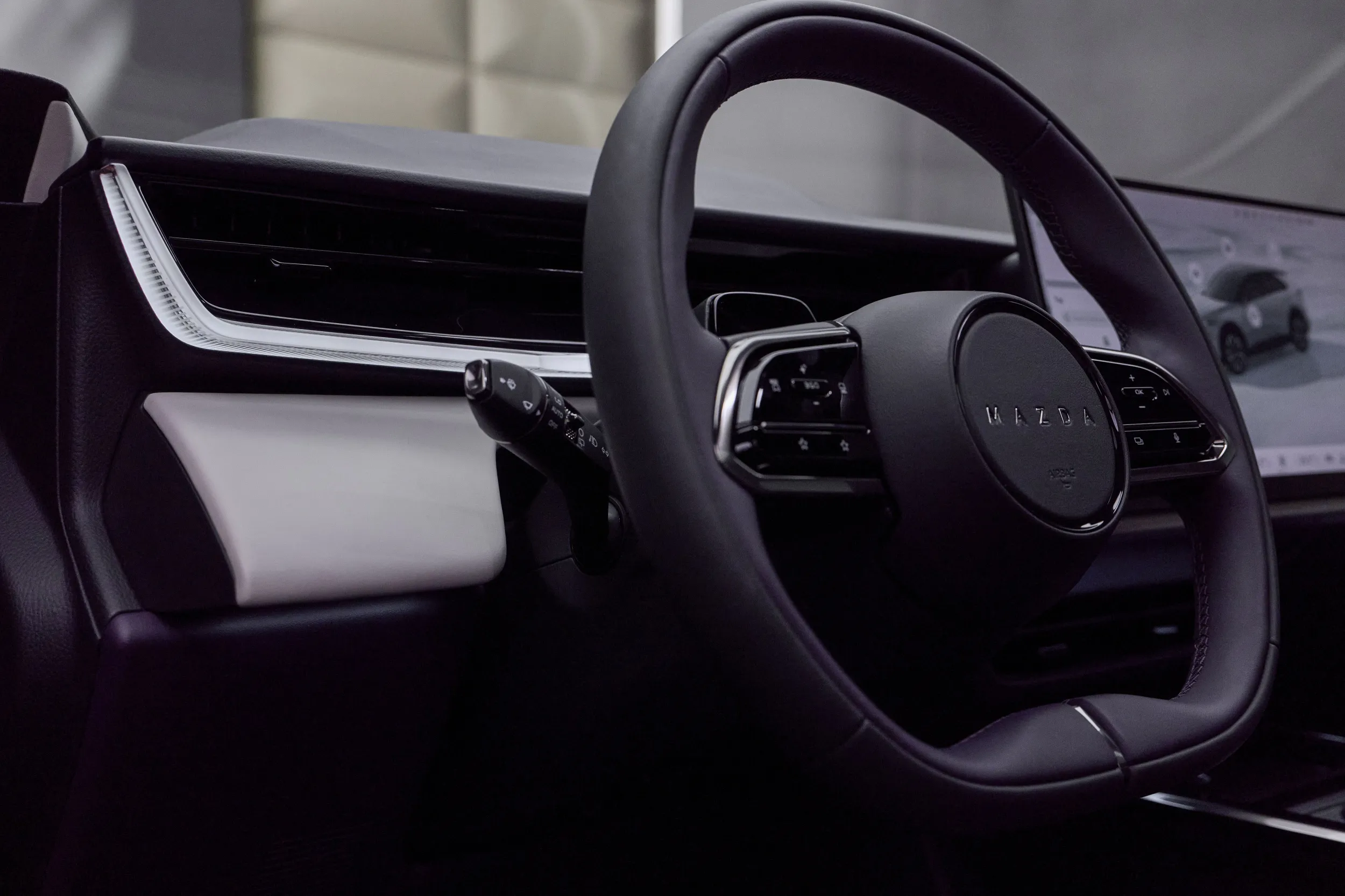
Mazda’s new patent application turns the digital instrument display into a kind of template for setting the steering wheel. The driver must adjust its height and reach so that the wheel rim aligns with lines shown on the display. The simple graphics are intended to improve the driving position without more complex mechanics or a new screen.
The US Patent and Trademark Office published Mazda’s application, US20260274069A1, on 17 September 2026. Mazda filed the US application in February, while the original priority date is 11 March 2025. It is therefore not yet a granted patent, but a technical solution for which protection is being sought.
The steering wheel becomes part of the display
Mazda’s idea uses the digital instrument display positioned behind the steering wheel. The screen shows symmetrical lines which, from the driver’s viewpoint, should run close to the inner edge of the steering wheel rim.
By moving the steering wheel up, down or fore and aft, the driver can align the lines with the contour of the rim. This helps the car identify a steering wheel position suited to the driver’s physique, reducing the risk of the wheel simply being set too high, too low or too far away by feel.
The upper lines converge in perspective, directing the eye from the display back to the road. Mazda also envisages the option of changing the colour of the lines according to the vehicle’s status or a hazard, meaning the same graphics could later serve a warning function as well.
Mazda brings an old idea to the screen at low cost
The solution fits well with Mazda’s existing ergonomic philosophy. The manufacturer already stresses that the correct driving position should keep joints at natural angles and allow faster reactions in an emergency. The CX-60, CX-70, CX-80 and CX-90 may even use an automatic driving-position guide that assesses the driver’s physique and eye position, then automatically adjusts the seat, steering wheel, windscreen display and mirrors.
The new solution would be considerably simpler. The core of the patent application does not require automatic adjustment of the seat and steering column using motors. The central element is the on-screen graphics, meaning the technology could be relatively inexpensive in a vehicle with a suitable display and steering-wheel layout.
The patent application itself does not identify an interior camera as an essential part of the system either. A camera is part of Mazda’s existing automatic driving-position system, but the core description of the new application focuses on the steering wheel, instrument display and its graphics.
Hand position raises one question
Mazda places some of the guide lines on the steering wheel around the 10:10 position and describes this as a recommended grip area.
This detail feels somewhat old-fashioned. Modern driver training no longer treats one fixed clock position as a universal rule. Britain’s DVSA, for example, primarily assesses whether the driver operates the steering wheel safely and with control, rather than whether their hands are positioned precisely at “10 and 2” or “quarter to 3”.
The value of Mazda’s idea therefore lies less in teaching hand position and more in finding the correct relative position of the steering wheel. That is surprisingly easy to set incorrectly in modern cars, especially when the seat, steering column and displays offer dozens of adjustment options.


