
Red Bull turned Vettel’s Formula 1 car into a metro train and sent it through a Madrid tunnel
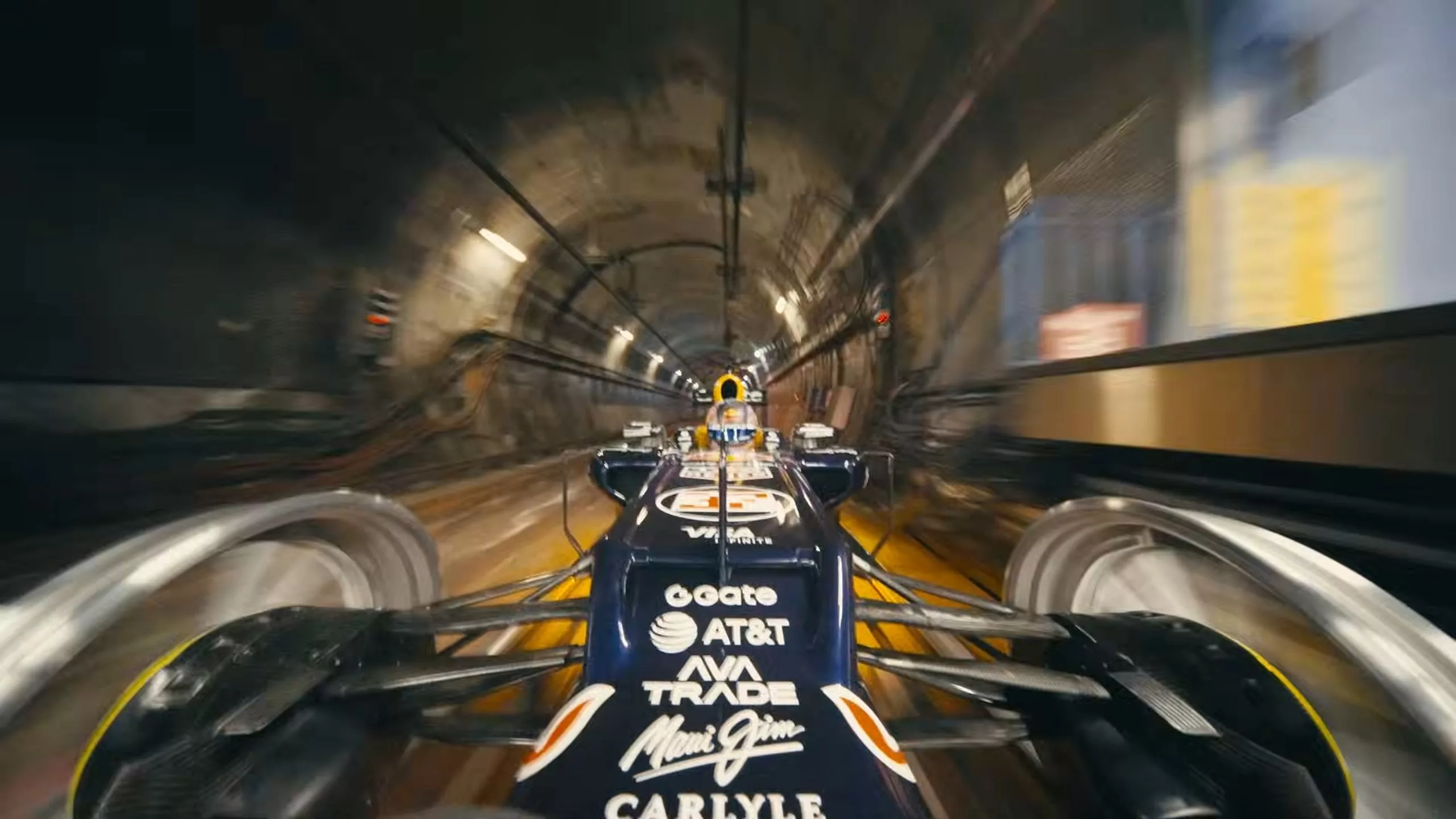
Red Bull found a new competition class for its 2012 Formula 1 car. The RB8 that carried Sebastian Vettel to the world title traded its tyres for nearly 30kg metal wheels and, driven by Patrick Friesacher, travelled through the Madrid Metro. Behind what appeared to be another Red Bull stunt was a surprisingly complex engineering project, as neither the historic F1 car nor the metro tracks could be modified.
Oracle Red Bull Racing staged the run ahead of this weekend’s inaugural Formula 1 event at Madring. Madrid’s new circuit will have exceptionally good metro links, with Estadio Metropolitano station essentially next to the venue.
Red Bull decided to celebrate that fact in typically Red Bull fashion: if spectators take the metro to watch an F1 car, then the F1 car can take the metro first.
Vettel’s RB8 received metal wheels in place of its tyres
The car used for the project was no random demonstration machine. Red Bull selected the 2012 RB8, with which Sebastian Vettel won his third consecutive Formula 1 world championship title and Red Bull won the constructors’ championship.
The RB8 is powered by a naturally aspirated 2.4-litre Renault RS27 V8. The engine produces approximately 550 kW and comes from a Formula 1 era before turbo hybrids were even on the horizon.
In metro specification, the car retained its own power unit. Red Bull’s aim was not simply to put the historic F1 car on rails and tow it past the cameras with a locomotive. The RB8 had to move under its own power.
The problem began with the wheels. The Red Bull Racing Heritage Team and Spanish engineering and creative collective Andtonic had to find a way to fit the F1 car to the metro tracks without modifying either the car itself or the track gauge. Fortunately, the Madrid Metro gauge proved sufficiently compatible with the RB8’s track width. That was the end of the easy part of the project.
One wheel weighs 29.8 kilograms
Placing a conventional Formula 1 tyre on a rail is not a particularly good idea. The engineers had to produce bespoke flanged metal wheels that would keep the RB8 on the rails on the same principle as train wheels.
The first prototypes proved too heavy. This posed a genuine technical risk to the historic car. Formula 1 suspension, driveshafts and gearboxes are not designed to withstand the unsprung mass of railway rolling stock. An excessively heavy metal wheel could have damaged components through vibration and impact loads, and replacing them on a 14-year-old world championship-winning car is not quite as straightforward as ordering a new wheel bearing for a family car.
The solution was a specially machined metal wheel, with its centre section and spokes designed to be as light as possible. Material was removed everywhere it was not needed to retain strength.
The final result still weighs 29.8 kg per wheel. That is approximately twice the weight of a conventional F1 wheel-and-tyre assembly. Across all four wheels, the RB8 therefore had to carry significantly more unsprung mass than it would on a circuit.
For an F1 engineer, that sounds about as appealing as being advised to attach four dumbbells to a car and see what happens.
There were only two weeks available
What makes Red Bull’s project more interesting is that the engineers did not have months to test prototypes.
Once the basic concept had been established, only two weeks remained to design and manufacture the final wheels. The work was carried out at the Madrid Metro Canillejas workshop. It required an entirely different approach from that used for a conventional F1 wheel. A racing wheel must withstand enormous lateral and braking forces, but its contact patch is a rubber tyre. A metro wheel has none of the tyre’s cushioning effect. The metal wheel transmits rail irregularities almost directly to the hub and then into the suspension.
Grip also changes radically. Formula 1 tyres rely on friction determined by temperature and rubber compound, while the coefficient of grip between a metal wheel and a metal rail is a completely different world.
There was therefore little point in using much of the RB8’s approximately 550 kW output. The project’s aim was to get the F1 car moving safely on the rails, not to set a lap record for a metro train.
Former F1 driver Patrick Friesacher took the wheel
Red Bull entrusted the RB8 to Austrian Patrick Friesacher. He raced in Formula 1 for the Minardi team in 2005 and now works as a demonstration driver for Red Bull’s historic cars.
Friesacher drove the RB8 through a closed section of the Madrid Metro network. The F1 car departed from Estadio Metropolitano station and also passed through the areas of the Sacedal and Chamartín depots. The run took place during a temporary suspension of metro services. In footage released by Red Bull, however, the RB8 can also be seen passing through a station while people standing on the platform are treated to a highly unusual morning sight.
The RB8 was one of F1’s most formidable weapons in its day
The RB8 is a very well-chosen car for a marketing stunt. Red Bull’s technical team, led by Adrian Newey, built it for the 2012 season, and it used Renault's 2.4-litre RS27 V8 engine. It was the final era before the 1.6-litre V6 turbo hybrids arrived in 2014.
The 2012 season was exceptionally close. Vettel went into the final round in Brazil defending the world championship against Fernando Alonso and ultimately secured his third consecutive title by just three points. Red Bull also won the constructors’ world championship that year.
The RB8 was not untouchably quick throughout the season, but the combination became highly effective in the second half. Vettel won consecutively in Singapore, Japan, South Korea and India, swinging the championship battle in his favour.
Fourteen years later, the car’s next major assignment was no longer to beat Ferrari, but to avoid leaving the rails.
Madring brings F1 back to Madrid after 45 years
The entire project, of course, serves one purpose: to draw attention to Madrid’s new Formula 1 event. Madrid will host the Spanish Grand Prix at the new Madring circuit from 11 to 13 September 2026. Formula 1 has not staged a world championship round in Madrid since 1981, when it raced at the Jarama circuit. Gilles Villeneuve won for Ferrari then, followed by Jacques Laffite and John Watson.
The 2026 Madring is a completely different project. It is an approximately 5.4km hybrid circuit combining public roads with purpose-built racing sections. The track’s most striking feature is La Monumental, an approximately 270-degree heavily banked corner. It is an entirely new circuit for F1, meaning drivers will have no telemetry or setup data from previous years to use.
This is where the metro becomes a genuinely important part of the project. Madring will be accessible by public transport, and organisers expect approximately 130,000 spectators per day over the race weekend.
Red Bull knows how to use old F1 cars better than most rivals
Unusual demonstration runs are nothing new for Red Bull. Over the years, the team’s historic F1 cars have run on snow, ice, in the desert, in the mountains and on city streets. Red Bull has taken F1 machinery to places its designers probably never imagined while drawing the CAD model.
In Madrid, however, the technical challenge is more interesting than usual. Putting an F1 car designed for asphalt onto rails essentially means rethinking the entire wheel-to-rail interface. At the same time, the engineers could alter neither the metro infrastructure nor the basic structure of the historic RB8.


