
Sergio Pininfarina was born 100 years ago: the man who shaped Ferrari’s look for an era
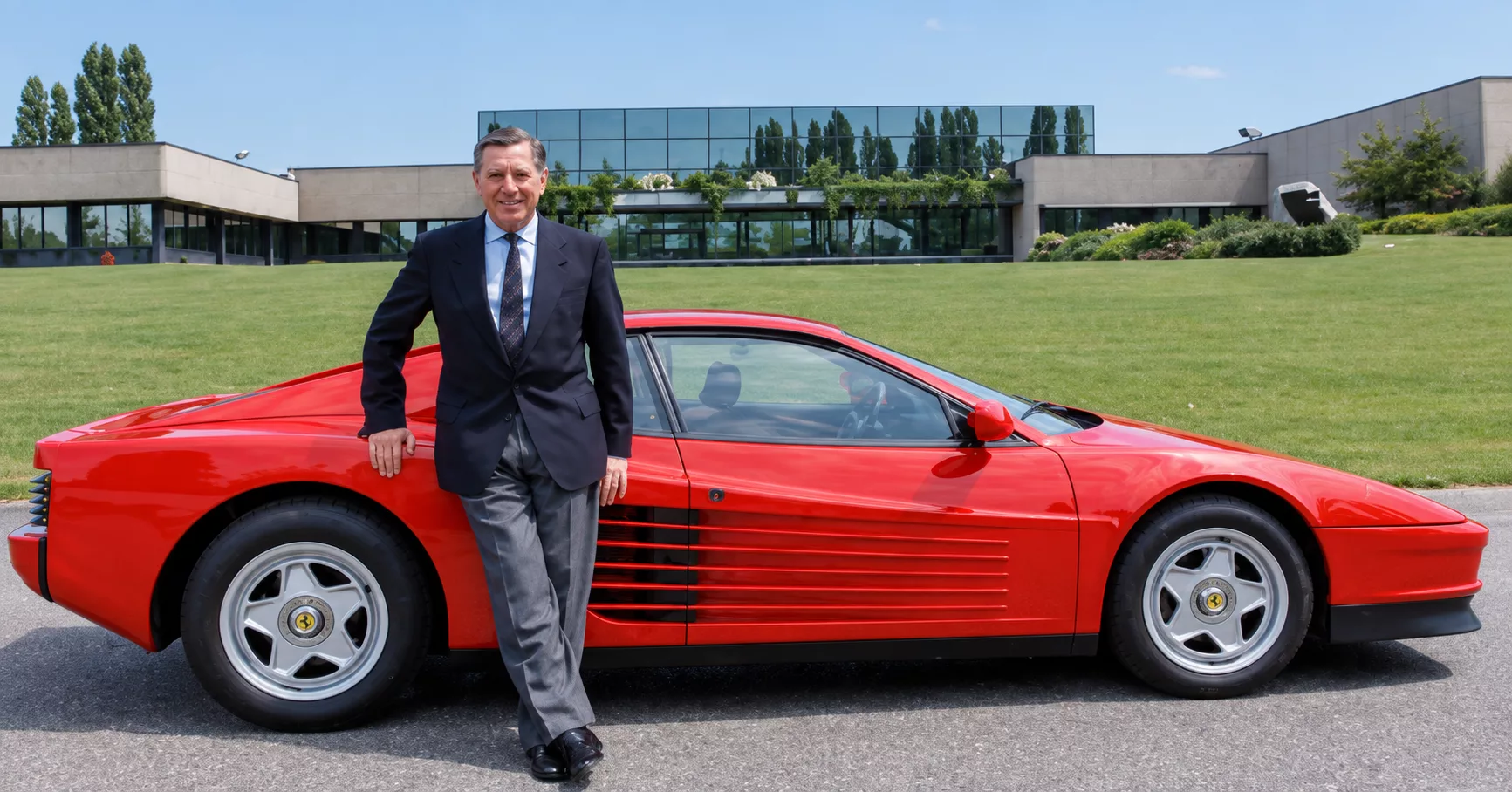
Today marks 100 years since Sergio Pininfarina’s birth. Born in Turin on 8 September 1926, the engineer led his father Battista Farina’s small coachbuilding firm into one of the world’s most influential automotive design companies. Yet measuring his legacy solely in beautiful Ferraris would be too simplistic. Sergio Pininfarina brought together design, aerodynamics and industrial production at a time when the three disciplines were only beginning to speak the same language.
According to Pininfarina’s official history, Sergio graduated in mechanical engineering from the Polytechnic University of Turin in 1950 and joined his father’s company, Carrozzeria Pinin Farina. He became general manager in 1960, managing director a year later and company president following Battista’s death in 1966.
However, his influence extended far beyond running the company. Sergio helped transform Pininfarina from a small Italian coachbuilding studio into an international design, engineering and manufacturing business. More importantly for car enthusiasts, it was during his era that the Pininfarina name became almost inseparable from Ferrari’s.
Ferrari and Pininfarina’s collaboration began with one stubborn meeting
The roots of Ferrari and Pininfarina’s long relationship date back to 1951. Enzo Ferrari and Battista “Pinin” Farina wanted to discuss working together, but neither wished to travel to the other’s premises. As a compromise, a meeting was arranged in Tortona, between Modena and Turin.
The meeting was organised by 25-year-old Sergio. According to Ferrari’s own account of its history, he could not have known then how much of his life would ultimately be defined by the collaboration between the two companies.
Over the following decades, Pininfarina produced a long line of Ferraris that defined the marque’s visual identity. Accuracy is important here: Sergio did not personally draw every car created during his leadership. Pininfarina worked as a team, and different designers were responsible for individual models.
Sergio’s role was greater than that. He led the company, chose its direction and shaped a system in which designers, aerodynamicists and engineers worked together.
The Testarossa showed how a technical problem can become design
The 1984 Ferrari Testarossa is one of the finest examples of this philosophy.
The car’s huge side air intakes and the horizontal strakes covering them were not created simply to give 1980s teenagers something to put on their bedroom walls. The Testarossa’s radiators were positioned at the rear, and the body had to channel sufficient cooling air to them.
Pininfarina turned an engineering requirement into the car’s most recognisable design feature. Ferrari itself describes the Testarossa as a model whose form was created in the service of aerodynamics and whose development involved extensive wind-tunnel time.
The result still works 42 years later. The Testarossa does not look like a modern Ferrari, and that is precisely where its value lies. Its wedge-shaped nose, exceptionally wide rear end and side strakes define both the car and its era at a glance.
Ferrari notes that the Testarossa was one of Pininfarina’s best-known works. The car also held personal significance for Pininfarina itself: the Testarossa was among Sergio’s personal cars.
Pininfarina built a wind tunnel before aerodynamics became a buzzword
One of Sergio’s most important decisions, however, did not concern the shape of any particular car.
In 1972, Pininfarina opened a full-scale wind tunnel for cars. According to the company, it was the first of its kind in Italy and one of only a few in the world.
This move says more about Sergio Pininfarina’s mindset than any striking concept car. To him, good car design was not merely sculpture. Form had to solve technical challenges. Today, a drag coefficient is almost as obligatory a figure at an EV presentation as battery capacity. In the early 1970s, a full-scale wind tunnel was far from an obvious investment for a design company.
Its effect is clearly visible in later Pininfarina cars. The Ferrari 365 GTB/4 Daytona, the Berlinetta Boxer family, the Testarossa and later models moved ever further away from an era when sports-car aerodynamics primarily meant a low nose and a designer’s good eye.
The Modulo proved Pininfarina could go completely wild too
The Sergio Pininfarina era was not merely a parade of elegant production cars. The company’s more experimental side produced cars beside which some modern concept cars seem almost timid.
The 1970 Ferrari 512 S Modulo is probably the best known of them. Designed by Paolo Martin, the car was essentially a geometric experiment on wheels: an exceptionally low body, partially covered wheels and a forward-sliding canopy in place of conventional doors.
Here lies an important distinction between Sergio Pininfarina and the term “car designer”. His legacy includes cars he did not draw himself. His achievement was building an organisation in which designers such as Paolo Martin, Leonardo Fioravanti and others could turn radical ideas into real cars. It is therefore more accurate to speak of the Pininfarina era than to pretend that every line of every Daytona, Modulo or Testarossa came from one man’s pencil.
The family name officially became Pininfarina only in 1961
The name itself also deserves an explanation. Sergio was born Sergio Farina. His father Battista Farina’s nickname was “Pinin”. It had become the company name, Pinin Farina, but in 1961 Italian president Giovanni Gronchi changed the family name from Farina to Pininfarina by official decree. From that point, Sergio Farina became Sergio Pininfarina.
The name proved exceptionally valuable beyond the automotive industry as well. Under Sergio’s leadership, the company gradually expanded into industrial design, engineering and other fields. Founded in 1986, Pininfarina Extra formally took the company’s design activities beyond transport.
That same year, the company was listed on the Italian stock exchange. Pininfarina had long ceased to be merely a place where a carmaker sent a chassis and asked for an attractive metal suit to be formed around it.
Sergio Pininfarina was an engineer, entrepreneur and ultimately a senator
Sergio’s influence was also recognised by the Italian state. In 2005, President Carlo Azeglio Ciampi appointed him senator for life. The Italian Senate database confirms the appointment date as 23 September 2005.
Pininfarina itself lists among the most significant achievements of his tenure the creation of the Grugliasco production complex, the research centre opened in 1966, the 1972 wind tunnel, the company’s transformation into a holding company, and the creation of new engineering and production centres.
In 2006, he became honorary chairman of Pininfarina.
Sergio Pininfarina died in Turin in July 2012. Pininfarina’s own historical source gives the date as 2 July, while the Italian Senate register gives 3 July. There is no discrepancy over the date of his 100th birth anniversary: both confirm his birth date as 8 September 1926.
His legacy is best seen in today’s cars
It is easy to romanticise Sergio Pininfarina’s importance as belonging to a time when cars were more beautiful and designers drew with pencils. But that would overlook what matters most.
Pininfarina helped make automotive design part of engineering.
Aerodynamics, a full-scale wind tunnel, computer-aided design, the integration of design and production, and serving international carmakers within a single organisation all seem routine today. They were not during Sergio’s early years in charge.
Nor was Pininfarina’s legacy limited to Ferrari. Over the decades, the company worked with Alfa Romeo, Peugeot', Lancia, Fiat, Maserati, Cadillac, Chevrolet' and many other manufacturers. Today’s Pininfarina operates in architecture, transport and industrial design in addition to the automotive sector.
Ferrari nevertheless remains the relationship for which Sergio Pininfarina is best remembered. Ferrari and Pininfarina’s collaboration began in 1951 and lasted for decades, producing a succession of cars whose shapes became almost inseparable from the identity of the Maranello marque.
A hundred years after Sergio Pininfarina’s birth, the most telling tribute is therefore not that the cars of his era still look good. More telling is that the principle that form must work with aerodynamics and engineering now governs the automotive industry more strongly than ever.


