
The automotive industry’s next revolution will see robots learn from humans
Toyota has estimated that around 400,000 robots will be needed to modernise the group’s production network. At first glance, this sounds like another story about machines replacing people. In reality, something far more technically interesting is happening in the automotive industry. Robots have long ceased to be a novelty in car factories. What is new is the attempt to teach machines to do work that, until now, only humans could do.
The automotive industry has used robots for more than half a century. Welding, painting and moving heavy body panels have become so automated that it would be difficult to imagine a modern car factory without industrial robots. Yet thousands of people still work in final assembly.
The reason is not sentimental. Humans are exceptionally capable general-purpose manipulators. They can feel with their fingers whether a connector has locked into place, find a wiring harness among other components, adjust a movement for a misaligned part and, without reprogramming, understand what to do when a car with different equipment arrives on the production line. A conventional industrial robot, by contrast, is fantastically fast and precise as long as the world around it remains exactly as an engineer programmed it. Carmakers now want to narrow that gap.
400,000 robots do not mean 400,000 lost jobs
Toyota put the issue firmly on the agenda with an estimate that around 400,000 robots may be needed to modernise the production network of the company, other companies in the group and major suppliers. According to Reuters, Toyota could spend around ¥1 trillion, or about €5.4 billion at current exchange rates, on automation annually from 2028.
Four hundred thousand is a huge number, but it needs to be interpreted correctly. It does not mean 400,000 humanoid robots or a plan to replace the same number of workers. The figure includes conventional industrial robots, new automation solutions and the replacement of existing equipment. An estimated 150,000 robots could go to Toyota’s own factories, with the remainder concerning the wider production network. (reuters.com)
What matters instead is the kind of work that the next generation of robots will perform.
Previous automation first took over tasks in which robots outperformed people in speed, strength and repeatability. The next wave targets work in which humans have so far outperformed robots in flexibility.
A car factory is a surprisingly difficult place for a robot
Spot-welding a car body is an almost ideal task for automation. A robot always picks up the same tool, moves to a known point and carries out a precisely defined operation. The same cycle is repeated thousands of times. Final assembly is a different world.
There, a robot must grasp parts of different shapes, handle soft materials, plug in connectors, fit seals, route wires and work alongside people. Making matters even more complicated, vehicles with different powertrains, equipment and interiors may move down the same production line one after another. A person solves many such problems almost subconsciously. A robot must be taught how to recognise an object, grip it correctly, apply the appropriate force and respond to a situation that the programmer did not anticipate in detail.
That is why the next breakthrough is not simply a better robot hand. It requires machine vision, force and tactile sensors, artificial intelligence and learning systems capable of turning a human demonstration into a robot’s action.
Toyota wants to digitise the hands of a master craftsperson
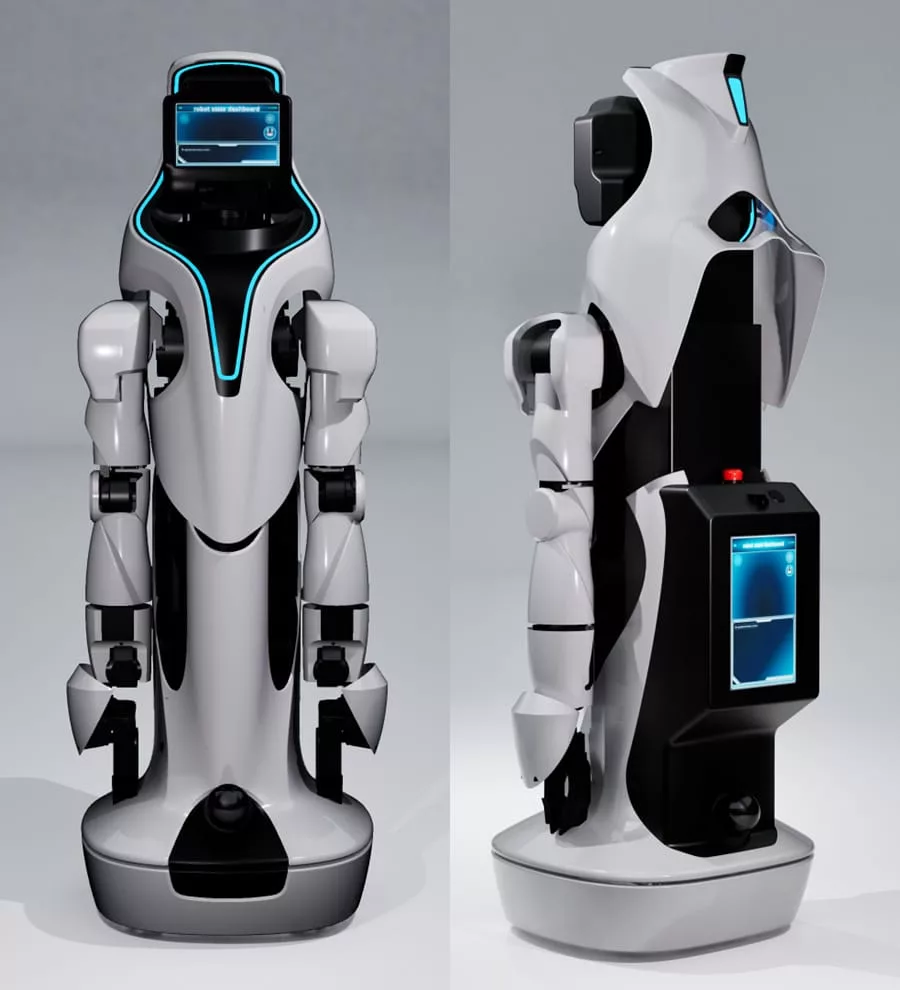
Toyota’s ELEY offers a good indication of where development is heading. The Embodied Learning robot for Enhanced Yield is a two-armed robot weighing around 50 kg that moves on wheels and learns from movements demonstrated by humans.
An operator demonstrates a task to the robot using dedicated control devices. The system gathers data from the demonstrations and uses it to train a model that enables the robot to repeat the task independently.
Toyota demonstrated the system by folding T-shirts. After around 1,500 practice runs and two weeks, ELEY was able to repeat the task almost without errors. Folding a shirt will not itself transform car production. The way the robot learns could.
With a traditional industrial robot, engineers build an entire automated process around a specific operation. With a learning robot, the skill could be demonstrated by a person who already knows how to do the job. That changes the starting point for automation.
The most valuable asset may be workers’ experience
Toyota’s production philosophy has for decades relied on highly experienced skilled workers. Japanese industry uses the term takumi for such masters. The problem arises when practical knowledge accumulated over decades leaves with a retiring worker.
Not everything can be written into a work instruction. An experienced assembler can feel by hand whether a part has seated correctly. They can hear from a sound that something is wrong, or automatically alter a movement when a component behaves slightly differently than usual.
One of the greatest promises of learning robots is the possibility of turning some of this tacit knowledge into data.
If one robot learns a specific operation from Toyota’s best worker, then, in principle, the next robot does not need to be taught everything from scratch. The learned model can be developed further and shared, allowing one person’s skill to become an asset for the entire production network.
That is a far greater change than simply installing another robot arm on an assembly line.
Why don’t all robots need to be humanoid?
The current fashion in robotics favours humanoids. The argument is compelling: factories, tools and logistics systems have been built around the human body. If a robot has two arms, two legs and human-like reach, the factory does not necessarily need to be rebuilt around the robot.
But a human form is not automatically the best engineering solution.
Walking on two legs requires energy, complex control and constant balancing. On a smooth factory floor, a wheeled robot may be simpler, cheaper, more stable and more energy-efficient.
Toyota’s ELEY uses wheels.
Hyundai Motor Group is moving in a different direction. Boston Dynamics, which is owned by the group, is developing the electric Atlas humanoid robot, and Hyundai plans to begin using humanoids in its production operations in 2028.
Atlas has a human-like basic configuration, but Boston Dynamics is not trying to replicate human anatomy precisely. Electric joints allow the robot to make movements that would be impossible, or at least extremely uncomfortable, for a human.
This is creating an interesting experiment in the automotive industry. Toyota is exploring, among other things, wheeled learning manipulators, while Hyundai is betting on a full-size humanoid. Both are trying to solve the same problem: how to make a general-purpose robot work in an environment that humans built for humans.
Robots’ biggest competitor remains conventional automation
Amid the excitement around humanoids, one important question is often forgotten: why use a general-purpose robot costing €100,000 when a simpler dedicated machine can perform the same operation for 20 years in a row?
Carmakers must answer that question in every automation project. If a robot performs one identical weld a million times, it does not need artificial intelligence, legs or human-like hands. A dedicated industrial robot will probably do the job faster, more cheaply and more reliably. The economic advantage of a general-purpose robot emerges when tasks change.
If the same machine can sort parts in the morning, install components in the afternoon and learn an entirely new task in the next model year, its higher purchase price begins to make sense.
That is why the most important metric for the next generation of robots is not lifting capacity or walking speed. More important is the time required to teach a new task.
China is forcing the pace
Robotisation also has a very specific competitive rationale. The automotive industry must simultaneously develop electric vehicles, battery technology, software and new production processes. Chinese manufacturers are pushing model-development cycles ever shorter, while price competition makes the cost of every production hour significant.
A conventional car factory is an enormous capital investment. If a new model requires a large part of the production line to be rebuilt, that consumes time and money. Flexible robotisation theoretically promises to make a factory less model-specific.
A robot that can be taught a new operation through software and demonstrations would allow a manufacturer to change its model range without redesigning the entire automation chain.
This may prove far more important than a direct reduction in labour costs.
People will not disappear from factories; their work will change
The most unfair way to describe robotisation would be with the formula “one robot equals one lost job”. The economics of a car factory are more complex. A robot may indeed take over work previously done by a person. This particularly applies to repetitive, physically demanding and ergonomically poor operations.
At the same time, an increasingly complex automated factory needs people to teach, monitor, maintain and repair robots. Demand is growing for automation, software, data and maintenance skills. The greatest pressure will probably fall on simple repetitive operations. The more standardised and predictable a person’s work is, the easier it is to justify its automation economically.
Toyota vice president Hiroki Nakajima described the company’s aim as a world in which people and robots work together, rather than a situation in which robots simply replace people. That is the company’s stated goal, not a guarantee that automation will not reduce the need for some types of work in the future.
In the end, 400,000 robots is a smaller story than one learning robot
Toyota’s estimate of 400,000 robots makes for a huge headline, but for the automotive industry’s next decade, a far more important question may be whether one robot can learn a new skill from a person and pass it on to another robot.
If the answer remains no, automation will continue along its familiar path. Robots will become faster and more precise, but every new operation will still require expensive engineering work.
If the answer becomes yes, the nature of the car factory will change.
The production line would no longer consist only of machines programmed for fixed tasks. Alongside them would emerge a class of machines whose tasks can be changed through software and which can be taught new skills by following a human example. The robot would then no longer be merely a piece of automation. It would become a digital skilled worker.


