
XPENG puts humanoid robot on the production line
 1/5
1/5 


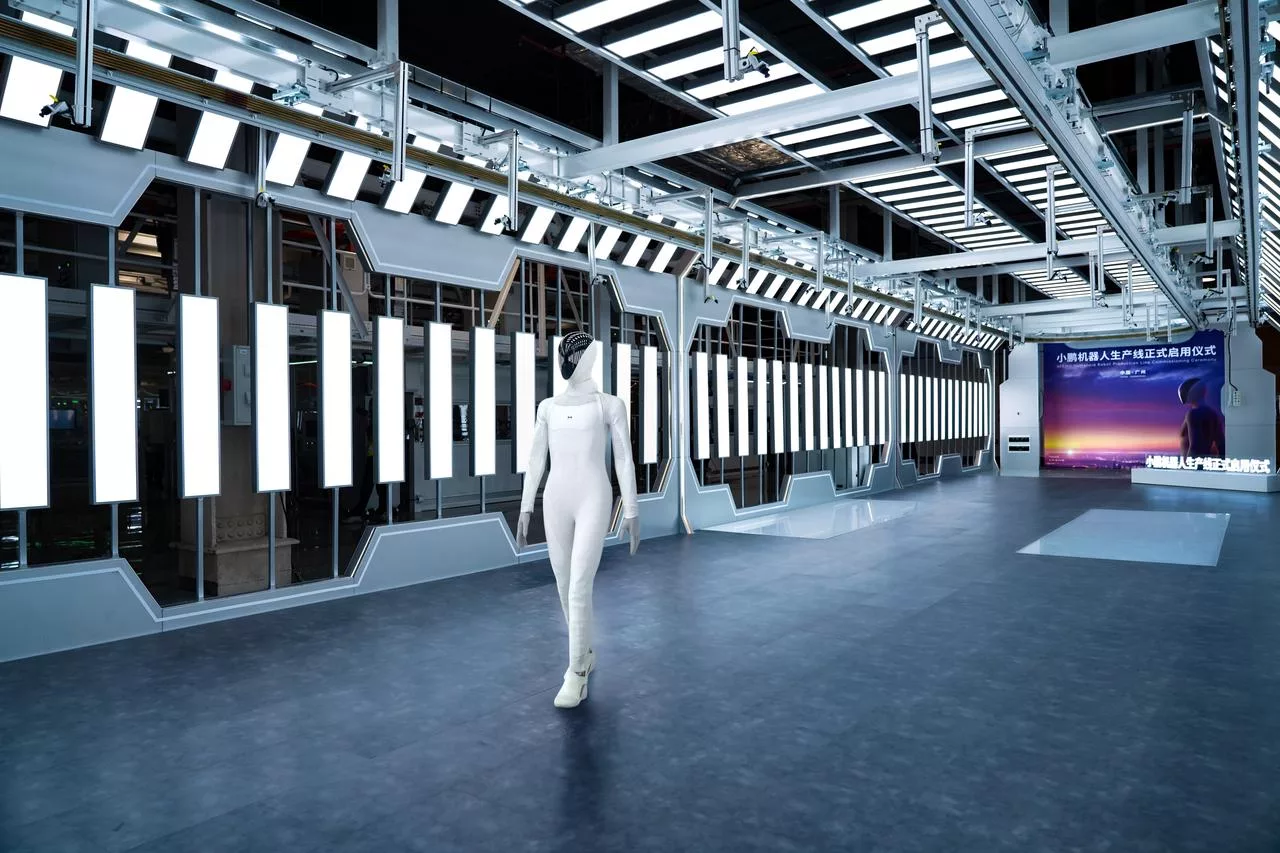
Chinese electric vehicle maker XPENG has taken a far more serious step in the humanoid robot race than another stage demonstration. The company has launched a production line for its IRON humanoid robot, with more than 80 per cent of core processes automated. The first robot completed the line and walked away under its own power. XPENG aims to begin mass production by the end of 2026, with sales in China and international markets expected to start in 2027.
The robot has moved from the lab to a real production line
XPENG announced that it has deployed production lines designed specifically for humanoid robots. For the company, this marks IRON's transition from prototype construction towards industrial production.
The current milestone means the company now has a real production line that has built its first robot. XPENG has set the start of mass production for the end of 2026.
The first IRON built on the production line completed final assembly and then walked off the line independently. It may sound like an eye-catching marketing stunt, but what matters more is how the robot was built.
According to XPENG, automation of the core production processes exceeds 80 per cent. The company uses quality-control principles familiar from electric vehicle production to build the robots, adapting them for the far more complex mechanics of a humanoid robot.
This is where an automaker has one uncomfortably large advantage over a robotics company. A prototype can be built from dozens of manually fitted components. Producing tens of thousands of identical machines, however, requires managing the supply chain, assembly tolerances, quality control, software versions and production speed. The automotive industry does this every day.
IRON is not simply an electric car without wheels
The production version of IRON has 76 degrees of freedom, including 21 in each hand. The robot uses three of XPENG's own Turing AI chips, with combined computing power of up to 2,250 TOPS. That equates to a theoretical 2.25 quadrillion operations per second.
The robot, which stands around 173 cm tall, weighs about 65 kg and can move at up to 2 m/s, or 7.2 km/h. Human proportions are not a random choice. The point of a humanoid robot is that it can operate in environments people have already built for themselves, such as passing through doorways, using work surfaces and grasping objects.
XPENG uses its Physical AI technology in IRON, along with the same world-model principles the company is developing for autonomous cars. The robot must perceive its surroundings, decide how to solve a task, plan its movements and ultimately carry them out physically.
This is where cars and humanoid robots begin to converge technologically in a surprising way. Both need cameras and other sensors, powerful local AI, a real-time model of the environment, and a system that turns software decisions into physical movement. Instead of steering, IRON simply has to control dozens of joints.
First, it will go to work at XPENG itself
XPENG does not intend to sell its first robots to private customers immediately. The company will first deploy IRON at its own campuses and dealerships to collect data from real-world use and refine the software before a broader market launch. The company has previously said that the robots will begin working in roles such as customer service staff at XPENG dealerships in the first quarter of 2027.
The official market launch and customer deliveries are expected to begin in 2027 in both China and international markets. XPENG has not yet disclosed either IRON's sales price or the new production line's annual production capacity.
That makes the current major claims about mass production somewhat premature. The existence of a production line proves that XPENG can at least assemble one IRON industrially. An entirely different question is how quickly the company can build thousands of robots to the same quality standard, and how many genuinely useful tasks they can perform without constant human intervention.
In the robotics industry, it is precisely this latter part that has so far proved much more stubborn than the marketing.
XPENG is already putting real money into robots
IRON is no longer a side project for XPENG. In August, the company's robotics unit raised more than US$900 million, or approximately €774 million at the September 9 exchange rate, in new capital. The funding round valued the unit at more than US$6.3 billion, or approximately €5.4 billion, after the investment. Investors include Tencent and Alibaba.
That gives a fairly clear indication of where XPENG is heading. The company does not want to be merely a Chinese electric vehicle maker in the future, but a physical AI company whose common technology base powers cars, robotaxis and humanoid robots.
For an automaker, it is a logical expansion. In the electric vehicle era, a large part of the competitive advantage no longer comes from the engine and gearbox, but from computing power, software, AI, electric drivetrains and their industrial production. A humanoid robot uses much of the same technological toolkit.
Tesla Optimus faces increasingly strong pressure from China
The most obvious comparison is Tesla Optimus. Elon Musk has spent years describing the humanoid robot as one of Tesla's most important future products, but XPENG can now demonstrate a working dedicated production line at a time when Optimus's industrial ramp-up has progressed more slowly than promised.
That does not mean XPENG has already won the humanoid robot race. China is home to a number of rapidly growing robot makers, and competition is becoming increasingly intense. According to Reuters, Chinese companies accounted for as much as 95 per cent of global humanoid robot deliveries in 2025.
For Europe, that figure should be rather sobering.
Europe's automotive industry is still debating electric vehicle demand, CO2 requirements and Chinese competition, while Chinese automakers are already trying to transfer their mass-production expertise from cars to the next industry. XPENG's new line is a good example of how the AI, chips, electric drivetrains and manufacturing know-how developed for electric vehicles could begin serving an entirely new market.
The big question is not whether IRON can walk
Walking is no longer particularly impressive in humanoid robot demonstrations. The real competition begins when a robot can perform useful work for eight hours straight, requires little maintenance, does not damage its surroundings and costs little enough to replace or complement human labour.
XPENG's production line does not yet answer those questions. However, it does address one prerequisite that robotics companies can easily overlook alongside impressive prototypes: a product must be built quickly, repeatably and cheaply enough.
In this game, an automaker has reason to be confident. A car itself is one of the most complex consumer products in the world to mass-produce. If XPENG can transfer the same production discipline to humanoid robots, IRON becomes much more interesting than another technology demo walking on a stage.


