
Tesla puts steering wheel-free, pedal-free Cybercab on public roads
 1/25
1/25 


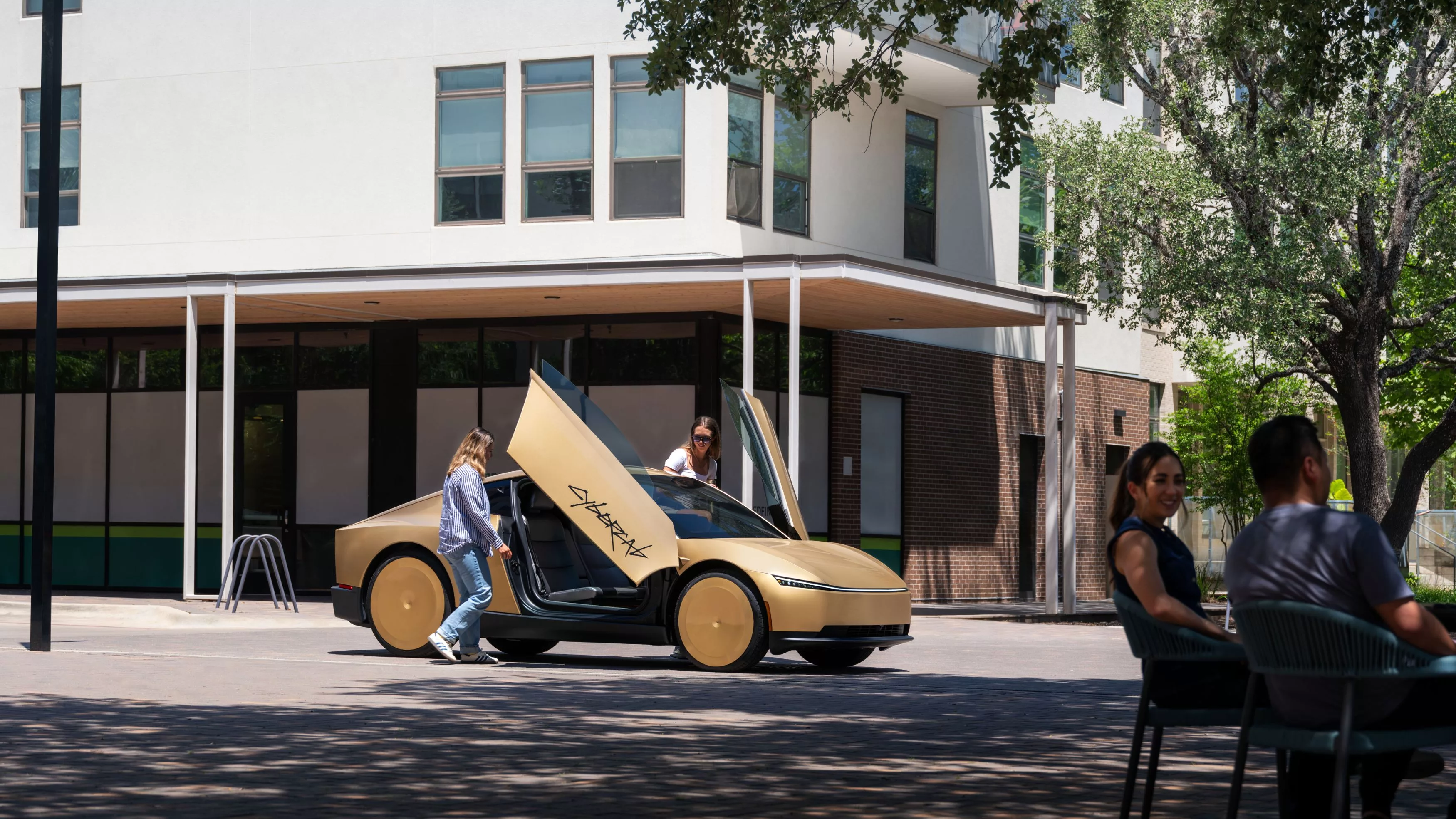
Tesla has taken its most important step yet in the robotaxi race, introducing the Cybercab in Austin, purpose-built for autonomous passenger transport. The two-seat electric car has no steering wheel or pedals. What was a technical demonstration has therefore become a real transport service, but Tesla must now prove to US regulators that its bold approach meets safety requirements.
A real robotaxi replaces the Model Y
Tesla began testing its robotaxi service in Austin as early as 2025 using Model Y SUVs. The Cybercab changes the proposition fundamentally, as it is not a self-driving vehicle adapted from a conventional passenger car. Tesla designed it from the outset for a situation in which there is no driver at all.
According to the company's official information, Robotaxi currently serves customers in several US cities, with the Cybercab joining the existing Model Ys. In Austin, the new vehicle can be ordered through the Tesla Robotaxi app.
The Cybercab cabin has just two seats. There is no steering wheel, accelerator pedal or brake pedal, with the entire passenger user interface centred on a large central screen. Tesla justifies the two-seat layout through robotaxi usage patterns: a large share of journeys are made by one or two people, while the Model Y remains in the fleet for larger groups. According to Tesla, the boot holds two standard checked suitcases and two carry-on bags.
That is one of the Cybercab's most significant differences from a conventional electric car. Tesla is not trying to sell a universal family car. The company is optimising every kilogram, seat and kilowatt-hour for the lowest possible cost per passenger kilometre.
Small battery, front-wheel drive and 163 kW
The Cybercab's engineering is surprisingly pragmatic against the backdrop of Tesla's existing model range.
According to US Environmental Protection Agency EPA certification data, the car is powered by a single 163 kW permanent-magnet electric motor mounted on the front axle. Front-wheel drive, unusual for Tesla, is not at all a foolish choice for a robotaxi. Rather than driving dynamics, the priorities here are production cost, efficiency, packaging and reliability.
The lithium-ion battery has a capacity of approximately 47.6 kWh and the kerb weight is 1,412 kg. Gross vehicle weight reaches 1,692 kg, leaving around 280 kg of payload for passengers and luggage. That is no problem for two people, but it again shows how tightly Tesla has built the car around its specific task.
The 673 km combined range found in EPA documents needs a major asterisk. It is an unadjusted laboratory result, not the final EPA consumer figure. Applying the usual EPA adjustment would put a more practical estimate at around 470 km. So the 48 kWh battery has not miraculously created a 673 km electric car; rather, this is a highly efficient and relatively lightweight working tool.
For a robotaxi, around 470 km is an even more significant achievement than reaching 600 or 700 km with a huge battery. A smaller battery means less material, lower weight and presumably a cheaper vehicle. In commercial service, success is ultimately determined by cost per kilometre, not the largest figure in a brochure.
Tesla takes on Waymo with a different weapon
The Cybercab's significance extends beyond a single Tesla model. In the autonomous driving market, Tesla has deliberately chosen a technical path different from that of its rivals.
Waymo uses cameras together with radar and lidar in its autonomous cars. Tesla relies far more heavily on camera-based machine vision. This makes the vehicle's sensor side cheaper and simpler, but places enormous responsibility on the software and its interpretation of visual information.
Tesla is still behind in the competition, however. According to Reuters, 420 Tesla autonomous vehicles were registered in Texas at the beginning of September, of which only 45 were Cybercabs. Waymo already operates thousands of driverless cars. The Cybercab launch nevertheless makes Tesla's plan considerably more credible, because the company is no longer talking only about turning existing passenger cars into robotaxis through software.
If Tesla can produce the Cybercab cheaply and in very large volumes, the vehicle's simplicity could become its biggest competitive advantage.
Regulator now wants answers from Tesla
Removing the steering wheel and pedals makes the Cybercab technically interesting, but legally quite a headache.
The US traffic safety agency NHTSA has opened an investigation into Cybercab certification. The issue is not merely autonomous driving software. In several respects, US federal safety standards still assume that a car has a human driver and controls intended for that person. According to Reuters, Tesla did not seek an exemption, instead choosing self-certification. The investigation concerns up to approximately one thousand Cybercabs.
This is a critical point for the entire project. Cameras, neural networks and a low-cost electric drivetrain are worth little if the regulator decides that a car without physical controls does not comply with current requirements.
Reaching Europe will be a far more difficult task
From a European perspective, the Cybercab is best viewed primarily as a technology preview, rather than a model that could soon be summoned by phone onto a Tallinn street.
Tesla has not announced the launch of a Cybercab robotaxi service in the European Union. Here, the company would have to navigate a regulatory obstacle course for autonomous driving and type approval that differs significantly from the US system. The steering wheel-free, pedal-free design makes the process even more complicated.
At the same time, it is difficult to underestimate the Cybercab's impact on Europe. Waymo, Zoox and other autonomous transport developers are building specialised machines with expensive sensor suites. Tesla is trying to prove that the same task can be solved with simpler hardware, mass production and strong software.
If it works, robotaxis will become economically viable much faster. If it does not, the Cybercab will become an exceptionally striking example of why dispensing with lidar, radar and physical controls was too optimistic.
For now, one thing matters: the Cybercab is no longer just a golden concept at a motor show. Passengers are already getting into a car with no steering wheel or pedals. From now on, Tesla must prove not whether it can build such a car, but whether it can bring it safely, legally and profitably to the masses.


