
Ferrari wants to give the passenger a steering wheel too, new patent could turn a supercar into a dual-driver machine
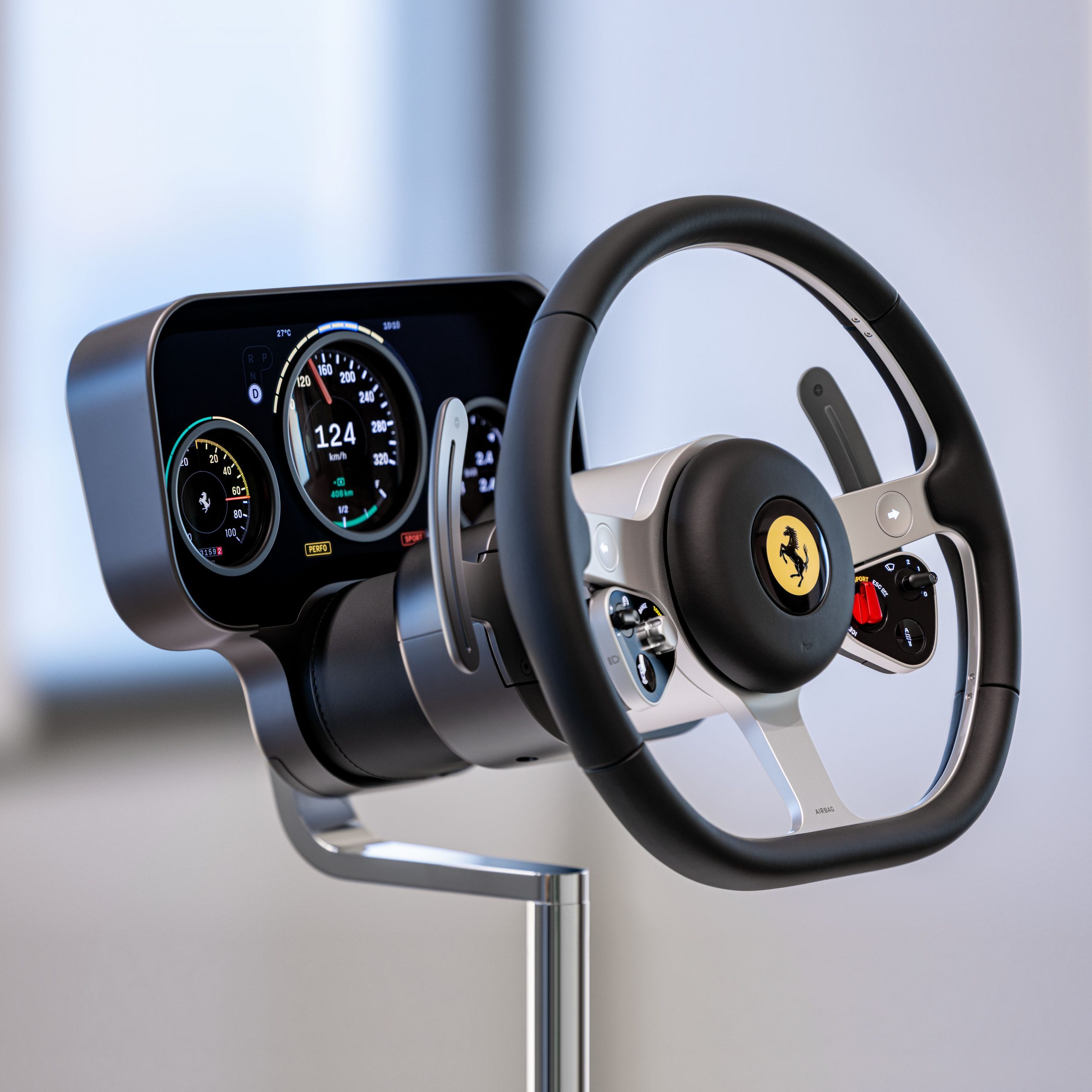
Ferrari’s latest patent turns the conventional supercar cockpit on its head. Maranello engineers envisage two separate driving positions, two folding steering wheels and an electronic steer-by-wire steering system. The car could then be driven from either the left- or right-hand seat, without the steering system’s mechanical hardware having to change sides. The patent does not yet mean a production car, but it clearly shows what electronic steering could enable in sports car design.
A Ferrari document published by the US Patent Office describes a solution in which the driver and passenger sit in separate cockpit sections, each with their own steering wheel. The system is based on steer-by-wire technology, which removes the conventional mechanical connection between the steering wheel and the steered wheels.
Electronic steering is not a new area of research for Ferrari. The company has patented steer-by-wire solutions for years, and earlier documents describe steering-wheel position sensors, an electronic control unit and an electric actuator that turns the wheels.
The steering wheel disappears into the dashboard
The idea of two steering wheels may seem almost comical at first glance, but Ferrari’s solution is far more elegant than simply fitting two conventional steering columns into a car.
The unused steering wheel can be rotated by approximately 90 degrees and folded towards the dashboard. This means the passenger does not have to endure an unused steering wheel in front of their knees for the entire journey. Its controls move with the steering wheel. The shift paddles described in the patent can move on guides and, when not in use, retract into the rear of the steering wheel.
This is precisely where steer-by-wire gives Ferrari’s engineers freedom that a conventional steering column cannot provide. The steering wheel essentially acts as the driver’s input device: sensors measure the steering angle and applied force, electronics interpret the driver’s command, and an electric actuator turns the wheels. Ferrari’s earlier steer-by-wire patent also describes independent and redundant steering-position measurements, which are essential to the safety of such a system.
This is no longer simply a matter of replacing a steering column with an electrical cable. Removing the mechanical connection makes it possible to rethink the entire cockpit.
Left- and right-hand-drive Ferraris could be the same car
The patent’s most practical application is not allowing the passenger to take over in a corner. Production is far more important.
Today, carmakers must account for differences between left- and right-hand-drive markets when designing the body, dashboard, pedals, steering column and several assistance systems. Ferrari’s solution could make it possible to build a single cockpit structure in which driving control can be electronically assigned to either side.
The patent also refers to the possibility of using both seats for driving, and the pedals may be duplicated. However, the document does not describe their exact design in as much detail.
For Europe, such a solution would primarily mean simpler production. A car with the same basic structure could be sold in left-hand-drive markets in continental Europe as well as in the UK and other left-hand-traffic markets. For a low-volume manufacturer such as Ferrari, this is economically far more interesting than it would be for a group producing millions of cars.
The driver could change sides during a long journey
The other possibility is even more unusual. If both seats have steering wheels and pedals, control could theoretically be transferred from one person to another while driving.
Technically, steer-by-wire makes this conceivable, as the car does not need to physically connect two steering columns to the same steering mechanism. Electronics can determine which steering wheel input the system follows at any given moment.
In practice, however, a whole range of questions arises. The system must prevent a situation in which two people simultaneously give conflicting steering commands. The car must manage accelerator and brake pedal inputs, as well as the transfer of driving control, with equal rigour. Type approval, airbags, crash safety and driver-assistance system requirements must also be addressed.
So the patent drawings should not be taken to mean that the passenger in the next Ferrari will simply be able to call out “my turn” on the motorway and unfold the steering wheel.
Ferrari has been developing steer-by-wire technology for years
The most interesting context comes from Ferrari’s earlier patents. A document with a 2017 priority date already described a steer-by-wire system in which the steering wheel has no mechanical connection to the wheels. Sensors read the steering angle and torque applied by the driver, a control unit processes the signal, and an electric motor moves the steering mechanism.
In a newer patent with a 2024 priority date, Ferrari developed the same principle further, focusing on steering-wheel adjustability and an electronically controlled steering system.
The dual-driver cockpit is therefore not an isolated mad drawing. It fits into a longer development direction in which Ferrari is exploring what can be done with the steering wheel and cockpit once the mechanical steering column disappears.
A patent does not mean the next Ferrari will have two steering wheels
It is worth slowing down here. Carmakers constantly patent technologies that never reach series production. With the patent, Ferrari is primarily protecting the technical idea and its potential applications.
A Ferrari with two steering wheels would, for example, complicate passive safety. The design would have to account for both use of the steering wheel and its folded position in front of each seat. Airbags, knee protection, dashboard deformation and crash loads would all need to be engineered accordingly.
At the same time, steer-by-wire itself is no longer science fiction. Toyota and Lexus have brought electronic steering solutions to the European market, and the technology’s greatest advantage is not merely the ability to alter the steering ratio through software. Removing the mechanical steering column gives designers entirely new freedom in shaping the cabin, controls and future automated driving functions.
Ferrari’s patent simply takes this logic much further. If the steering wheel is no longer physically connected to the wheels, there is no longer any technical reason set in stone for which side of the car it has to be on.


