
BYD’s EV Rise Runs Into a Security Question
BYD has so far looked like one of Europe’s most uncomfortable automotive challengers: cheaper, faster-moving, more vertically integrated and increasingly convincing on technology. Now a much harder question sits alongside that success. The US Department of Defense has added BYD to a list of companies Washington considers linked to China’s military.
That does not automatically mean sanctions. Nor does it prove that BYD is building military equipment for the Chinese army. But it does mean that one of the world’s most important electric car makers now faces an official US security concern.
For BYD, this is not awkward only because the Pentagon could in future restrict dealings with companies on the list. The issue is wider. BYD is no longer just a car maker. It is a battery company, a power electronics company, a software company, a data company, a charging technology company and a global supply chain player. Companies like that are increasingly attracting the attention of security agencies, because the modern car is no longer just transport. It is a connected data platform.
What the Pentagon is actually saying
The US Department of Defense’s 1260H list is intended to identify Chinese companies Washington regards as linked to China’s military modernisation. In BYD’s case, the public document does not claim that the company produces missiles, tanks or weapons systems. The allegation is different, and politically more awkward.
The Pentagon’s reasoning says BYD is directly and indirectly linked to China’s state asset supervisor, SASAC, and indirectly linked to the Ministry of Industry and Information Technology, MIIT. It also describes BYD as a contributor to military-civil fusion, citing its links to MIIT and its location in, or association with, a military-civil fusion enterprise zone.
The wording matters. Washington is not merely saying BYD is close to the Chinese state, something that can be said to some degree about many large strategic companies in China. The US claim is that BYD’s technological, industrial and institutional position could contribute to China’s defence-industrial capability.
Based on public material, however, the evidence remains limited. The Pentagon states its conclusion, but does not disclose the full intelligence or procedural basis behind it. This is therefore a national security assessment, not a body of evidence that has been fully tested in court.
BYD rejects the designation
BYD has told Reuters it strongly opposes being designated as a company linked to China’s military and will use available administrative and legal means to protect its rights and interests. That is an expected response. A listed company of this size cannot simply accept a label that could affect investors, partners, public procurement and its public reputation.
It is also important that the 1260H list is not a conventional sanctions list. BYD does not become a banned car brand in Europe overnight. It can still sell cars, open dealerships and serve customers. But in security policy, such lists often act as an early warning signal. First comes the list. Then procurement restrictions may follow. After that, banks, insurers, public authorities and business partners begin asking whether a possible technological and political vulnerability is worth the saving offered by a cheaper or more attractive Chinese product.
Why BYD is not a conventional car maker
The security questions around BYD do not arise only from the company’s Chinese origins. They arise from what BYD now controls.
The company makes cars, batteries, power electronics and many key components itself. That vertical integration has been BYD’s biggest competitive advantage. European and American car makers have to buy expensive battery technology, negotiate with suppliers and work around slower industrial legacies. BYD builds much of the value chain in-house. That makes it cheaper, more flexible and strategically far more important.
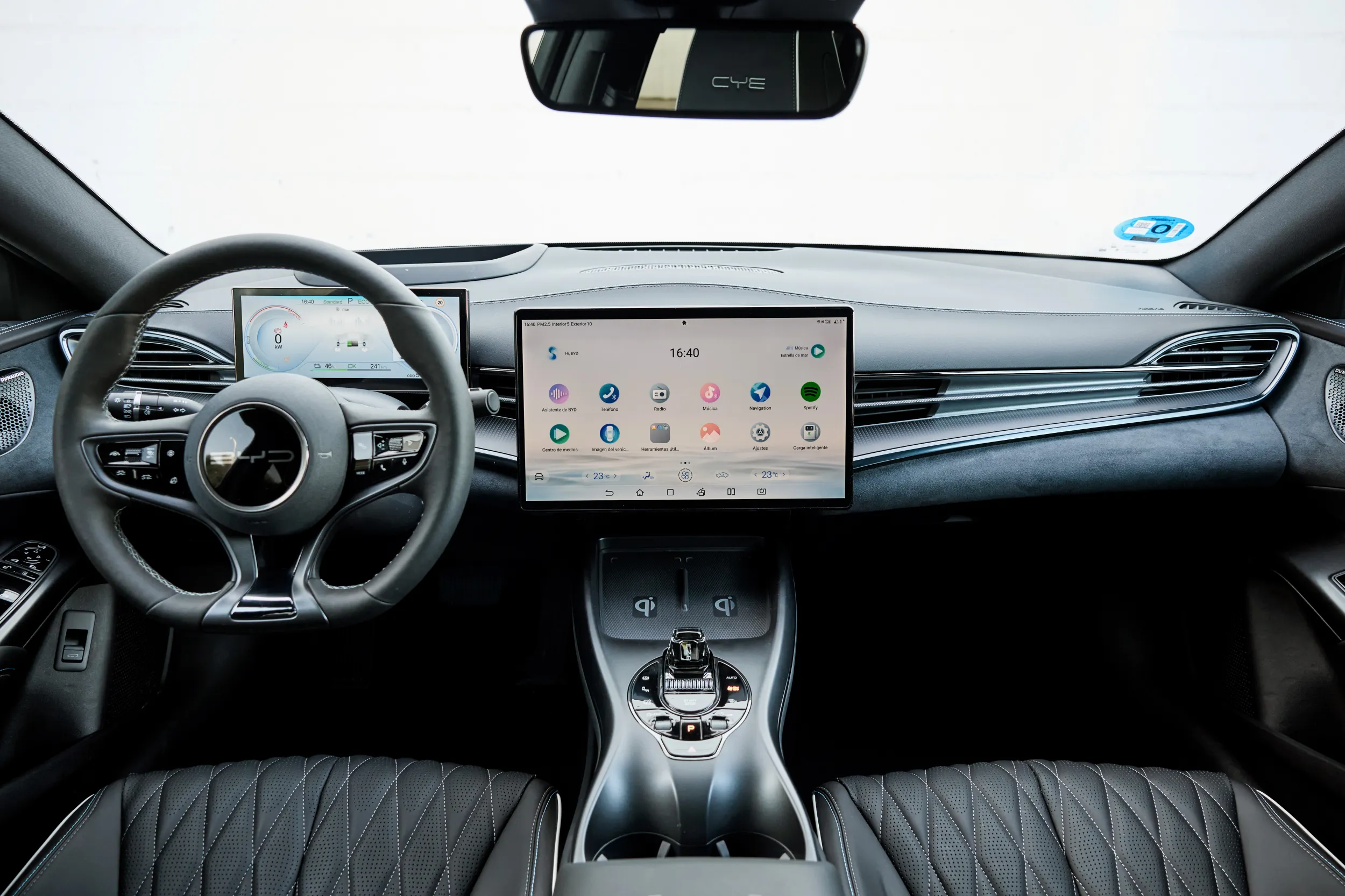
A modern electric car is not just a battery and a body shell. It is a software-led system that gathers data and uses cameras, radar, mobile connectivity, navigation, remote diagnostics and over-the-air software updates. For the customer, that can be useful. For a national security agency, it can be a problem.
If a vehicle constantly exchanges diagnostic, usage and location data with its maker, and receives regular remote updates, it is no longer just a vehicle. It becomes part of digital infrastructure. The question is not only whether a particular car is good or bad. It is who controls the data, where that data is processed and under which country’s jurisdiction the manufacturer sits.
US rules on connected vehicles show that Washington no longer treats the issue of Chinese cars only as a matter of industrial policy or import competition. The focus has moved to software, connectivity, data flows and remote access. That turns the BYD case from a car industry story into a broader technology and security issue.
Europe has so far seen BYD mainly as an economic threat
The European Union has not treated BYD in the same framework as the US Department of Defense. Europe’s main concern has so far been competition and subsidies. The European Commission found that China’s electric vehicle value chain benefits from unfair state support that harms European manufacturers. BYD received a lower additional tariff than some other Chinese car makers, but the 17 per cent rate still shows that Brussels does not see the success of Chinese EVs purely as the result of better engineering.
That is the first layer of the BYD debate: economic pressure. A Chinese manufacturer is entering Europe with pricing the European industry cannot match without painful restructuring.
The Pentagon list adds a second layer: security. The question is no longer only whether BYD is too cheap. It is whether BYD’s technology ecosystem could become a strategic dependency for Europe.
That does not mean Europe should copy American policy. Europe’s car market, industry and consumer interests are different. But it would be naive to think Washington’s assessment will not affect the European debate. If the US Department of Defense treats BYD as a potential part of military-civil fusion, Europe cannot limit the discussion to how many euros cheaper a Chinese EV is than a Volkswagen, Renault or Stellantis model.
The consumer sees the price, the state must see the dependency
BYD’s rapid growth in Europe is not based only on Chinese state support or geopolitical manoeuvring. It is also based on cars that make sense for many buyers. The European consumer sees a competitive price, generous equipment, a long warranty, decent range and a company that controls much of its own battery technology. Someone buying a family car will not usually think first about the US Department of Defense’s 1260H list. They will look at the price, monthly payment, range and warranty terms.
European states, local authorities and critical infrastructure companies cannot take such a narrow view. If connected vehicles are used by police, rescue services, defence-related bodies, energy infrastructure operators, ports, airports, public transport fleets or government agencies, origin, software control and data processing become far more important. The same applies to charging networks, battery storage, fleet management software and data platforms.
BYD’s strength is precisely that it can offer a complete technology ecosystem. From a security perspective, that same strength can become a dependency. If one manufacturer controls the vehicle, battery, software, connectivity and part of the service platform, the issue is no longer just the car. It is technological access and control.
For European countries, this is especially difficult because electrification needs more affordable vehicles. When a Chinese manufacturer offers a cheaper and often well-equipped electric car, it is politically uncomfortable to say that the lower price may carry a higher strategic cost. Yet that is the debate Europe cannot avoid.
Is BYD a security risk?
Based on public information, it is not possible to say that every BYD vehicle is a security threat. That would be too simplistic and factually weak. It is also not credible to say that BYD is an ordinary car maker and that its price list and warranty terms are all that matter. That would be naive.
The more uncomfortable conclusion is that BYD is a technologically strong Chinese company in a strategic sector, and the US has now formally raised a security concern about it. The company denies the designation. Europe is currently more focused on subsidies and industrial policy. The consumer sees a good price. A security agency sees data, software, batteries, suppliers and the potential influence of the Chinese state.
These truths do not cancel each other out. They can all be true at once.
That is what makes the BYD case difficult. If the company were technologically weak, the question would be less acute. If its cars were poor, the market would solve the problem itself. But BYD is strong enough, cheap enough and fast-growing enough that its success can no longer be treated as a purely commercial story.
What Europe should do next
Europe’s problem is that it needs cheaper electric cars, but does not want to wake up in ten years to find that its transport data, battery supply chains and vehicle software depend on a country it describes as a systemic rival.
The answer cannot be a simple slogan that all Chinese cars should be banned. That would be expensive, politically difficult and would probably mean higher prices for consumers. It would be just as foolish to pretend this is only a free-market question. When a car is connected, software-led and constantly exchanging data, it is part of a much wider digital infrastructure.
Europe needs at least three things. First, there must be clarity over where vehicle data is collected and processed. Second, public-sector and critical infrastructure vehicle procurement should include risk assessments covering origin, software and remote access. Third, Europe must distinguish between private consumer cars and vehicles used in sensitive state-linked roles. A private buyer can choose on price and equipment. The state should not give itself that luxury.
There is also a simple question that is still asked too rarely: which vehicle functions run through the manufacturer’s cloud services, what data is collected, when is it transmitted and can some connected services be disabled in sensitive public-sector use? Without such answers, the security debate remains too vague.
Europe does not need to reach the same political conclusion for every Chinese manufacturer. But it does need clear rules for connected vehicle data, software, remote access and critical infrastructure procurement. Without those rules, decisions will be driven by individual scandals, political pressure and price tags. That is a poor way to manage one of the most important industrial shifts of the next decade.
BYD’s success will not disappear
BYD is too large and too technologically competitive for this debate to end with a simple boycott or political slogan. The company will continue expanding in Europe, building production capacity closer to customers and trying to position itself not as a Chinese risk, but as a global car maker. That is exactly what makes the story complicated. BYD’s cars are not caricature cheap products. They are genuinely competitive vehicles.
The better Chinese cars become, the bigger the political question gets. A poor cheap car threatens little beyond its owner’s patience. A good cheap car changes the market. A good cheap connected car can change dependencies.
The Pentagon list does not prove BYD’s guilt. But it does end the comfortable period in which a Chinese electric car could be judged only by price, battery and range. With BYD, Europe must now also ask who stands behind the technology, whose interests that ecosystem ultimately serves and how much strategic comfort it is prepared to trade for a lower monthly payment.
For BYD, this is not awkward only because the Pentagon could in future restrict dealings with companies on the list. The issue is wider. BYD is no longer just a car maker. It is a battery company, a power electronics company, a software company, a data company, a charging technology company and a global supply chain player. Companies like that are increasingly attracting the attention of security agencies, because the modern car is no longer just transport. It is a connected data platform.
What the Pentagon is actually saying
The US Department of Defense’s 1260H list is intended to identify Chinese companies Washington regards as linked to China’s military modernisation. In BYD’s case, the public document does not claim that the company produces missiles, tanks or weapons systems. The allegation is different, and politically more awkward.
The Pentagon’s reasoning says BYD is directly and indirectly linked to China’s state asset supervisor, SASAC, and indirectly linked to the Ministry of Industry and Information Technology, MIIT. It also describes BYD as a contributor to military-civil fusion, citing its links to MIIT and its location in, or association with, a military-civil fusion enterprise zone.
The wording matters. Washington is not merely saying BYD is close to the Chinese state, something that can be said to some degree about many large strategic companies in China. The US claim is that BYD’s technological, industrial and institutional position could contribute to China’s defence-industrial capability.
Based on public material, however, the evidence remains limited. The Pentagon states its conclusion, but does not disclose the full intelligence or procedural basis behind it. This is therefore a national security assessment, not a body of evidence that has been fully tested in court.
BYD rejects the designation
BYD has told Reuters it strongly opposes being designated as a company linked to China’s military and will use available administrative and legal means to protect its rights and interests. That is an expected response. A listed company of this size cannot simply accept a label that could affect investors, partners, public procurement and its public reputation.
It is also important that the 1260H list is not a conventional sanctions list. BYD does not become a banned car brand in Europe overnight. It can still sell cars, open dealerships and serve customers. But in security policy, such lists often act as an early warning signal. First comes the list. Then procurement restrictions may follow. After that, banks, insurers, public authorities and business partners begin asking whether a possible technological and political vulnerability is worth the saving offered by a cheaper or more attractive Chinese product.
Why BYD is not a conventional car maker
The security questions around BYD do not arise only from the company’s Chinese origins. They arise from what BYD now controls.
The company makes cars, batteries, power electronics and many key components itself. That vertical integration has been BYD’s biggest competitive advantage. European and American car makers have to buy expensive battery technology, negotiate with suppliers and work around slower industrial legacies. BYD builds much of the value chain in-house. That makes it cheaper, more flexible and strategically far more important.
A modern electric car is not just a battery and a body shell. It is a software-led system that gathers data and uses cameras, radar, mobile connectivity, navigation, remote diagnostics and over-the-air software updates. For the customer, that can be useful. For a national security agency, it can be a problem.
If a vehicle constantly exchanges diagnostic, usage and location data with its maker, and receives regular remote updates, it is no longer just a vehicle. It becomes part of digital infrastructure. The question is not only whether a particular car is good or bad. It is who controls the data, where that data is processed and under which country’s jurisdiction the manufacturer sits.
US rules on connected vehicles show that Washington no longer treats the issue of Chinese cars only as a matter of industrial policy or import competition. The focus has moved to software, connectivity, data flows and remote access. That turns the BYD case from a car industry story into a broader technology and security issue.
Europe has so far seen BYD mainly as an economic threat
The European Union has not treated BYD in the same framework as the US Department of Defense. Europe’s main concern has so far been competition and subsidies. The European Commission found that China’s electric vehicle value chain benefits from unfair state support that harms European manufacturers. BYD received a lower additional tariff than some other Chinese car makers, but the 17 per cent rate still shows that Brussels does not see the success of Chinese EVs purely as the result of better engineering.
That is the first layer of the BYD debate: economic pressure. A Chinese manufacturer is entering Europe with pricing the European industry cannot match without painful restructuring.
The Pentagon list adds a second layer: security. The question is no longer only whether BYD is too cheap. It is whether BYD’s technology ecosystem could become a strategic dependency for Europe.
That does not mean Europe should copy American policy. Europe’s car market, industry and consumer interests are different. But it would be naive to think Washington’s assessment will not affect the European debate. If the US Department of Defense treats BYD as a potential part of military-civil fusion, Europe cannot limit the discussion to how many euros cheaper a Chinese EV is than a Volkswagen, Renault or Stellantis model.
The consumer sees the price, the state must see the dependency
BYD’s rapid growth in Europe is not based only on Chinese state support or geopolitical manoeuvring. It is also based on cars that make sense for many buyers. The European consumer sees a competitive price, generous equipment, a long warranty, decent range and a company that controls much of its own battery technology. Someone buying a family car will not usually think first about the US Department of Defense’s 1260H list. They will look at the price, monthly payment, range and warranty terms.
European states, local authorities and critical infrastructure companies cannot take such a narrow view. If connected vehicles are used by police, rescue services, defence-related bodies, energy infrastructure operators, ports, airports, public transport fleets or government agencies, origin, software control and data processing become far more important. The same applies to charging networks, battery storage, fleet management software and data platforms.
BYD’s strength is precisely that it can offer a complete technology ecosystem. From a security perspective, that same strength can become a dependency. If one manufacturer controls the vehicle, battery, software, connectivity and part of the service platform, the issue is no longer just the car. It is technological access and control.
For European countries, this is especially difficult because electrification needs more affordable vehicles. When a Chinese manufacturer offers a cheaper and often well-equipped electric car, it is politically uncomfortable to say that the lower price may carry a higher strategic cost. Yet that is the debate Europe cannot avoid.
Is BYD a security risk?
Based on public information, it is not possible to say that every BYD vehicle is a security threat. That would be too simplistic and factually weak. It is also not credible to say that BYD is an ordinary car maker and that its price list and warranty terms are all that matter. That would be naive.
The more uncomfortable conclusion is that BYD is a technologically strong Chinese company in a strategic sector, and the US has now formally raised a security concern about it. The company denies the designation. Europe is currently more focused on subsidies and industrial policy. The consumer sees a good price. A security agency sees data, software, batteries, suppliers and the potential influence of the Chinese state.
These truths do not cancel each other out. They can all be true at once.
That is what makes the BYD case difficult. If the company were technologically weak, the question would be less acute. If its cars were poor, the market would solve the problem itself. But BYD is strong enough, cheap enough and fast-growing enough that its success can no longer be treated as a purely commercial story.
What Europe should do next
Europe’s problem is that it needs cheaper electric cars, but does not want to wake up in ten years to find that its transport data, battery supply chains and vehicle software depend on a country it describes as a systemic rival.
The answer cannot be a simple slogan that all Chinese cars should be banned. That would be expensive, politically difficult and would probably mean higher prices for consumers. It would be just as foolish to pretend this is only a free-market question. When a car is connected, software-led and constantly exchanging data, it is part of a much wider digital infrastructure.
Europe needs at least three things. First, there must be clarity over where vehicle data is collected and processed. Second, public-sector and critical infrastructure vehicle procurement should include risk assessments covering origin, software and remote access. Third, Europe must distinguish between private consumer cars and vehicles used in sensitive state-linked roles. A private buyer can choose on price and equipment. The state should not give itself that luxury.
There is also a simple question that is still asked too rarely: which vehicle functions run through the manufacturer’s cloud services, what data is collected, when is it transmitted and can some connected services be disabled in sensitive public-sector use? Without such answers, the security debate remains too vague.
Europe does not need to reach the same political conclusion for every Chinese manufacturer. But it does need clear rules for connected vehicle data, software, remote access and critical infrastructure procurement. Without those rules, decisions will be driven by individual scandals, political pressure and price tags. That is a poor way to manage one of the most important industrial shifts of the next decade.
BYD’s success will not disappear
BYD is too large and too technologically competitive for this debate to end with a simple boycott or political slogan. The company will continue expanding in Europe, building production capacity closer to customers and trying to position itself not as a Chinese risk, but as a global car maker. That is exactly what makes the story complicated. BYD’s cars are not caricature cheap products. They are genuinely competitive vehicles.
The better Chinese cars become, the bigger the political question gets. A poor cheap car threatens little beyond its owner’s patience. A good cheap car changes the market. A good cheap connected car can change dependencies.
The Pentagon list does not prove BYD’s guilt. But it does end the comfortable period in which a Chinese electric car could be judged only by price, battery and range. With BYD, Europe must now also ask who stands behind the technology, whose interests that ecosystem ultimately serves and how much strategic comfort it is prepared to trade for a lower monthly payment.


