
BYD Sealion 5 falls short in new ANCAP test, ending the brand’s five-star run
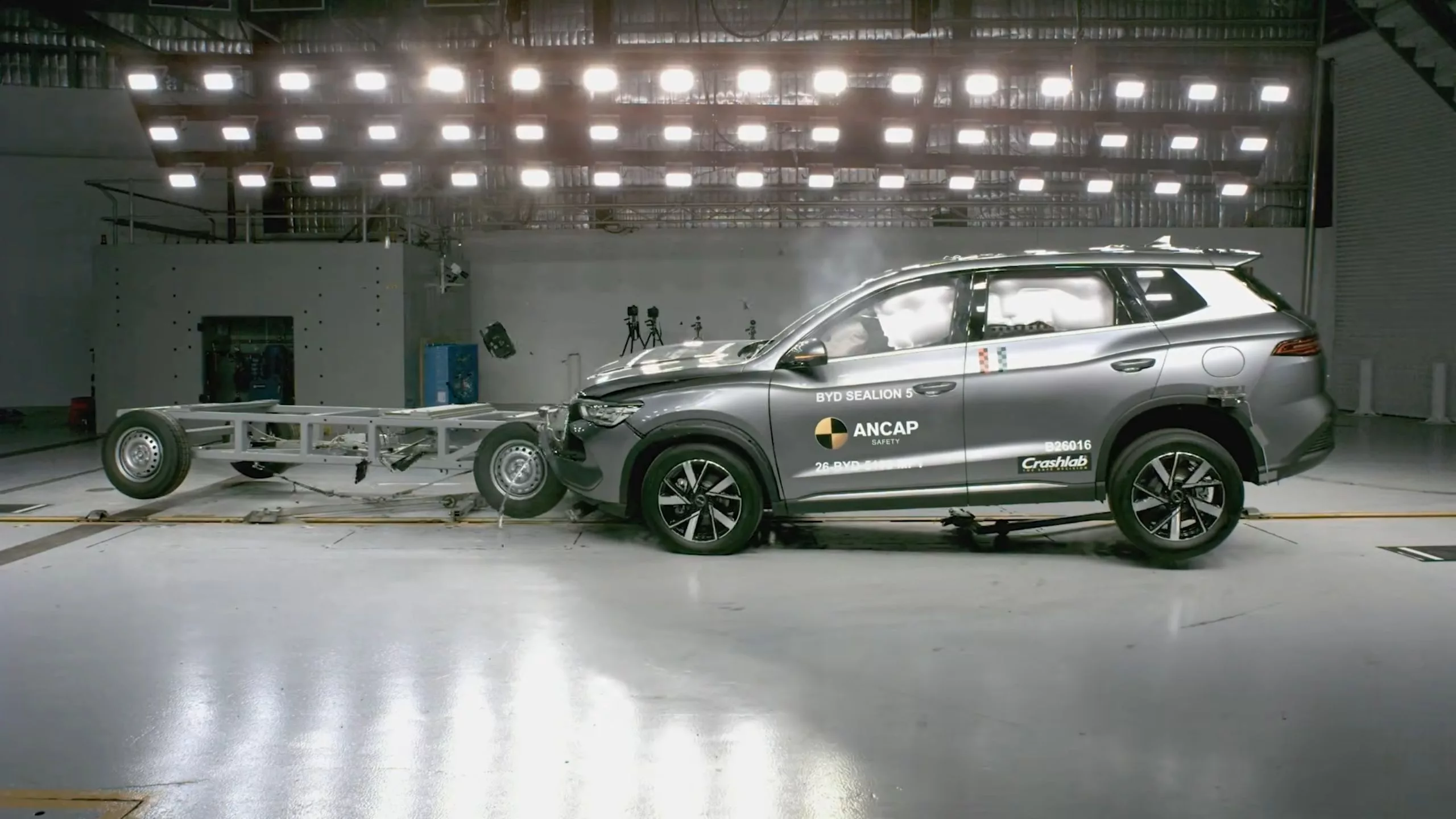
BYD has become accustomed to five-star safety ratings, but the new Sealion 5 DM-i spoiled that record in Australia. The plug-in hybrid SUV earned just three stars under ANCAP’s new, tougher assessment methodology. The most interesting detail, however, lies behind the numbers: the main problem was not the crashworthiness of the car’s body structure, but missing and poorly performing electronic safety systems.
The Australasian New Car Assessment Program, or ANCAP, published the results on 29 September. The organisation tested the Sealion 5 alongside the large BYD M9 under its new 2026–2028 requirements. The M9 earned five stars, while the Sealion 5 managed three. That made the latter the first BYD tested by ANCAP not to receive the maximum rating.
Four per cent was not the problem; 48 per cent was
ANCAP’s new assessment no longer looks at a car simply by asking, “How well does it withstand a crash?” The assessment is divided into four broad areas, and a manufacturer must perform well in all of them to achieve a respectable overall result.
The Sealion 5’s results were telling: safe driving 48% crash avoidance 51% crash protection 79% post-crash safety 74%
It is therefore not entirely accurate to describe the Sealion 5 simply as a car that performed poorly in crash testing. Its 79% score for physical crash protection is actually a respectable result. ANCAP found that the car generally provides a reasonable level of protection for adults and children, although new virtual simulations and sled tests revealed weaker protection for larger occupants and in more severe collisions.
The real reason for the three-star rating emerges from the first two scores.
Emergency lane keeping fell short
One of the more specific criticisms concerns the emergency lane-keeping system. In ANCAP’s test, the Sealion 5’s system failed to intervene in scenarios where the car was moving towards the roadside.
In 2026, this is no longer an exotic optional extra. ANCAP has included this functionality in its assessments since 2018. The organisation’s emphasis is understandable, as Australian statistics show that unintended road departures account for a significant proportion of serious crashes.
A whole range of features increasingly expected of a modern car was also missing.
In the Australian specification tested by ANCAP, the Sealion 5 does not offer detection of a child left in the car. It also lacked detection of an incorrectly fastened seat belt, occupant size classification, and a system that limits engine power if the driver accidentally presses the accelerator at low speed in front of a pedestrian.
The last of these may sound like yet another electronic nanny, until you think of multi-storey car parks, shop entrances and situations where someone panics and presses the accelerator instead of the brake.
No emergency call function either
The Sealion 5 achieved a much better score of 74% for post-crash safety. The plug-in hybrid’s high-voltage battery thermal management, multi-collision braking and provisions for exiting the car after a crash largely met ANCAP’s expectations.
One important omission remained, however: the Australian Sealion 5 has no eCall function.
For European buyers, a very important distinction must be made here. The equipment fitted to the car tested in Australia should not automatically be assumed to apply to the European model. The European Union has different type-approval and safety requirements for new cars, including a requirement for automatic emergency calling. ANCAP’s three-star rating therefore primarily reflects the safety level of the Australian- and New Zealand-specification Sealion 5.
The most uncomfortable comparison comes from BYD’s own garage
BYD could quite conveniently explain the poor result by pointing out that ANCAP changed its rules in 2026. The new protocol is indeed more demanding than before and assesses active safety, driver monitoring and post-crash functions much more broadly. But the BYD M9, tested at the same time, removes that excuse.
The seven-seat M9 went through exactly the same 2026–2028 assessment and received five stars. It scored 89% for crash protection, 78% for crash avoidance, 75% for safe driving and a full 100% for post-crash safety.
More tellingly, the M9 has several systems missing from the Sealion 5. These include child presence detection, occupant size classification and eCall.
So the question is not whether BYD can build a car that meets ANCAP’s new requirements. It can. The Sealion 5 simply did not receive the same comprehensive safety package.
ANCAP bought the test car itself
There is another unusual aspect to the story. According to ANCAP chief executive Carla Hoorweg, BYD has generally been proactive in submitting its cars for testing, but the Sealion 5 was not a model for which the manufacturer itself sought an ANCAP rating.
ANCAP selected the car for testing on its own initiative to give buyers independent information about its safety. The three-star result applies to both the Essential and Premium versions in Australia.
This makes the result a little more uncomfortable for BYD. The Sealion 5 is not some marginal old model that the manufacturer is quietly selling off in a developing-country market. It is a new plug-in hybrid that went on sale in Australia and New Zealand in January 2026.
The Sealion 5 is also coming to Europe
This is where the Australian result becomes considerably more relevant to European buyers. BYD has added the Sealion 5 DM-i to its European model range. The manufacturer’s European website already presents it as a new “Super Hybrid SUV”. That means the ANCAP result cannot simply be dismissed in Europe as a curiosity from another continent. At the same time, it would be equally wrong to claim that the European Sealion 5 is automatically a three-star car.
Euro NCAP has not yet published a comparable safety rating for the European Sealion 5. Although ANCAP’s and Euro NCAP’s methodologies are related, and both place increasing emphasis on active safety, their star ratings cannot simply be transferred from one system to the other.
More importantly, the European car’s safety equipment may differ from that of the Australian version. European buyers must therefore wait for the Euro NCAP result. ANCAP has nevertheless already shown where testers should look particularly closely.
Three stars is a bigger problem for BYD than for some other brands
The Sealion 5’s result stands out precisely because of BYD’s previous record. Every BYD model previously assessed by ANCAP had earned five stars. The Sealion 5 has now ended that run.
This comes at a time when BYD is moving ever more clearly beyond its role as a low-cost Chinese alternative in Europe to become a direct competitor to Volkswagen, Toyota, Hyundai, Kia and other major manufacturers. In that situation, a safety rating becomes part of a product’s credibility, rather than simply a logo on the last page of a sales brochure.
It is particularly instructive that the body structure and airbags were not the main problem here. In a modern safety assessment, a manufacturer can build a fairly strong car and still receive three stars if the software fails to keep it on the road at the right moment, or if the equipment list lacks systems that competitors already offer.
The Sealion 5 demonstrated this to BYD at considerable cost.


