
McLaren moves to protect Remuera and Muriwai names, but has yet to announce new supercars
McLaren Automotive has filed UK trademark applications for “Remuera” and “Muriwai”. Both are directly linked to Bruce McLaren’s youth in New Zealand and fit the brand’s recent identity shift strikingly well. The register entries, however, do not show that McLaren is already preparing new supercars under those names: the applications are too broad in scope to support that conclusion.
Records based on data from the UK trademark register show that McLaren Automotive Limited filed both applications on 21 September 2026. Muriwai carries the number UK00004449263 and Remuera UK00004449265, and both applications are currently under examination. The more important detail lies in the list of goods: McLaren wants the names to cover, among other things, cars, electric vehicles, hybrids, SUVs, racing cars and track-only vehicles. The same applications also cover clothing, watches, toys and a range of other products. A “new supercar” is therefore not yet a fact, but one possible use.
Remuera is not just an exotic-sounding name
“Remuera” is a district of Auckland where Bruce McLaren grew up and where his parents, Les and Ruth McLaren, ran a service station. The sign above that workshop inspired McLaren’s new wordmark, unveiled on 22 September.
The timing therefore hardly appears coincidental. McLaren registered the Remuera name a day before the company placed that same location at the centre of its new visual identity.
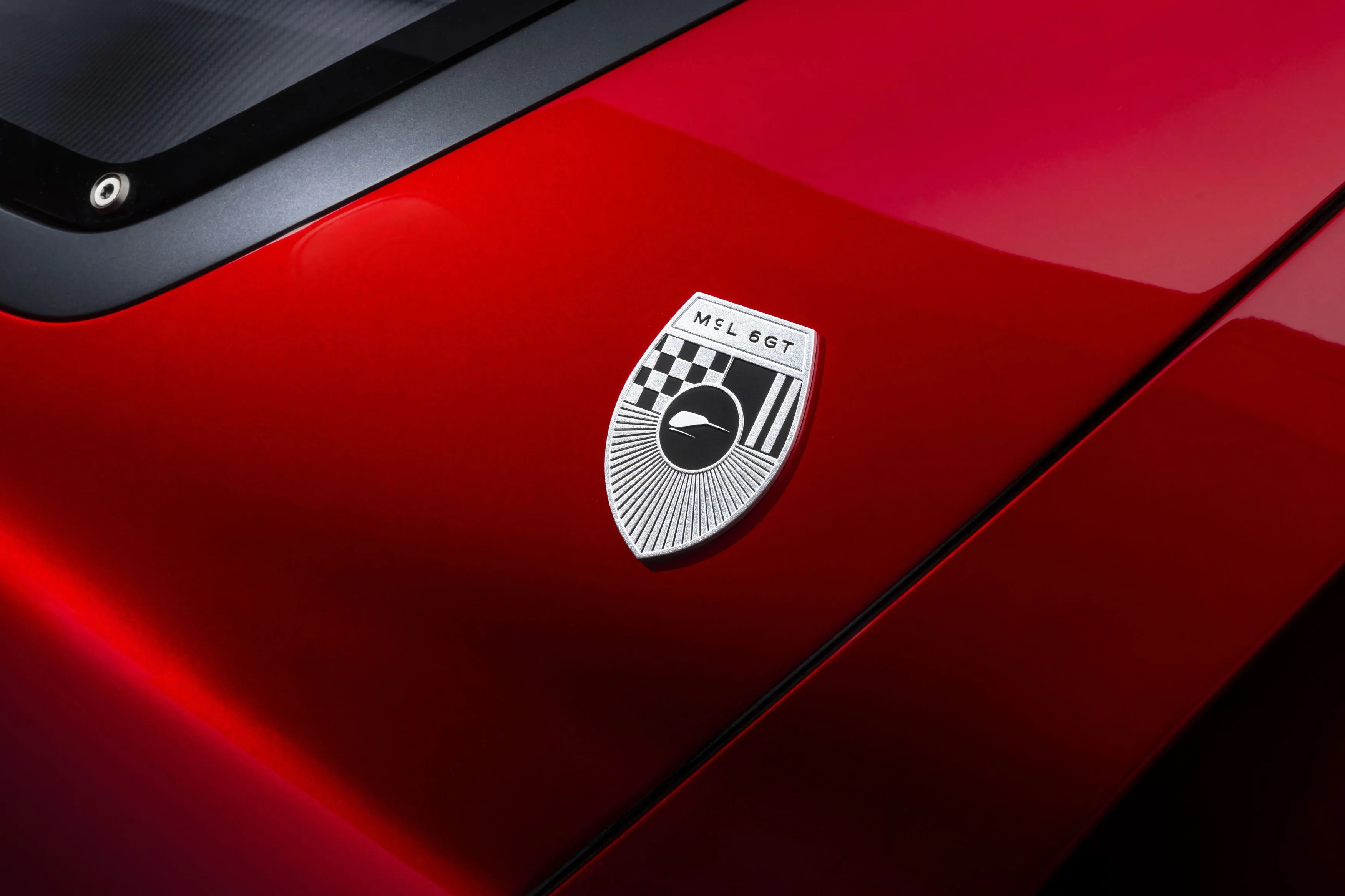
This fits McLaren’s direction for 2026 far better than another numerical combination. The company is increasingly highlighting Bruce McLaren’s legacy, has brought back the Speedy Kiwi symbol, and linked the story of the new McL 6GT to the early M6GT. At the same time, McLaren is preparing to expand its model range beyond two-seat supercars, including its first high-performance SUV.
Muriwai marks the place where racing really began
The second name carries an even more specific meaning. In 1952, at the age of 15, Bruce McLaren competed in the Muriwai Beach hillclimb, driving an Austin Ulster prepared at the family workshop. McLaren’s own historical archive describes it as his first race start. The same car is now housed at the McLaren Technology Centre.
If Remuera marks the place where the car was made, Muriwai marks the place where Bruce went racing in it. For a marketer, it would be hard to write a better story.
That makes both names strong candidates for a limited series, a special model or a future flagship. But this is where caution is warranted: McLaren has not confirmed that either name is linked to a specific car.
McLaren’s naming is already changing
For decades, McLaren has favoured technical-sounding designations. The MP4-12C, 650S, 720S and current 750S form a fairly clear lineage. Today’s 750S produces 552 kW and 800 Nm from a 4.0-litre twin-turbo V8, and accelerates from 0-100 km/h in 2.8 seconds.
However, not all McLarens have been confined to numbers for some time. Artura uses a name, while the Senna and Elva did so earlier, and the Ultimate Series now continues with the W1. McLaren’s current supercar line-up places the Artura, 750S and 788HS alongside one another, showing that the company no longer follows one strict nomenclature.
Remuera and Muriwai would take that logic a step further. They are not made-up luxury names, but specific geographical names whose connection to McLaren predates the company itself.
Ferrari and Lamborghini have a head start in this regard
In the European supercar market, a strong model name is part of the product itself. Ferrari uses historical and geographical references, while Lamborghini has spent decades making names associated with bullfighting an inseparable part of its brand. By comparison, McLaren has often sounded like an Excel spreadsheet from an engineering department.
This was not a problem when light weight, carbon fibre and telepathically precise steering were enough as the central message. The situation changes as the model range expands. When a mid-engined supercar, a hybrid, a limited-series flagship and an SUV start sharing the same showroom, the name must help the cars stand apart from one another emotionally.
Remuera and Muriwai would give McLaren material that rivals cannot copy. Bruce McLaren’s own story belongs only to McLaren.
A trademark application is not model confirmation
The most important correction to the original report concerns terminology. McLaren did not “patent” two new supercar names. The company filed trademark applications. A patent protects a technical invention, while a trademark protects a name, logo or other commercial identifier.
The names have also not yet been finally registered, as the UK applications are currently under examination.
McLaren may use them on future cars, special series or accessories, or leave them on the shelf altogether. Carmakers often protect names simply to preserve options for the future.
However, what makes these applications more interesting than usual is their clear connection to McLaren’s newly launched identity shift. The new wordmark comes from Remuera, Bruce’s first race took him to Muriwai, and McLaren itself says it wants to link its future more closely than before to its founder’s story.
If a future McLaren really does bear one of these names, it will not be an arbitrary marketing ploy. The company is already building the backdrop for it.


