
New BMW 3 Series keeps the six-cylinder, while M350 xDrive gets 326 kW and drift mode
 1/48
1/48 


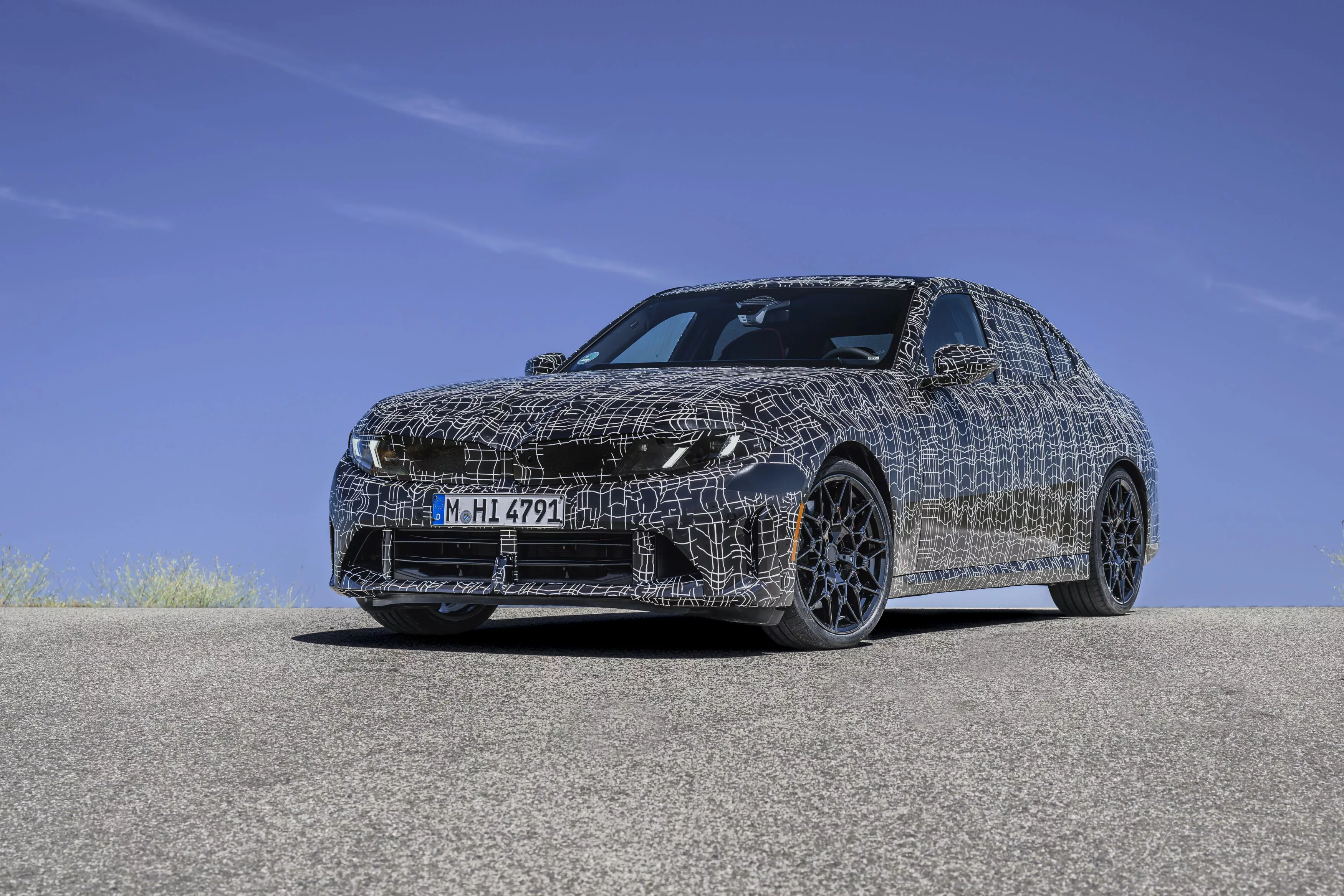
BMW has no intention of sending the combustion-engined 3 Series into history when the electric i3 arrives. The new-generation petrol model is undergoing its final driving tests, and the M350 xDrive makes Munich’s direction clear: a 3.0-litre inline-six, 326 kW, 580 Nm and the ability to turn all-wheel drive into rear-wheel drive at the press of a button.
BMW has released its first more detailed technical information on the new 3 Series as camouflaged prototypes complete their final summer development programme at the Miramas test centre in southern France. The manufacturer is currently focusing on final tuning of the chassis, ride comfort and lateral dynamics. Series production will begin in the second half of 2026.
One thing should be made clear straight away. The new electric i3 and the combustion-engined 3 Series will coexist. BMW is not forcing buyers of the classic sports saloon into an electric car, and at least in the case of the M350 xDrive, the company does not appear to be apologising for its six-cylinder engine either.
M350 xDrive gets a 3.0-litre inline-six
At the top of the combustion-engined range sits the BMW M350 xDrive. Its 3.0-litre TwinPower Turbo inline-six works with a 48 V mild-hybrid system, bringing total powertrain output to 326 kW. Maximum torque is 580 Nm.
BMW pairs the engine with an eight-speed Steptronic automatic transmission and xDrive all-wheel drive. According to preliminary figures, the M350 xDrive accelerates from standstill to 100 km/h in 4.1 seconds and has a top speed of 250 km/h.
This is a notable step forward from the current M340i xDrive, but more important than the power figure alone is BMW’s decision to retain the inline-six. Four-cylinder engines will also remain available and receive a 48 V electrical system, but the M350 xDrive is the only six-cylinder 3 Series in the new generation before stepping up to the full M3.
From a European perspective, this is noteworthy. The Mercedes-AMG C 43 uses a 2.0-litre four-cylinder hybrid powertrain, while Audi has also expanded electrification aggressively. At the M Performance level, BMW retains the combination brand enthusiasts are probably most keen to see: a longitudinal inline-six, automatic transmission and all-wheel drive biased towards the rear wheels.
An all-wheel-drive BMW becomes rear-wheel drive
Even more interesting is a new function called “Drift Moment”. When activated, the M350 xDrive sends all of the engine’s drive force to the rear wheels. With DSC switched off and a controllable multi-plate clutch modelled on those in M cars, the all-wheel-drive M350 effectively becomes a rear-wheel-drive car.
This is not an entirely new M3 trick, as M xDrive has offered a similar solution before. What is new is its arrival in an M Performance 3 Series model.
And, in typical BMW fashion, there is a small software catch. “Drift Moment” will not be available immediately when the cars launch. BMW will activate the function during 2027, and cars already delivered to customers will receive it via a Remote Software Upgrade.
In other words, the customer buys a car with the necessary hardware, but part of the fun arrives later as a software update.
The chassis must handle both 580 Nm and everyday driving
The M350 xDrive comes as standard with adaptive M suspension, an M Sport differential and variable-ratio sports steering. BMW has also increased the body’s torsional and vertical rigidity and developed a separate chassis setup for the M350.
For the new generation, BMW is bringing the control of systems affecting lateral dynamics together more closely than before. This includes dynamic all-wheel drive. The electric i3 uses Neue Klasse’s “Heart of Joy” central control system, while the combustion-engined 3 Series retains an architecture comprising several control units, but BMW wants both to deliver the same result: faster and more precise responses to driver inputs.
For the first time, the 3 Series will also be available with serious-looking 20-inch sports tyres. The car uses 245/35 R20 tyres at the front and 275/30 R20 tyres at the rear. Such a wide rear tyre is hardly decorative with 580 Nm and a drivetrain capable of becoming rear-wheel drive.
BMW does not make the i3 the 3 Series’ only future
The strategy for the new model generation may be even more interesting than the car itself. Alongside the electric i3 based on Neue Klasse technology, BMW will introduce an entirely new combustion-engined 3 Series. The exterior design and digital user experience are moving in the same direction, but the technical foundations of the powertrains differ.
This gives BMW flexibility in the European market that competitors increasingly need. The share of electric cars is growing, but demand is not the same in every country or price bracket. BMW can offer buyers in the same model class both a fully electric i3 and a 3 Series with four- and six-cylinder engines, without either immediately having to displace the other.
Paradoxically, the electric Neue Klasse makes the combustion-engined M350 xDrive even more interesting. A figure of 326 kW is no longer shocking today. But a 3.0-litre inline-six, 580 Nm, all-wheel drive and the ability to send all power to the rear wheels is a combination whose lifespan in the European market should no longer be taken for granted.
BMW appears to understand this very well.


