
New Mitsubishi Pajero undercuts Toyota Land Cruiser Prado on price, while its mechanical package stays deliberately conservative
 1/6
1/6 


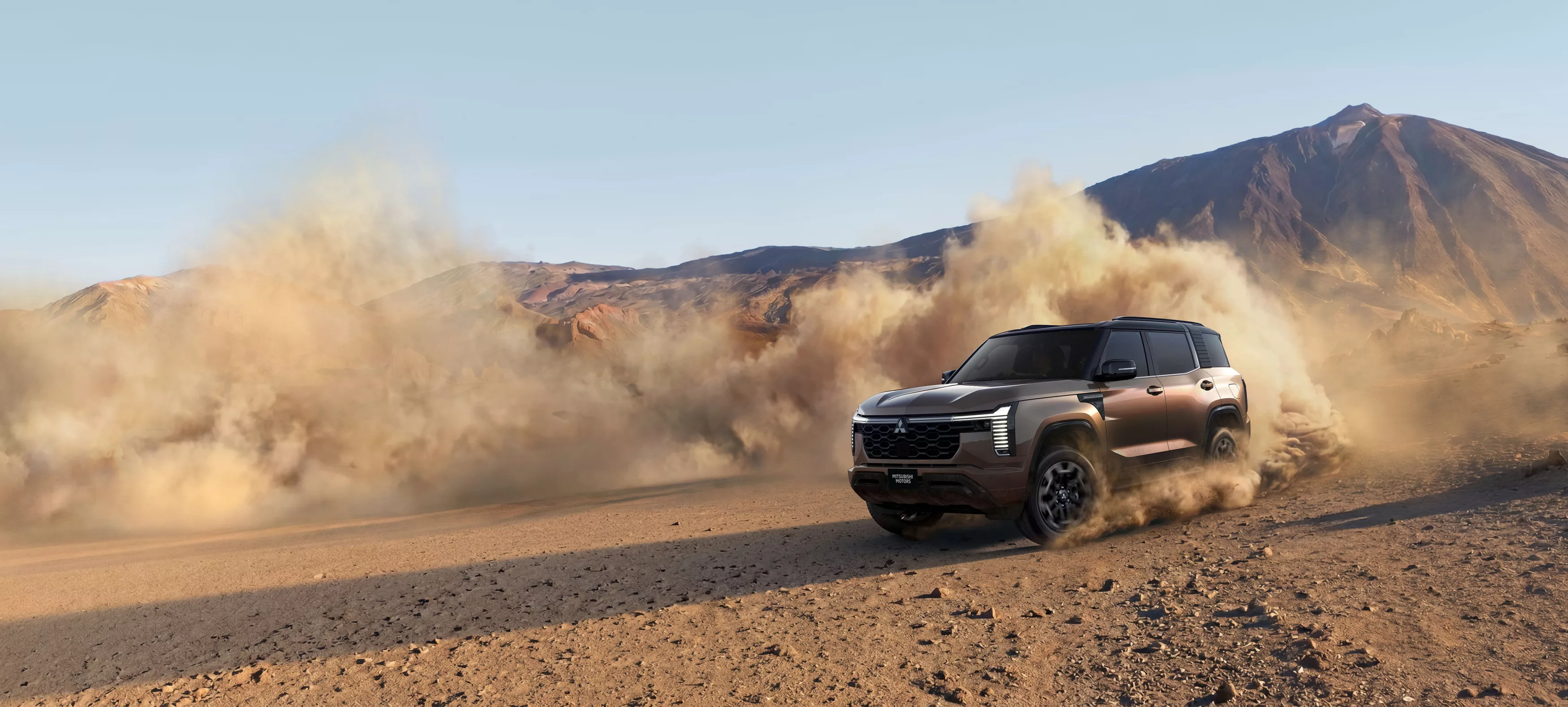
Mitsubishi has brought the Pajero back after a five-year hiatus, and Australian pricing shows the legendary name is not returning on nostalgia alone. The new seven-seat body-on-frame SUV starts at A$68,490, or around €39,000, undercutting the equivalent Toyota Land Cruiser Prado. Mitsubishi’s advantage is not record power, but old-school four-wheel-drive hardware, 230 mm of ground clearance and pricing that should make Toyota buyers at least glance next door.
Pajero starts almost €2,300 below the Prado
The new Pajero goes on sale in Australia in December in three core trim levels. The five-seat GLS costs A$68,490, the seven-seat GLS A$69,990, the Exceed A$79,990 and the GSR A$84,990. Local on-road costs are added to the price.
The Toyota Land Cruiser Prado range starts at A$72,500 for the GX in the same market. The seven-seat GXL already costs A$79,990, the VX A$87,400 and the range-topping Kakadu A$99,990.
That means the entry-level Pajero costs A$4,010 less than the Prado. The top end of the price list is even more telling: the A$84,990 Pajero GSR undercuts the A$99,990 Prado Kakadu by A$15,000. At an approximate exchange rate, that equates to differences of around €2,300 and €8,500 respectively.
Mitsubishi’s strategy is laid bare here. The Pajero wants to be a credible Toyota alternative again, not a Mitsubishi priced like a Toyota.
The frame comes from the Triton, but the Pajero is not simply a pickup with a closed body
Mitsubishi calls the Pajero its new-generation flagship. The vehicle uses a ladder-frame platform related to the Triton, but the manufacturer developed the suspension and tuning specifically for the Pajero. Mitsubishi emphasises that a frame with larger cross-sections and more extensive use of high-strength steel increase both torsional and bending rigidity.
At the front is an independent double-wishbone suspension, while the rear gets a new five-link rigid axle. This is a significant choice. Mitsubishi is not trying to turn the Pajero into a large crossover; it has once again built a genuine SUV whose priorities are wheel travel, durability and keeping the wheels in contact with the ground.
The dimensions confirm that the Pajero enters essentially the same ring as the Prado. The Mitsubishi is 4,920 mm long, 1,925 mm wide and 1,910 mm tall, with a 2,870 mm wheelbase. The Prado is around 4,925 mm long and has a 2,850 mm wheelbase. In external dimensions, the Pajero is therefore a close relative of the Toyota, not a smaller, cheaper substitute.
The Mitsubishi has 230 mm of ground clearance. Its approach angle is 30.4 degrees, breakover angle 22.6 degrees and departure angle 25.8 degrees. Weight distribution is 52:48. These are numbers that matter more on a forest track than another giant centre screen.
2.4-litre diesel produces 480 Nm
There is no electric motor, plug-in hybrid or six-cylinder show of force under the bonnet. Mitsubishi uses a 2.4-litre four-cylinder VGT turbo-diesel with peak torque of 480 Nm. Power is sent to the wheels through a new eight-speed automatic transmission.
According to Australian data, the engine produces 150 kW. That puts the Pajero almost exactly alongside the Toyota Prado, whose 2.8-litre turbodiesel also produces 150 kW but 500 Nm. Toyota also uses a 48 V electrical system. Power is therefore tied, while Toyota has a 20 Nm advantage in torque.
The Ford Everest, meanwhile, offers a 3.0-litre V6 diesel with 184 kW and 600 Nm. On powertrain figures alone, the Pajero does not sit on the throne of the class. Mitsubishi is betting elsewhere: a lower price, a proven diesel, a proper low-range gearbox and a sophisticated four-wheel-drive system.
It is a rather sober decision. A large SUV buyer who tows a trailer or genuinely drives off-road is likely to value 480 Nm of torque and controllable four-wheel drive more highly than the marketing gloss of a hybrid powertrain.
Super Select 4WD-II still gives the driver real choice
The Pajero’s most interesting technical argument is Super Select 4WD-II. The driver can choose between four main settings: 2H rear-wheel drive, 4H full-time four-wheel drive, 4HLc four-wheel drive with a locked centre differential, and 4LLc four-wheel drive with a locked centre differential and low range.
This is supplemented by S-AWC traction and vehicle dynamics control. The system uses, among other things, AYC, stability and traction control, and ABS to distribute braking and drive force according to the situation.
The driver can choose from seven drive modes: Normal, Eco, Gravel, Snow, Mud, Sand and Rock. Mitsubishi has therefore not taken the route of the modern urban SUV, where the essence of four-wheel drive is reduced to a snowflake appearing on a screen. In the Pajero, the driver can still decide what the drivetrain does.
Mitsubishi has also paid attention to the brakes. The manufacturer specifically highlights the large 18-inch brake discs and electric brake booster.
The cabin finally wants to look like a flagship
The strength of previous Pajeros was never a Mercedes-Benz-level interior. With the new model, Mitsubishi is trying quite decisively to move away from that image.
The dashboard houses two 14.3-inch screens. The digital Multi Meter revives the old Pajero idea of three off-road information gauges, but now displays altitude, a compass, temperature, the vehicle’s pitch and roll angles, and S-AWC operation.
In the seven-seat cabin, the second row slides through 150 mm. Mitsubishi says the third row can also accommodate adults, and passengers can place their toes beneath the second-row seats to improve legroom. Acoustic laminated glass and additional body sound insulation are intended to tame diesel-engine and wind noise at the same time.
This is a necessary development for the Pajero. The Toyota Prado has long since ceased to be merely a tool, while the Ford Everest has raised the bar high for cabin quality, multimedia and ride comfort. In 2026, 230 mm of ground clearance and a famous name are not enough if the cabin of an A$80,000 vehicle resembles a pickup.
The Pajero’s return is not just another new SUV
The Pajero’s importance to Mitsubishi extends beyond the sales figures of a single model. The first generation reached the market in 1982, and total production across four generations exceeded 3.29 million vehicles. The Pajero won the Dakar Rally 12 times, including seven consecutive victories.
The last vehicle of the previous generation left international markets in 2021. Mitsubishi is now making the Pajero its flagship once again and intends to sell it in around 100 countries. Production takes place in Thailand, with Thailand the first market to begin sales, followed by Japan and Australia in fiscal year 2026. ASEAN countries, Latin America and the Middle East will follow from the next fiscal year.
Europe will initially miss out on the Pajero
From a European perspective, the less welcome part of the news is simple: Mitsubishi has not named the European Union among the Pajero’s announced market regions. The manufacturer speaks of around one hundred countries, but the public market plan so far focuses on Asia, Australia, Latin America and the Middle East.
It is not difficult to see emissions requirements behind this. A 2.4-litre diesel, ladder frame and large body are perfectly suited to Australia, but in Europe’s CO2-based regulatory environment, the business case for a model with this powertrain becomes considerably more complicated.
That is a shame, because there are increasingly few genuine body-on-frame seven-seat options in the European SUV market. The new Pajero is not technically revolutionary, but that is precisely part of its appeal. Mitsubishi did not try to build another two-tonne electric luxury crossover. It built a large diesel SUV with low range, a rigid rear axle and 230 mm of ground clearance.
Better still, the Australian price list shows that Mitsubishi is not using the famous name as an excuse to charge Toyota money. That could prove to be the new Pajero’s strongest weapon.


