Wingless flying car takes off in China
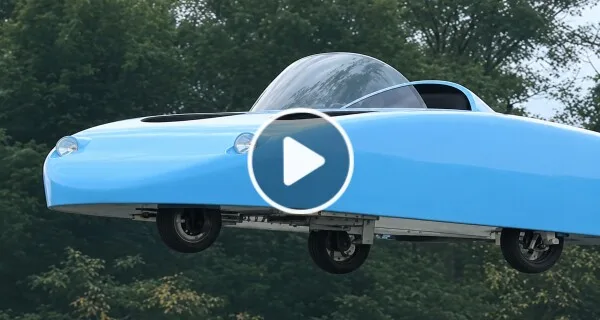
An unusual flying car prototype with neither wings nor visible propellers has completed its first test flight in China. The single-seat vehicle can take off vertically, hover and drive on its wheels after landing. Its developers say it could have a flight range of up to 300 kilometres and reach speeds of up to 150 km/h in the air.
An aircraft without wings or visible propellers
The prototype, developed by Chinese company Zhongfei Chuangzhi Manufacturing, took off for the first time from Kaihui Airfield in Changsha, Hunan province. Testing continued in Yiyang the following day.
The vehicle's distinguishing feature is a multistage ducted-fan system with vectored thrust. Unlike a conventional drone, it houses all its rotating blades inside the body.
The fans force air downwards to generate lift, allowing the vehicle to take off and land without a runway. Changing the direction of the airflow also controls the vehicle's attitude and movement.
Housing the fans inside the body reduces the risk of contact with the rotating blades, but does not eliminate other aviation risks.
During the test flight, the prototype took off vertically, hovered and made a controlled landing. This was an initial demonstration of the technology, not the unveiling of a vehicle ready for use.
Up to 150 km/h in the air and 80 km/h on the road
The single-seat prototype has a maximum take-off mass of 280 kg, of which up to 120 kg is payload.
According to figures released by the manufacturer, the vehicle can reach up to 150 km/h in the air and up to 80 km/h on the road. Its target flight range is up to 300 kilometres.
Its normal operating altitude would be around 100 metres, while its calculated maximum flight altitude is 3,000 metres.
For now, these specifications come from the developer. The test flights made public so far have yet to confirm either the 300-kilometre range or the top speed.
The developer says the vehicle can continue by road after landing. There is no confirmation, however, that the prototype is already approved for use on public roads.
Rivals have taken a different approach
Several developers are active in China's flying vehicle market, but their approaches differ considerably.
XPeng AeroHT, for example, is developing the Land Aircraft Carrier, a six-wheeled road vehicle that carries a separate electric aircraft. The aircraft must be detached from the car before it can fly.
Zhongfei Chuangzhi's prototype aims to combine road travel and flight in a single vehicle. In principle, that would make it easier to use, but it makes weight and structural design more demanding.
Another rival is China's EHang EH216-S, which has already received national aviation approvals and is designed to carry two passengers without a pilot.
The EHang uses an electric lift system with exposed rotors. Its manufacturer lists a maximum flight range of 30 kilometres and a top speed of 130 km/h.
The wingless prototype's claimed 300-kilometre range would therefore be considerably longer, but that does not establish which vehicle is better. The EHang is a certified aircraft, while Zhongfei Chuangzhi's vehicle is still being tested and its actual range has yet to be verified.
Developers also want to build a 15-seat version
The developers do not intend to stop at the single-seat prototype.
The company says it has also completed the engineering design for a larger vehicle with a take-off mass of up to 5.5 tonnes and a payload of two tonnes.
The developers want to build versions with 2–4, 6–8 and even 12–15 seats.
Potential uses include rescue operations, medical transport, freight and passenger travel in areas where conventional transport links are difficult.
Several important questions still need to be resolved. Above all, longer flights need to demonstrate the technology's reliability and safety, and establish how much energy it uses.
The vehicle will also need certification from the aviation authority and the approval required for use on public roads.
The test flight in China shows that a vehicle with no wings and with concealed fans can indeed take off. That does not mean flying cars are ready for city traffic.
For now, it is an interesting engineering experiment whose practical value will only become clear with further testing.