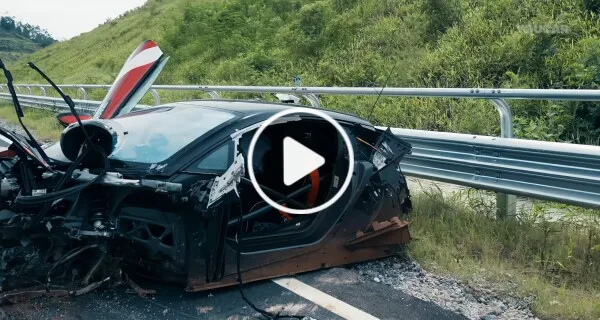
BYD hypercar travelling at nearly 450 km/h wrecked in trackside crash

Chinese automotive giant BYD’s electric Yangwang U9 Xtreme hypercar has been involved in a serious crash during high-speed testing. The car went out of control, hit a track barrier and sustained such extensive damage that its rear section separated from the rest of the body. Despite the damage, the driver reportedly escaped uninjured and was able to get out unaided. The accident comes as BYD prepares to break the 500 km/h barrier.
Serious crash ahead of record attempt
According to information published by CarNewsChina, the accident happened at a closed test track in China. Video released to the media shows the Yangwang U9 Xtreme going out of control at high speed and hitting a safety barrier.
The impact destroyed much of the car’s bodywork and tore the rear section away from the rest of the structure. However, the passenger compartment’s safety structure retained its shape, protecting the driver from more serious consequences.
The exact speed and cause of the crash are unknown. It therefore cannot be confirmed that the car was travelling at 500 km/h at the moment of impact. BYD has also not disclosed whether the crash will affect the schedule for its next record attempt.
2220 kW and the world’s fastest production car record
The Yangwang U9 Xtreme uses four electric motors with a combined output of 2220 kW. Its electrical system uses a 1200-volt architecture, while its 80 kWh battery supports an exceptionally high discharge rate of up to 30C.
In September last year, the U9 Xtreme reached a top speed of 496.22 km/h at the Papenburg test track in Germany, surpassing the Bugatti Chiron Super Sport 300+’s previous result of 490.48 km/h.
BYD plans another attempt in Dubai in November, aiming to break the 500 km/h barrier. The company needs a suitable stretch of road approximately 15 kilometres long, but has not publicly confirmed the final location or date.
At 500 km/h, every mistake becomes critical
At 500 km/h, a car covers almost 139 metres in one second. At that speed, aerodynamic forces, tyre loads and the consequences of even the slightest handling problems become exceptionally severe.
The U9 Xtreme uses special GitiSport semi-slick tyres and an aerodynamic package with a large rear wing. These must ensure stability at speeds most production cars will never reach.
The actual cause of the crash remains to be established, but the accident shows how difficult it is to gain those final kilometres per hour in pursuit of the outright speed record.
In the European hypercar market, Yangwang competes primarily with Bugatti, Koenigsegg and Rimac. BYD has already proved that Chinese electric technology can compete with the world’s fastest cars. It now needs to show that exceptional power goes hand in hand with stability and safety.
The most remarkable outcome of this crash is not the wrecked car, but the unharmed driver. Although the precise circumstances of the impact are unknown, the survival of the passenger compartment demonstrates the importance of a strong safety structure in hypercars.